Who these pedals suit

Low-grip technique learners

If you are practising gradual brake release and throttle application in a simulator, repeatable inputs matter more than pedal stiffness alone. Blayze notes that there is no wet line that stays consistent in every condition.

Desk and wheel-stand racers

If you are not moving to a full cockpit, consider how you will stop the pedals and seat moving under braking. Brake resistance and mounting options both affect whether you can repeat an input comfortably.

Rig-building PC and console racers

If you want to tune travel, resistance or pedal position, match the set to your cockpit, platform and wheel-base first. The stated connection and mounting requirements differ among the Thrustmaster, Heusinkveld, MOZA Racing and SIMAGIC models discussed below.

What to check before buying

For wet-line practice in a simulator, establish a stable, compatible setup before deciding how much brake resistance or pedal adjustment you want.

Concern What to check Who this matters to
Repeatable braking Check the brake sensor, available force or resistance settings, and how you will calibrate the input. If I am practising brake release as grip changes, I need an input I can repeat without chasing a stiffer setting. Around 40% of consumers would put brake modulation first.
Progressive throttle Check throttle travel, pedal position and the available calibration controls. On a low-grip corner exit, I want to make small accelerator changes without an awkward pedal position. Throttle progression would come first for around 30% of consumers.
Stable mounting Compare the set's bracing or fixing options with your stand, cockpit, seat and intended brake resistance. If my pedals or chair shift under braking, it becomes harder to judge whether my foot input was consistent. Around 20% of consumers would prioritise a stable installation.
Platform and setup fit Confirm the exact pedal variant, wheel-base connection, game recognition and calibration route. When my console or wheel-base limits what I can connect, I need a workable setup before considering finer adjustments. Compatibility would be the primary concern for around 10% of consumers.

Buying pitfalls

  • Choosing maximum brake resistance before securing the pedals

    If the pedals or seat move, applying the same pressure becomes difficult even with a load-cell brake.

    Secure the setup, start at a manageable resistance and calibrate the brake before increasing the force you use.

    Depending on your current setup, this may require a stand, baseplate, bracing solution or fixing hardware.

  • Expecting a pedal upgrade to reveal the wet line

    Pedal hardware can help you repeat inputs, but Blayze notes that a wet line does not stay fixed across changing conditions.

    In your chosen simulation, compare braking points, brake release, throttle application and lines deliberately rather than treating one pedal feature as the answer.

    Optional feedback or hydraulic modules add hardware and setup decisions without replacing that practice.

  • Assuming platform support from a brand name

    Connection and calibration options vary by model and can depend on the wheel-base and game. Thrustmaster Support, for example, gives wheel-base firmware guidance specifically for T-LCM pedals used through a Thrustmaster wheel-base.

    Check your exact pedal variant, PC or console, wheel-base, connection method and game before ordering.

  • Using one setting as proof of a universal wet setup

    Pedal calibration affects your input, while grip and vehicle behaviour can still change. One quick simulated lap does not establish the right line for every condition.

    Keep a baseline calibration, change one setting at a time and compare your inputs over repeatable practice sessions.

Brands and product lines to consider

Thrustmaster

The T-LCM is a three-pedal route for buyers considering a load-cell brake across supported PC, PlayStation and Xbox setups.

  • Thrustmaster lists a 100 kg load-cell brake, six included springs and adjustable pedal placement for the T-LCM.
  • Check your exact wheel-base, game and connection method; stated platform coverage does not settle every setup.

Fanatec

The CSL Pedals LC suit buyers considering pressure-based braking with a set they can brace or mount.

  • Fanatec describes a load-cell brake that measures pressure rather than travel, with adjustable braking force.
  • Confirm the connection required by your platform and keep the pedals and seat stable at your chosen resistance.

Heusinkveld

Sprint pedals are a PC-focused option for racers already planning a full-frame rig and detailed pedal adjustment.

  • Heusinkveld specifies Windows 10 or newer, a force-sensitive 120 kg brake load cell and six brake-resistance settings.
  • The stated mounting arrangement is a full-frame rig, so check that your cockpit can accommodate the set.

MOZA Racing

CRP2 pedals offer a configurable route for buyers considering a stable PC or compatible Xbox setup.

  • MOZA Racing lists a 200 kg load cell, 15-bit angle sensing, tool-free adjustment and an inverted-mounting option.
  • Choose a controllable resistance rather than assuming the highest force setting helps you learn; confirm the exact Xbox connection and game support.

SIMAGIC

P1000 variants suit PC rig builders who want adjustable travel and the option to change their pedal arrangement later.

  • SIMAGIC lists PC or SIMAGIC wheel-base connection and modular haptic, hydraulic and inversion options.
  • Check which options belong to the variant you intend to buy; additional modules bring further setup decisions and do not identify a wet line.

Joybuy wheel-and-pedal system

This wheel-and-pedal system is a combined-hardware choice for racing-simulation practice. Check its pedal controls against your braking and throttle priorities rather than treating the included pedals as a separately selected set.
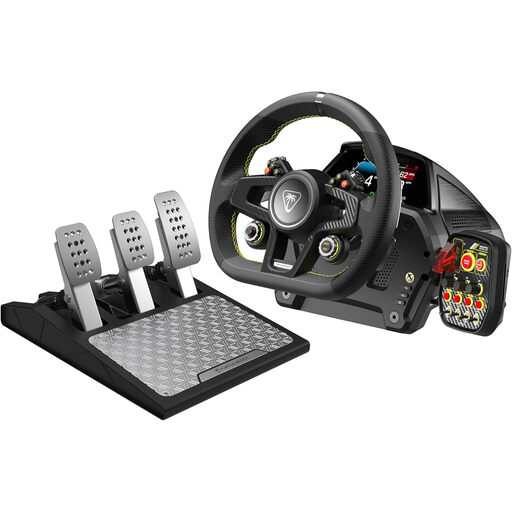
Turtle Beach VelocityOne Race wheel-and-pedal system for Xbox and Windows 10/11

Turtle Beach VelocityOne Race wheel-and-pedal system for Xbox and Windows 10/11

A combined wheel-and-pedal system to consider if you want to practise racing-simulation inputs rather than buy standalone pedals.

The product name specifies Xbox and Windows 10/11. Before buying, confirm support for your game and setup, along with the brake and throttle adjustments you need for practice.

View on Joybuy

Common questions

Do I need a load-cell brake to practise wet-condition driving in a simulator?

No: the immediate requirement is a brake input you can control and repeat. If pressure-based modulation is your priority, a load-cell model is worth considering; Fanatec describes its CSL Pedals LC brake as measuring pressure rather than travel. Stable mounting and calibration still matter.

Can better pedals teach me the correct wet racing line?

Pedals can help you practise repeatable inputs, but they cannot establish one correct wet line. Blayze notes that the line changes with the track, car, tyres and conditions, so compare lines and inputs within the simulation you use.

Do I need a cockpit for a higher-force brake?

Not for every pedal set, but you do need an installation that stays stable at your chosen resistance. Fanatec describes bracing or mounting options for CSL Pedals LC, whereas Heusinkveld specifies a full-frame rig for Sprint pedals. Check the mounting guidance for the exact model.

Will any sim-racing pedal set work with my console or wheel-base?

No; support depends on the model and connection. Thrustmaster lists PC, PS4, PS5 and Xbox support for T-LCM, while Heusinkveld lists Windows 10 or newer for Sprint. Confirm your pedal variant, wheel-base, game and calibration method before buying.