PC learner building a first hill-climb rig
You want a wheel and pedals you can begin using without assembling a complete ecosystem, while checking that your desk or stand can hold the wheel securely.


Choose a racing wheel for virtual hill-climb practice around your simulator, mounting and preferred steering feedback, not the number of monitors. A wheel-and-pedal bundle avoids selecting separate components, while a modular base calls for compatible controls and a secure mount; the PC, graphics connections and simulator determine how the view spans several screens.
You want a wheel and pedals you can begin using without assembling a complete ecosystem, while checking that your desk or stand can hold the wheel securely.
You want to practise with a wider driving view and need to check both wheel compatibility and the PC display setup. iRacing Support treats its three-monitor configuration as a simulator and graphics setup, separate from wheel choice.
You have, or plan to use, a sturdy cockpit and would rather choose a base, rim and other controls separately than start with a bundled wheel-and-pedal set.
Decide how the wheel will be mounted and which simulator it must work with before comparing feedback figures. Treat the monitors as a separate PC setup decision.
Choose when: You are starting without compatible pedals or a rim and want the included components selected together.
Trade-off: The Thrustmaster T598 is a direct-drive bundle listed at 5 Nm constant torque; that figure is not directly comparable with another brand's peak or holding torque.
Choose when: You want to select a rim and pedals separately, perhaps adding a shifter or handbrake later.
Trade-off: A base such as the PC-only MOZA R12 needs compatible components and suitable mounting before it becomes a complete driving setup.
Choose when: You have a rigid mount and want to assess greater stated force-feedback headroom for repeated sessions.
Trade-off: More stated torque is not a reason to overlook comfort, wheel-specific limits or the stability of your rig.
| Concern | Buying checks | Who this matters to |
|---|---|---|
| Controllable steering feedback | Check the stated torque basis and available feedback adjustment; consider whether your mount stays secure through a full session. | If steering feel during changing gradients and grip is my deciding factor, I need settings I can use comfortably throughout practice; around 29% of consumers put controllable feedback first. |
| PC and multi-monitor integration | Confirm the exact wheel variant works with your simulator, then check graphics outputs and the simulator's display method. | I need my chosen wheel to work on the PC while the driving view spans my screens; for around 29% of consumers, system integration is the primary concern. |
| Separate controls and mounting | Check rim, pedal and accessory compatibility alongside the base's mounting pattern and your stand or cockpit. | If I plan to add a handbrake or change rims, I want those parts to fit a stable rig; around 24% of consumers chiefly prioritise modular controls and mounting. |
| Included components | Check whether the exact set includes the wheel and pedals you need, and select the correct platform variant. | I want to start practising without choosing each control separately; a simpler included package comes first for around 18% of consumers. |
A racing wheel controls steering; it does not determine how the PC draws across displays. iRacing Support describes separate three-monitor setup methods that depend on simulator and graphics configuration.
Check your graphics card's outputs, screen resolutions and simulator display options before choosing the wheel.
Product listings use different terms: Thrustmaster states 5 Nm constant torque for the T598, while the MOZA R12 is described with peak torque and Fanatec states holding torque for the ClubSport DD. Those labels do not establish a like-for-like performance order.
Read the measurement wording and weigh it against mounting, feedback adjustment and what feels manageable for a full session.
A modular wheel base is not, by itself, a wheel-and-pedal set. Fanatec also describes wheel-specific torque limits, so a base's stated output need not apply with every rim.
Confirm the rim, pedals, connections and mounting hardware for the exact base and wheel combination you intend to use.
MOZA Support identifies the R12 as PC only, whereas Logitech G PRO Racing Wheel listings distinguish PC and console variants.
Match the full variant name to your operating platform and check support in your intended simulator.
The G PRO Racing Wheel is a complete direct-drive wheel option for consumers who would rather select a wheel than assemble a separate base-and-rim system.
The T598 PlayStation/PC bundle suits consumers seeking a direct-drive wheel and pedals together.
The R12 is a PC-focused modular base for consumers planning to select a rim, pedals and possibly further controls.
The ClubSport DD is a modular base to consider when planning a rigid rig and a separately selected wheel.
These wheel-and-pedal sets are options for PC-based practice. Check each model's feedback, mounting and simulator support separately; the PC and simulator still determine the several-monitor view.
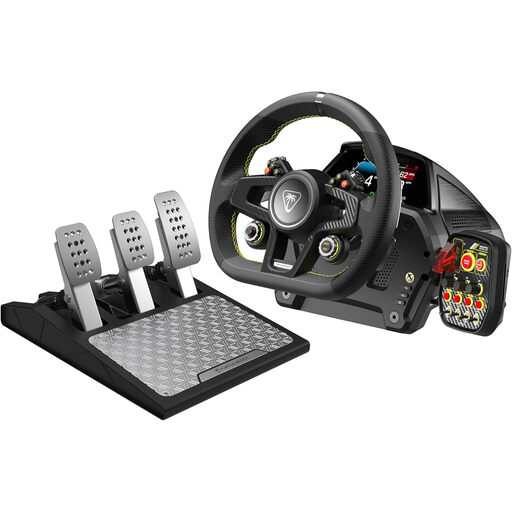 No image available
Consider this wheel-and-pedal system if you practise on a Windows 10/11 PC and want the controls together. Check that your desk or cockpit provides a stable mount, and confirm support in your simulator.
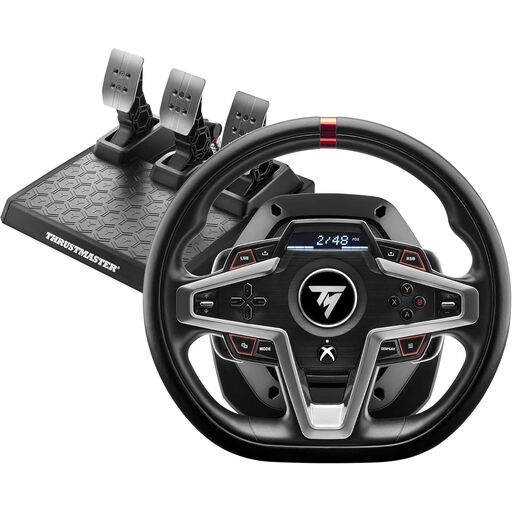 No image available
This PC-compatible wheel-and-pedal set is an option if you want included pedals. If direct drive is important to you, check the feedback mechanism before choosing it, as well as how it attaches to your desk or stand.
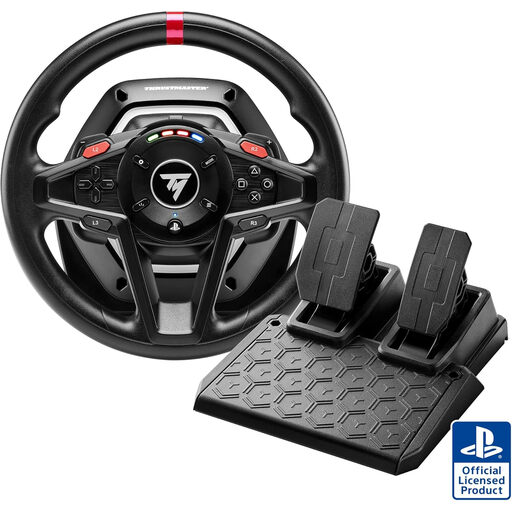 No image available
This force-feedback wheel and pedal set is an option for PC practice. Confirm the mounting arrangement, steering range and support in your intended simulator before buying.
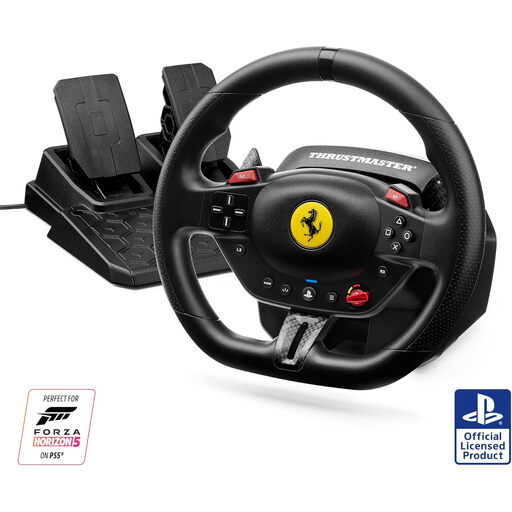 No image available
Consider this PC-compatible wheel-and-pedal set if included basic controls meet your needs. Check its force-feedback provision and mounting arrangement before relying on it for your preferred hill-climb practice.
No: the number of monitors does not itself set a wheel-torque requirement. For iRacing, check the PC's graphics connections and the simulator's three-monitor setup; choose steering feedback and mounting for the way you intend to drive.
Not necessarily, but matching resolution matters for some configurations. iRacing Support calls for three monitors at the same resolution in its AMD Eyefinity instructions; check your chosen simulator and graphics setup before arranging screens of different sizes.
MOZA Support identifies the R12 as PC only. If your hill-climb simulator runs on a console, look for a wheel variant explicitly compatible with that platform and check the simulator's peripheral support.
Match the exact base's mounting pattern to a suitably sturdy stand or cockpit, and check whether any required clamp or hardware is included. MOZA describes four-hole bottom mounting for the R12 and front-mount support on V2; its R12 V1 listing calls the desk clamp optional.