
24/7 Customer Support

Free returns

Same-day & Next-day Delivery

Quality Guaranteed

Unlock Your Welcome Offers: FREE Delivery | Up to 80% OFF | Free 30-day JoyPlus trial
Download the APP
A random orbital sander can smooth timber, prepare painted surfaces and refine furniture far faster than hand sanding. However, choosing by wattage or advertised speed alone can lead to disappointing results. The right tool depends on pad size, speed control, dust management and the type of surface you plan to work on.
A 350W sander may offer more power than a 200W or 230W model, but raw wattage does not determine finish quality on its own. A high-powered tool without useful speed adjustment may remove too much material from softwood or leave marks on a painted panel.
For most home projects, consider the combination of motor power, variable speed and handling comfort. A variable speed sander gives you more control when moving between rough timber, paint preparation and fine finishing.
A dust bag can collect a substantial amount of debris, but it will not make sanding dust disappear. Poorly aligned holes, a full collection bag or blocked vents can reduce airflow. A useful orbital sander with dust collection should have a perforated backing plate, matching sanding discs and, where possible, an adapter for a workshop vacuum.
Always wear suitable eye protection and a properly selected dust mask or respirator. Work in a ventilated area and take extra care with old painted surfaces that may contain hazardous substances.
A common mistake is checking only the disc diameter. You also need to confirm the attachment method and hole pattern. A 125mm random orbital sander normally requires 125mm hook and loop sanding discs, while detail sanders often use shaped or 140mm sheets.
Using incorrectly sized paper can cause poor adhesion, uneven sanding and ineffective dust extraction. Check the product specification before buying replacement abrasives.
A 125mm circular pad is a practical size for doors, shelves, worktops and furniture panels. Random orbital movement combines rotation with an eccentric action, helping to reduce visible swirl marks when the tool is used correctly. It is suitable for broad surfaces and general finishing, but it is not designed to reach narrow corners like a triangular detail sander.
For skirting edges, intricate mouldings and tight spaces, consider a detailed sander instead.
A 350W sander can be useful for repeated sanding, paint removal and tougher timber preparation, while lower-powered models may be easier to control for occasional furniture work. Speed range is equally important. Lower settings help with delicate finishes and heat-sensitive materials; higher settings are more appropriate for faster stock removal.
Always match the selected speed to the abrasive grit and surface. Do not press heavily on the tool, as this can slow the pad, clog the disc and create unwanted marks.
Look for a dust bag that is easy to remove and clean, or a vacuum adapter if you work indoors or on larger projects. An eight-hole suction base can help align extraction holes with compatible discs.
A rubberised grip, balanced body and manageable vibration are also important. These features can make a noticeable difference during furniture restoration or longer DIY sessions, but they do not remove the need to take breaks and use appropriate PPE.
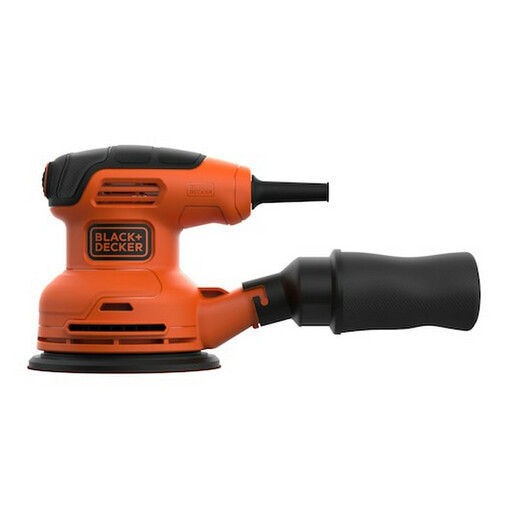
Why This Fits Their Persona: A straightforward option for UK homeowners sanding shelves, doors, painted timber and occasional metal or PVC projects.
Its 230W motor is paired with random orbital action and a dust bag, avoiding a specification list based on power alone.
Multiple grip areas, quick-fit paper attachment and a dust bag are listed features.
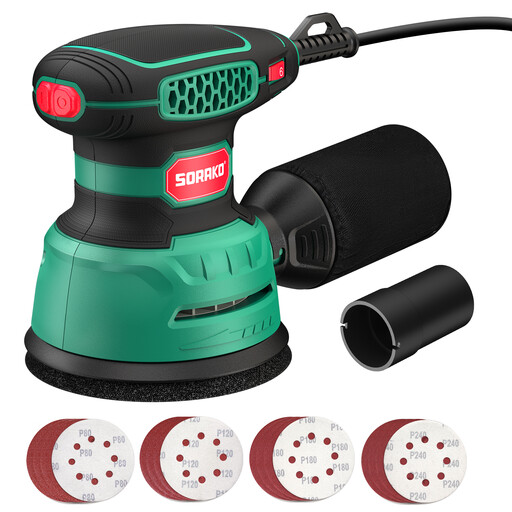
Why This Fits Their Persona: Suits users who want adjustable control and a broader accessory package for regular home improvement and furniture projects.
The six adjustable speeds, eight-hole base and removable dust bag address speed control, paper alignment and extraction concerns.
350W motor, speeds up to 13,000 rpm, electric brake and 16 included sheets in 80, 120, 180 and 240 grit.
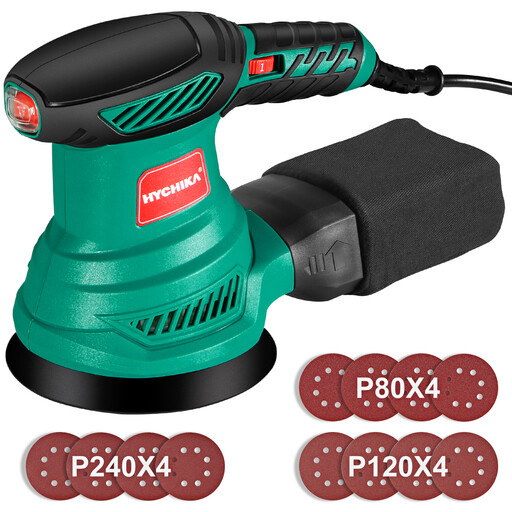
Why This Fits Their Persona: A practical match for frequent sanding of wood, furniture and metal surfaces where changing between materials and grits is part of the job.
Six speed settings from 6,000 to 13,000 rpm provide more adjustment than a single-speed DIY power sander.
300W motor, 125mm pad, eight-hole extraction base, dust collection bag and 12 hook and loop sanding discs.
We have compiled a complete, real-time list of products that fully satisfy these strict selection criteria and UK safety regulations.
Do not use a wood polishing sander on walls or lime-based materials unless the manufacturer specifically permits it. For old paint, check whether additional precautions are required before sanding.
Yes, it can prepare flat furniture panels, remove old finishes and smooth between coats. Use a coarse grit for controlled removal, then progress through medium and fine grits. A detail sander may still be needed for corners and carved sections.
Lifespan depends on workload, dust exposure, storage and maintenance. Empty the dust collector, clean vents with a dry cloth, inspect the cable and avoid forcing the pad. Replace worn discs promptly so the tool is not operated against excessive resistance.
A corded model rated between 200W and 350W uses electricity according to its power rating and operating time. For example, running a 350W tool for one hour would consume approximately 0.35kWh at its rated input, although actual consumption can vary with load. A corded sander avoids battery charging but requires safe access to a suitable mains supply.