
24/7 Customer Support

Free returns

Same-day & Next-day Delivery

Quality Guaranteed

Unlock Your Welcome Offers: FREE Delivery | Up to 80% OFF | Free 30-day JoyPlus trial
Download the APP
Finding the right tool for a mechanical task can be the difference between a job done efficiently and a frustrating afternoon with a stripped bolt. For professional mechanics and dedicated DIY enthusiasts, a reliable ratchet spanner set is a cornerstone of any well-equipped toolbox. But with so many options available, from basic socket sets to specialised wrenches, choosing the correct one for your needs can be challenging.
This guide is designed to help you understand the key features to look for in a mechanics tool kit. We will explore different types of ratchets and wrenches, helping you identify the right tools for everything from routine car maintenance tools to intricate bicycle repair kit adjustments.
Before diving into specific products, it's useful to understand what sets different tools apart. Here are a few key considerations to keep in mind when building or upgrading your tool collection.
The drive size (e.g., 1/4", 3/8", 1/2") determines which sockets the ratchet can accommodate.
The tooth count of the ratchet's internal gear is also critical. A 72-tooth ratchet is a popular standard, as it requires only a 5-degree arc to engage the next tooth. This small swing arc is invaluable when working in the confined spaces of an engine bay or under a vehicle.
While a standard socket wrench set covers many jobs, some tasks require a more specialised approach.
Here are our recommendations for ratchets and spanners that offer practical features for a range of mechanical tasks.
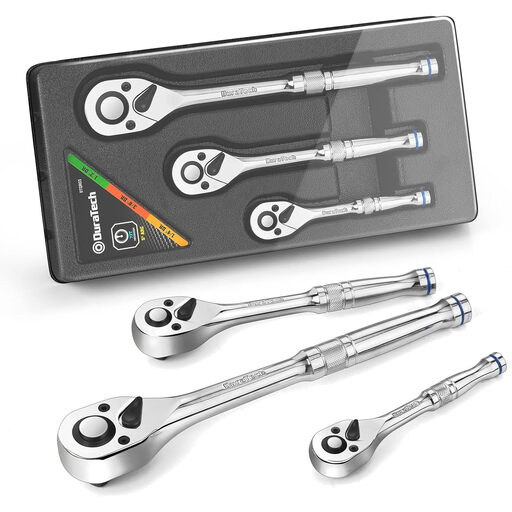
Why It Stands Out: This set provides a comprehensive solution by including all three common drive sizes: 1/4", 3/8" and 1/2". Each ratchet features a 72-tooth mechanism for a smooth 5-degree swing arc, making it highly effective in tight spots. The fully polished chrome finish is easy to clean and resists corrosion.
Pros:
Who is it for? This set is an excellent foundation for any new mechanics tool kit or a great upgrade for DIYers and professionals who want a single, organised solution covering a wide range of tasks.
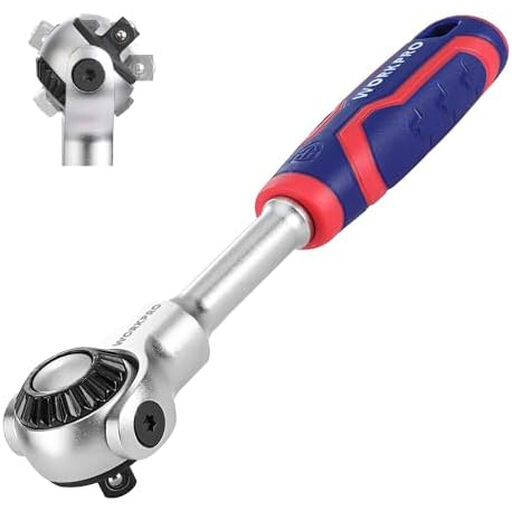
Why It Stands Out: The standout feature of this WORKPRO ratchet is its 270° flexible head. This swivel head ratchet is specifically designed to tackle fasteners in hard-to-reach areas where a standard ratchet simply won't fit. Despite its flexibility, it retains a strong 72-tooth reversible mechanism for efficient work.
Pros:
Who is it for? Automotive technicians, engineers and serious DIYers who frequently work on complex machinery with obstructed fasteners will find this tool indispensable.
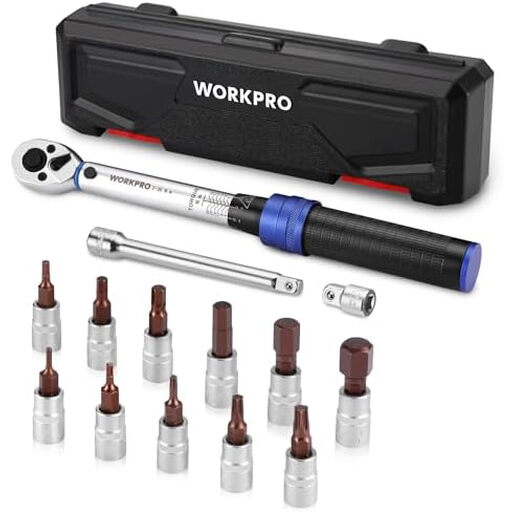
Why It Stands Out: This torque wrench set is built for precision. With a torque range of 2-26 N.m and a stated accuracy of ± 3%, it ensures that components are tightened correctly, which is crucial for modern vehicles and high-performance bicycles. When the preset torque is reached, the wrench produces an audible "click," preventing over-tightening.
Pros:
Who is it for? This is a must-have for cyclists and motorcycle enthusiasts who need a reliable bicycle repair kit. It's also ideal for mechanics working on engine components that require precise torque specifications.
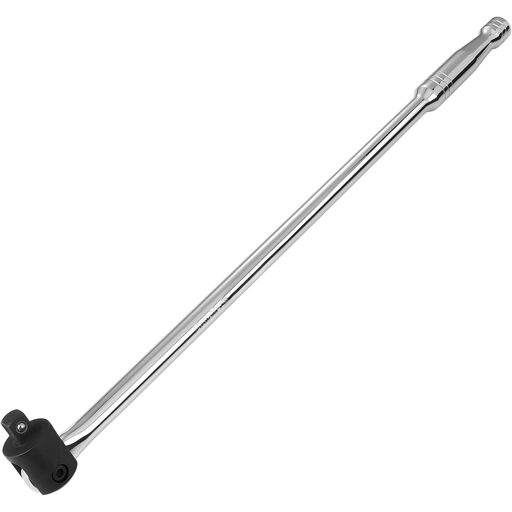
Why It Stands Out: When you encounter a bolt that refuses to budge, this breaker bar 1/2 inch is the tool for the job. Its 60 cm long handle provides significant leverage to generate high torque (up to approx. 780 Nm), making short work of seized, rusted or over-tightened fasteners. The 240° rotatable head adds flexibility to position the bar for the best possible leverage.
Pros:
Who is it for? This is an essential tool for anyone performing heavy-duty automotive work, such as changing tyres, working on suspension or dealing with large industrial machinery. It's designed to handle the force that would break a standard ratchet.
This selection highlights tools designed for specific needs, from general-purpose sets to specialised wrenches. If you are looking for a wider variety of hand tools or other automotive accessories, you can find more in our collection.
Explore our full range of automotive hand tools
A ratchet is designed for speed and convenience, allowing you to tighten or loosen fasteners quickly without removing the tool. A torque wrench, on the other hand, is a precision instrument used to apply a specific amount of rotational force (torque) to a fastener. It is used for final tightening to ensure components are secured to manufacturer specifications.
A 72-tooth ratchet is widely considered an excellent standard for most professional and DIY applications. It provides a 5-degree swing arc, which allows for fine adjustments in tight spaces while maintaining sufficient strength. Ratchets with higher tooth counts (e.g., 90 or 120) offer an even smaller swing arc but may be less durable under extreme force.
You should always use a breaker bar to loosen extremely tight, rusted or seized fasteners. Applying excessive force to a standard ratchet, especially when trying to "break" a bolt loose, can damage its internal gearing mechanism. A breaker bar has no moving parts in its handle and is built purely for applying high leverage safely. Once the fastener is loose, you can switch to a ratchet to remove it quickly.