
24/7 Customer Support

Free returns

Same-day & Next-day Delivery

Quality Guaranteed

Unlock Your Welcome Offers: FREE Delivery | Up to 80% OFF | Free 30-day JoyPlus trial
Download the APP
A ratchet wrench set can make routine repairs quicker, but choosing one based only on piece count or a prominent torque figure can lead to wasted money. UK buyers need to consider drive sizes, metric coverage, access in confined spaces and whether the kit is designed for hand use, powered work or controlled tightening.
This guide explains the practical differences between ratchet spanners, socket sets and cordless ratchet wrenches, then matches suitable options to common user profiles.
A 100-piece or 400-piece mechanics’ tool set may look impressive, but the total can include duplicate bits, adapters and accessories that are rarely used. Check the actual socket sizes and drive formats first. For many UK cars, bicycles, motorcycles and household repairs, a useful spread of metric sockets from 8 mm to 19 mm may be more valuable than a high number of small accessories.
Also check whether the set includes both metric and imperial sizes. A metric spanner set is suitable for many modern vehicles and general UK repairs, but imperial sockets can still be useful for older machinery, imported equipment and certain bicycles or motorcycles.
A fine-tooth ratchet needs a smaller swing arc, which is useful when a handle cannot move far. However, tooth count does not automatically make a tool suitable for every restricted space. The head profile, handle length and socket depth also matter.
For example, a 72-tooth ratchet commonly requires around a 5-degree swing arc, while a 90-tooth design may require around 4 degrees. A 144-tooth ratcheting combination wrench can reduce the working arc to approximately 2.5 degrees, but it may not cover as many sizes as a larger combination ratchet wrench set.
A cordless ratchet wrench is designed to speed up fastening and removal. It is not automatically a substitute for a calibrated torque wrench when a vehicle or component requires a specified tightening value.
A powered tool’s stated torque, such as 55 N·m, should be viewed alongside speed, battery capacity, drive size and control. For final tightening on bicycles, motorcycles or sensitive vehicle components, use an appropriate torque wrench set and follow the equipment manufacturer’s instructions.
The most common drive formats are 1/4-inch, 3/8-inch and 1/2-inch.
A drive socket set with more than one format can offer flexibility, but confirm that the ratchet, extensions and sockets use compatible square drives. Adapters are useful, although they do not turn a smaller ratchet into a higher-capacity tool.
Look for clearly specified materials such as chrome vanadium steel for sockets and spanners. Heat treatment, drop forging and chrome plating are relevant construction details, but they do not remove the need to use the correct size and avoid overloading the tool.
A polished or chrome-plated finish can make grease easier to wipe away and may help resist surface corrosion. Store tools clean and dry, particularly if they are kept in a vehicle or used in damp workshops. Keep ratchet mechanisms free from grit and apply light lubrication according to the manufacturer’s care instructions.
A ratcheting spanner can work directly around a fastener, while a socket offers a more enclosed grip and can be paired with extensions or universal joints. Flex-head ratchet spanners are useful around obstructions, but the hinged head should be positioned securely before force is applied.
Check whether the kit includes:
A secure storage system is more than a convenience: it helps prevent missing sizes and makes it easier to select the correct tool during a repair.
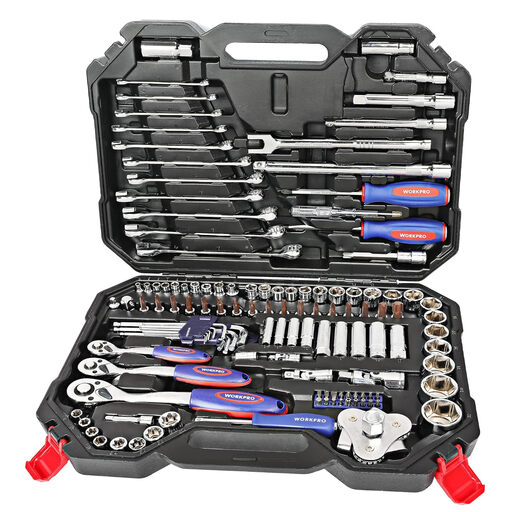
Why This Fits Their Persona: A practical starting point for UK households, vehicle owners and DIY users who want sockets, ratchets, spanners, bits and hex keys in one case.
The contents are specified rather than relying only on the headline piece count, with 1/4-inch, 3/8-inch and 1/2-inch drive tools included.
Includes a storage case, quick-release ratchet wrench, spanners, bits and hex keys for general repairs.
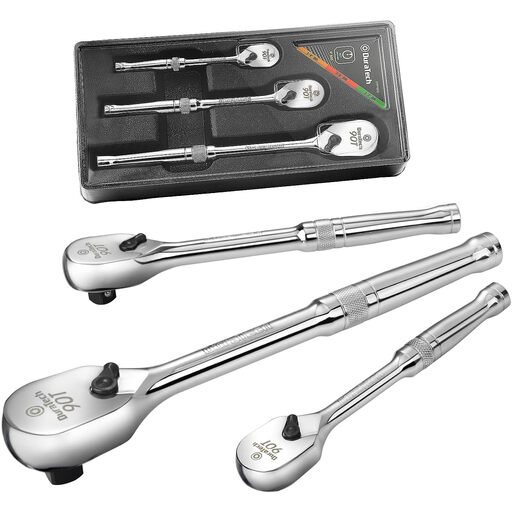
Why This Fits Their Persona: Suitable for users who already own sockets or want three core ratchet handles for workshop, automotive and household jobs.
It provides clearly defined 1/4-inch, 3/8-inch and 1/2-inch drive sizes rather than unnecessary duplicate accessories.
The ratchets use 90-tooth gears with an approximately 4-degree swing arc and have polished chrome alloy construction.

Why This Fits Their Persona: A powered option for frequent automotive maintenance, construction tasks or repairs where repeated manual ratcheting is tiring.
The specification separates powered speed from final tightening: it provides up to 55 N·m and 200 RPM, while torque-critical work still calls for a suitable torque wrench.
Includes a 12 V 2.0 Ah battery, one-hour charger, LED light, battery indicator, seven metric sockets and an extension bar.

Why This Fits Their Persona: Designed for mechanics, motorcyclists and DIY users who regularly work around brackets, pipes and other obstructions.
The hinged head addresses access limitations that a fixed ratchet spanner may not solve, while the size range remains clearly defined.
Includes 12 metric sizes from 8 mm to 19 mm, 180-degree flex heads, 72-tooth gears and a storage case.
We have compiled a complete, real-time list of products that fully satisfy these strict selection criteria and UK safety regulations.
Yes, provided the set contains the required metric sizes and drive format. A 3/8-inch ratchet spanner set is a useful general-purpose choice, while 1/2-inch tools are more suitable for larger fasteners. Always use the correct socket size and follow the vehicle manufacturer’s tightening guidance.
Wipe off grease and moisture after use, then return each item to its marked case or pouch. Keep the mechanism clean and lightly lubricated where permitted. For a cordless ratchet wrench, recharge the battery after use and follow the supplied storage instructions, including periodic charging if it will remain unused.
If a component has a specified torque setting, a torque wrench set is appropriate for final tightening. For example, a 1/4-inch torque wrench covering 2–26 N·m can suit many bicycle, motorcycle and smaller mechanical applications. A standard ratchet wrench is primarily for turning fasteners, not confirming the final torque.