
24/7 Customer Support

Free returns

Same-day & Next-day Delivery

Quality Guaranteed

Unlock Your Welcome Offers: FREE Delivery | Up to 80% OFF | Free 30-day JoyPlus trial
Download the APP
A ratchet wrench can make repetitive fastening much quicker, but choosing the wrong design often leads to wasted money. A small 1/4 inch ratchet may be convenient for trim and bicycle work yet unsuitable for stubborn suspension bolts. Similarly, a cordless ratchet wrench can save time but may not provide the control required for final tightening.
The main buying traps are easy to miss:
The three common sizes are 1/4 inch, 3/8 inch and 1/2 inch:
A longer ratchet handle can provide more leverage, but avoid using extensions or cheater bars to exceed the tool’s stated limits. For critical vehicle fasteners, follow the vehicle manufacturer’s torque specification.
A 72-tooth ratchet generally has a working arc of around 5 degrees, while a 90-tooth ratchet may operate at approximately 4 degrees, depending on the mechanism. A smaller arc means less handle movement is needed before the next engagement, which is useful in an engine bay or confined workshop space.
However, tooth count is only one consideration. Check the head profile, reversing switch, socket retention and handle comfort. A high tooth count does not make a small ratchet suitable for loosening seized fasteners.
A reversible ratchet wrench should allow quick switching between tightening and loosening. A quick-release ratchet adds a button that helps remove sockets without pulling forcefully on the connection.
For everyday hand tools, chrome vanadium steel ratchet construction is widely used because it combines hardness with resistance to wear and corrosion when properly maintained. A polished or plated finish also makes grease and dirt easier to wipe away.
Cordless models should be assessed by more than voltage. Check:
A digital torque wrench is a separate category. It displays applied torque and may provide audible, visual or vibration alerts. Treat the stated accuracy as a specification to verify, keep the tool within its operating range and follow the maker’s storage and calibration guidance.
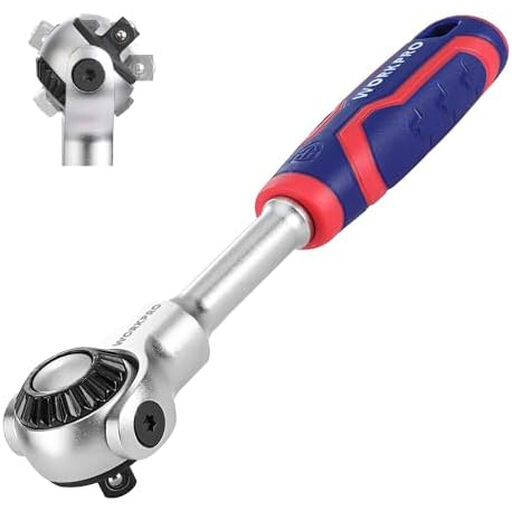
Why This Fits Their Persona: A compact option for UK home toolboxes, bicycle adjustments, small automotive fasteners and occasional DIY repairs.
Its 270° swivel head addresses restricted access, while the 72-tooth mechanism has a stated 5° working arc.
The handle measures 150 mm and weighs 140 g, with a quick-release feature and non-slip grip.
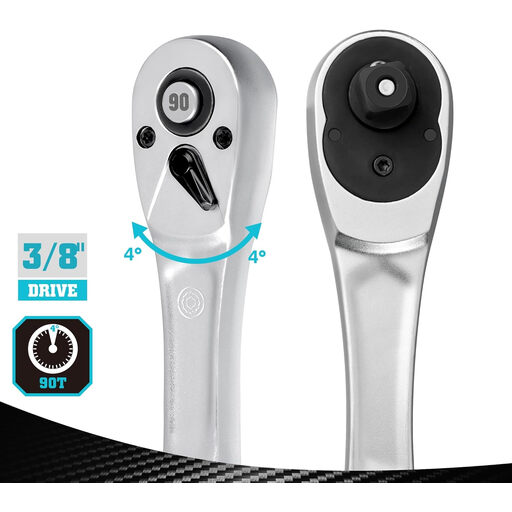
Why This Fits Their Persona: Suits workshop users and frequent DIY mechanics who want a durable manual ratchet for repeated automotive and maintenance work.
The 90-tooth mechanism has a stated 4° operating angle, and the quick-release button reduces socket-change friction.
It uses chrome vanadium steel, has a reversible switch and includes an ergonomic rubber handle.
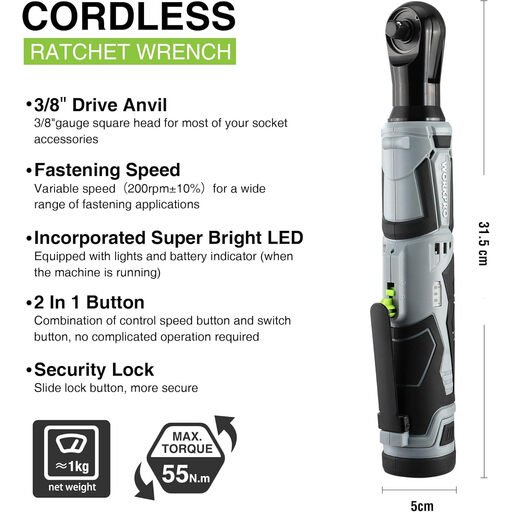
Why This Fits Their Persona: A practical match for vehicle owners, construction workers and workshop users handling repeated fastening where mains-free operation is useful.
The stated 55 N·m maximum torque clarifies its intended range, helping prevent buyers from treating it as a heavy-impact tool.
The set includes a 2.0 Ah battery, one-hour charger, seven metric sockets, extension bar, adapter and LED lighting.
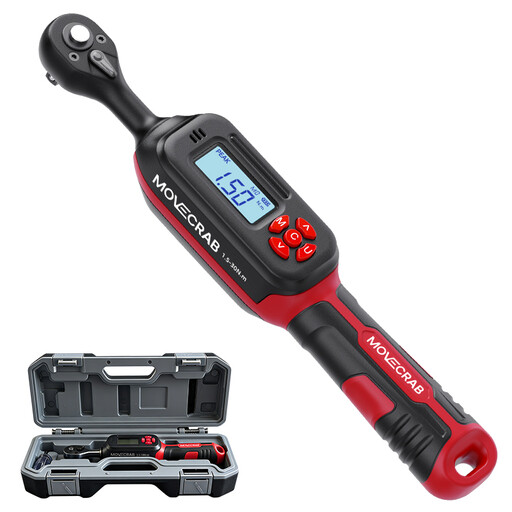
Why This Fits Their Persona: Appropriate for users who need an audible, visual and vibration reminder when working on bicycles, motorcycles, cars or household equipment.
Its stated 4.2–85 N·m range makes the operating limits clearer than relying on feel alone for specified fasteners.
It offers track and peak modes, ten preset values, multiple measurement units and storage for up to 500 readings.
Choose a manual ratchet handle when you need maximum control, straightforward maintenance and no battery charging. It is also the sensible choice for final tightening when a torque specification must be followed with a suitable torque wrench.
A cordless ratchet wrench is useful for removing and installing fasteners efficiently, particularly in awkward vehicle bays. It should be used within its stated torque range and not treated as an impact wrench. Keep batteries charged according to the product instructions and store them away from excessive heat and moisture.
For broad coverage, consider a socket set with the drive sizes and measurements you actually use. A 123-piece set can suit home and car maintenance, while a 450-piece set may be more suitable for a shared workshop requiring metric, imperial, bits and spanners in one case.
We have compiled a complete, real-time list of products that fully satisfy these strict selection criteria and UK safety regulations.
A 1/2 inch ratchet may be suitable for loosening or tightening wheel fasteners within its rated capacity, but it does not confirm the final torque. Use a correctly sized torque wrench and the vehicle manufacturer’s specification for final tightening.
A 3/8 inch ratchet is versatile for many general automotive tasks. A 1/2 inch ratchet is more suitable for larger fasteners and wheel-related work, while a 1/4 inch ratchet is better for small components and confined spaces.