Tent-side gear organisers
If you mainly sort cookware, tent fittings and small items at arm's length, look for light you can aim and turn down. Silva recommends softer light levels for camp-area tasks.


For packing equipment beside a tent, choose a rechargeable head torch with controllable close-range light rather than judging it by maximum lumens alone. A low white setting and continuous red mode matter when other campers are nearby; if you will also walk after dark or pack in rain, check the beam options and water-resistance rating of the exact model. Compare runtime at the setting you expect to use and confirm that its charging system works with your campsite power source.
If you mainly sort cookware, tent fittings and small items at arm's length, look for light you can aim and turn down. Silva recommends softer light levels for camp-area tasks.
If you pack around rain-soaked gear or move between damp tents, compare the exact model's stated water resistance, controls and charging instructions before relying on it outdoors.
If you share a pitch, a low setting or continuous red mode gives you an alternative to directing bright white light towards occupied tents. Petzl and Silva both describe red-light options in their camping head-torch ranges.
Start with the light you need for packing, then check how long that setting runs and how you will recharge the torch. Weather protection and fit become more important if you will use it in rain or wear it for longer tasks.
| Concern | What to check | Who this matters to |
|---|---|---|
| Close-range light without glare | Check for a low white setting, a continuous red mode and a head you can tilt towards your kit. | When I am sorting small items beside other tents, I want to see into a bag without shining a bright beam at my neighbours; around 31% of consumers put close-range, low-glare light first. |
| Charging and usable runtime | Compare runtime at the setting you expect to use, the charging connection and what you need to charge away from mains power. | If I am packing over several evenings, I need the torch to last through each task and recharge from the power source I bring; charging and usable runtime come first for around 31% of consumers. |
| Rain and damp kit | Check the exact model's IP rating and instructions for using and charging it around moisture. | With wet tent fabric and gear to put away, I care most about whether the torch suits the exposure it will face; roughly 23% of consumers prioritise wet-weather resilience. |
| Comfort and carry weight | Compare stated weight, headband adjustment and how the lamp sits and tilts when worn. | I want a torch that stays comfortable while I work through the kit and is easy to carry afterwards; for around 15% of consumers, fit and low carry weight are the main concern. |
A maximum-output figure does not tell you how the beam works over an open bag or how long the torch runs at a useful packing setting. Ledlenser publishes different output and runtime figures by mode for the HF4R Core.
Compare low and mid settings, beam direction and runtime before treating maximum output as a deciding factor.
Black Diamond describes the rechargeable Cosmo 350-R and the separately listed Cosmo 350 with different battery arrangements. A feature stated for one should not be assumed for the other.
Check the chosen variant's charging method, supplied battery, red mode and runtime on its own product information.
Mid and West Wales Fire and Rescue Service warns that mishandled lithium batteries can overheat or catch fire.
Follow the torch's charging instructions, use its supplied charger or a suitable genuine replacement, and stop using it if the battery or casing is swollen, damaged or unusually hot.
An IP rating describes model-specific ingress protection; it does not establish that a wet charging connection or charging setup is safe.
Follow the exact model's instructions and dry the torch and charging connection before charging, away from rain and wet tent fabric.
Petzl's ACTIK range is relevant if campsite packing is paired with walking after dark.
The Cosmo range includes a rechargeable option for general outdoor use.
Silva offers rechargeable outdoor head torches and guidance for camp-area lighting.
Ledlenser's rechargeable HF Core models include options for close-range work and movement around camp.
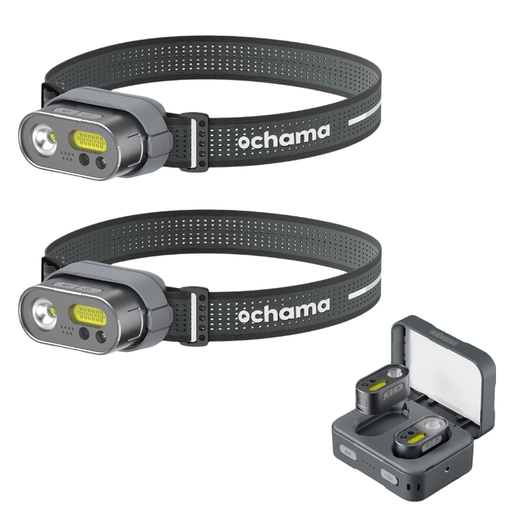
The ochama MH1 set offers two head torches with dimmable light for hands-free campsite tasks. Before choosing it for shared pitches, wet weather or a trip without mains power, confirm the lighting modes, runtime and charging requirements that matter to you.
 No image available
The two-headlamp set suits hands-free campsite tasks when more than one person needs a light.
The product information describes dimmable light and lists a charging box, magnetic charging base, one strap and a Type-C charging cable. Confirm whether it has a continuous red mode, its runtime at your chosen setting, its water-resistance rating and whether its charging arrangement works with your power bank.
Not for close-range packing alone: a low white setting, a beam you can aim at your kit and a suitable runtime are more useful checks. Silva recommends softer light levels and red light around camp; consider stronger distance lighting if you will also walk dark paths.
You can if the exact torch's charging requirements match your power bank and cable. Silva specifies USB-C charging for the Seek 450 Recharge, whereas Ledlenser uses a Magnetic Charge System for the HF4R Core, so check the connection and accessories before travelling.
Follow the model's instructions and use its supplied charger or a suitable genuine replacement. Mid and West Wales Fire and Rescue Service advises against leaving lithium batteries charging unattended; stop using a battery that is damaged, swollen or unusually hot.
Use an appropriate battery collection point rather than putting a removable battery in household rubbish. GOV.UK describes UK battery collection and recycling arrangements; if the battery cannot be removed safely, check the appropriate electrical-waste collection route for the whole torch.