Dusk tent-set-up campers
If most of your work is at arm's length—handling pegs, zips and kit—look for hands-free light you can direct downwards. Silva's camping guidance says a low light level is enough for pitching a tent, cooking and reading.


Choose a rechargeable head torch with a low, aimable white beam for pitching a tent at dusk; Silva advises that low light is enough for campsite tasks such as putting up a tent. A red mode is worth considering around companions. If you will also walk unlit paths, check for a longer-reaching beam; rain and multi-night trips make water protection and charging arrangements more important.
If most of your work is at arm's length—handling pegs, zips and kit—look for hands-free light you can direct downwards. Silva's camping guidance says a low light level is enough for pitching a tent, cooking and reading.
If the torch will be used in rain or packed alongside damp kit, check its stated water-protection rating and whether it has a transport lock. The protection specifications cited by Black Diamond, Silva and Ledlenser apply to particular models, not every torch they make.
When daily charging is uncertain, compare runtime at the setting you expect to use and decide whether you need a battery indicator or a backup power option. Petzl's ACTIK CORE, for example, can use its rechargeable CORE battery or three AAA/LR03 batteries.
For tent setup at dusk, start with the task that would most affect your choice: working comfortably beside others, using the torch in wet conditions or keeping it powered across several nights.
| Concern | What to check | Who this matters to |
|---|---|---|
| Comfortable close-range light | Look for a low white setting and an adjustable beam angle; consider red light when sharing a campsite. | When I am fastening guylines beside other campers, I want to see my hands without shining a bright beam at their faces. For around 46% of consumers, considerate close-up lighting would be the primary concern. |
| Wet-weather use | Check the exact model's IP rating and instructions for wet use, including care of its charging port. | If I may pitch in rain, I want a stated protection level rather than a vague weather claim. Wet-weather reliability would come first for around 27% of consumers. |
| Power across several nights | Compare runtime at the intended setting, battery indication and any compatible backup-power option. | With limited chances to recharge, I need to know how long the torch will run at a usable setting. Around 27% of consumers would make power resilience their primary concern. |
A peak-output figure does not tell you how comfortable the beam will be over pegs and zips. Silva says low light is enough for pitching a tent, while Petzl's guidance distinguishes camping settings from modes intended for more movement.
Check the low and standard settings, beam pattern and angle adjustment before comparing maximum output. If you will walk away from the tent, check the longer-reaching mode separately.
Protection labels differ between models: Black Diamond specifies IP67 for Spot 400-R, Silva specifies IPX5 for Seek 450 Recharge and Ledlenser specifies IP68 for HF4R Core.
Match the exact model's stated rating and test conditions to the exposure you expect, and follow its instructions for the charging port after wet use.
Petzl states that the ACTIK CORE charging cable is not included, and Silva says the same for Seek 450 Recharge. A rechargeable torch may therefore need a cable you already own or pack separately.
Check the box contents and connector type for the exact model before leaving, particularly if you plan to charge from a power bank.
London Fire Brigade warns that batteries can present a fire risk if they are damaged, submerged, short-circuited or overcharged.
Do not charge a swollen or damaged battery. Follow the device's instructions after wet use, use a supplied or genuinely compatible charger, keep it uncovered while charging and avoid leaving it continuously on charge once charging is complete.
These examples show different features to check on specific head torches; they are not endorsements of every model from each brand.
The ACTIK CORE illustrates a choice for campers who want both close-range and longer-reaching light, with an AAA/LR03 backup option.
Spot 400-R illustrates an integrated-battery option for campers comparing stated wet-weather protection.
Seek 450 Recharge illustrates a campsite-focused option with a particularly low stated setting.
HF4R Core illustrates a slim rechargeable model for campers considering adjustable direction and stated water-and-dust protection.
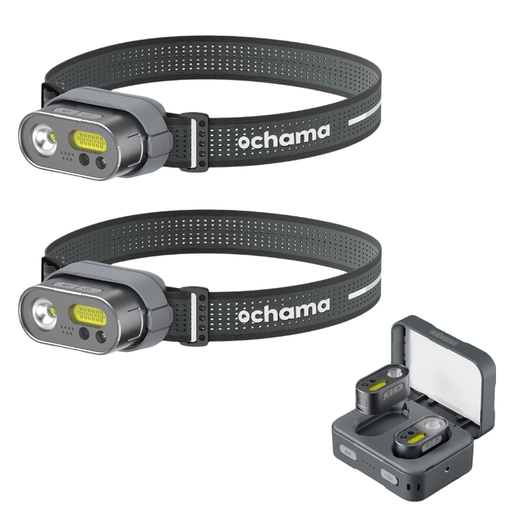
This two-headlamp set is relevant if you want hands-free light for camping and a shared charging kit. Before choosing it for close-up work in rain or over several nights, check its lighting modes, runtime and water-protection details.
 No image available
The hands-free format and dimmable light make this set worth considering for campsite tasks. It includes a magnetic charging base, an extra strap, a Type-C charging cable and a charging box; the title also specifies a gesture sensor.
For tent work near companions, check the available low white setting, red mode and angle adjustment. For wet or multi-night use, confirm the IP rating, runtime by mode and battery details for this exact set.
Start with a usable low setting rather than a maximum-lumen target. Silva's camping guidance says low light is enough for pitching a tent, cooking and reading; if you will also walk unlit paths, check whether the torch has a suitable longer-reaching mode.
Yes, it is worth considering if you want to avoid shining bright white light towards companions. Petzl describes its red lighting as a way to avoid dazzling people nearby, and Silva lists red light on Seek 450 Recharge for preserving night vision.
Check the exact model's box contents rather than assuming a cable is included. Petzl and Silva both say that a charging cable is not included with ACTIK CORE and Seek 450 Recharge respectively; also check the connector before relying on a power bank.
Charge it according to its instructions and keep damaged batteries out of use. London Fire Brigade advises against covering chargers or leaving devices continuously on charge after completion. For disposal, GOV.UK advises that batteries and electrical products bearing the crossed-out-wheelie-bin symbol should not go in household rubbish; use an appropriate recycling point, treating a torch with a non-removable battery as electrical waste.