Hands-free loft checkers
If you need to keep both hands available for access or to inspect insulation, pipes, cables or stored items, a head torch is the more relevant format. It leaves your hands free but does not remove hatch or fall hazards.


Choose a rechargeable head torch if you need both hands available while entering and checking a loft; choose a compact handheld torch if directing the beam at a particular detail matters more, especially where a magnetic tail can be placed on a suitable surface. Compare runtime at the brightness setting you expect to use, not just maximum output. Lighting does not make an unsafe hatch or fragile surface safe, and an ATEX torch is a specialist choice for a documented hazardous-atmosphere requirement.
If you need to keep both hands available for access or to inspect insulation, pipes, cables or stored items, a head torch is the more relevant format. It leaves your hands free but does not remove hatch or fall hazards.
If the task is to examine a pipe joint, cable run or hatch mechanism, consider a handheld torch with controllable brightness. A magnetic tail offers temporary placement only where there is a suitable ferrous surface.
In an older property, suspected asbestos-containing material takes priority over the lighting choice. A documented workplace hazardous-atmosphere requirement also calls for a separate assessment of suitable equipment, rather than a general household torch choice.
Choose when: You need your hands available for access, handling items or looking around the loft.
Trade-off: A beam that follows your view may be less convenient for lighting a fixed point from the side.
Choose when: You mainly need to aim at a detail or can place the torch on a suitable ferrous surface.
Trade-off: Without a suitable place to attach it, you will need to hold it.
Choose when: A workplace assessment or site documentation identifies a hazardous-atmosphere requirement.
Trade-off: Certification must match the identified hazard; it is not a general upgrade for an ordinary domestic loft check.
| Concern | What to check | Who this matters to |
|---|---|---|
| Hands-free access | Check headband fit and whether the lamp can be angled towards the area you need to see. | If I need both hands for access or inspection, I want light that follows where I look without holding a torch. Around 42% of consumers would put hands-free access first. |
| Close-range light | Compare brightness settings and stated runtime at the same intended working mode, rather than comparing maximum outputs alone. | When I am examining a nearby joint or insulation edge, I need light I can direct without relying on turbo mode. Roughly 33% of consumers would prioritise that control. |
| Charging and runtime | Check the charging method, any battery-level indication and stated runtime at the setting you plan to use. | For an occasional loft check, I want to know the light is charged before I reach the hatch and will last for the task. About 25% of consumers would make readiness their primary concern. |
Maximum output does not necessarily describe what a torch sustains throughout an inspection. Fenix Light UK says the E35R reduces output on High and Turbo when its head reaches 60°C.
Compare the manufacturer’s output and runtime for the lower and middle settings you are likely to use, as well as any stated behaviour at higher settings.
A torch helps you see, but it cannot prevent a fall through an opening or onto a fragile surface. The Health and Safety Executive has reported a serious fall through an unguarded loft hatch.
Assess the hatch, access route and footing before entering; do not use the torch as a substitute for appropriate fall-prevention measures.
An ATEX torch is intended for specified hazardous atmospheres. Fenix Light UK describes its WF30RE 2025 as a specialist model with a 300 lm maximum and a dedicated battery.
Use the documented workplace assessment or site requirements to establish whether an intrinsically safe torch is needed and which specification applies.
The specialist battery requirements add a practical consideration to charging and replacement.
The Health and Safety Executive advises stopping work if you encounter material you think may contain asbestos. More light does not make disturbing it safe.
Leave the material undisturbed and check the building owner’s or employer’s asbestos information before work that might affect it.
These model examples illustrate different lighting formats and features; check the specifications of the particular model and variant you are considering.
The MH4 is a rechargeable head torch to consider when hands-free loft checks are the priority. Its lamp head can also be removed.
Its E35R offers a handheld inspection option, while the WF30RE 2025 serves a distinct hazardous-atmosphere use case.
The Baton 3 Pro is a compact handheld example for buyers comparing low-output settings and close-range use.
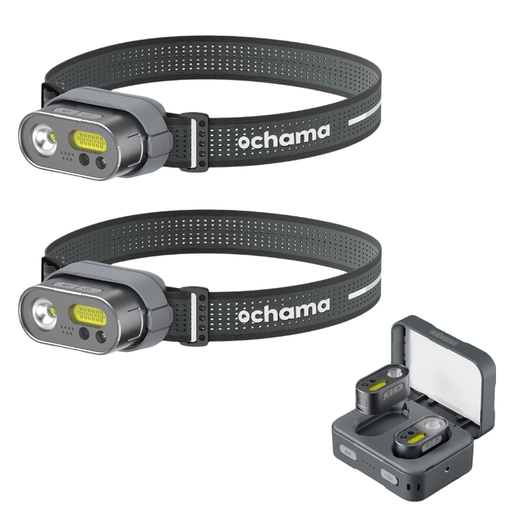
This head torch set is relevant if keeping your hands available is your main reason for choosing a loft light. Check its fit and working-mode performance against your intended inspection before buying.
 No image available
A head-mounted option to consider when you need both hands available during a loft check.
The listed set includes two headlamps, one base, one strap, a Type-C charging cable and a charging box. The product name also describes a gesture sensor and dimmable light.
Confirm headband fit, lamp-head adjustment, output and runtime at the settings you expect to use.
Use a head torch when the inspection requires both hands available; a handheld torch suits deliberate aiming at a particular area. If you plan to use a magnetic tail for temporary hands-free light, check that there is a suitable ferrous surface where you need it.
No: choose by the light output and stated runtime at a setting suited to your inspection. Fenix Light UK says the E35R’s High and Turbo modes are temperature regulated, so its maximum output is not a sustained-output promise.
Consider an ATEX or intrinsically safe torch when a workplace assessment or site rule identifies a hazardous-atmosphere requirement. An ordinary domestic loft check does not by itself establish that need, while a standard torch must not be assumed suitable for an identified hazardous atmosphere.
Stop work and avoid disturbing the material. The Health and Safety Executive says asbestos can be found in buildings built before 2000; check the building owner’s or employer’s asbestos information before any work that may disturb suspected material.
Take unwanted electrical products and batteries to a suitable recycling collection point rather than putting them in household rubbish, as GOV.UK advises. Check the collection point’s instructions for a removable battery or a torch with a battery that stays inside.