Who needs which features?

Regular unlit-path walkers

If you regularly encounter uneven ground, gates or turns after dark, look for a beam that shows the ground close to your feet as well as the route ahead. A peak-lumen figure alone will not tell you how that beam is distributed.

Wet-weather dog and countryside walkers

If rain and wet vegetation are part of your usual route, check the exact model's water-resistance rating and charging-port arrangement. You will also need enough runtime at the setting you use throughout the walk.

Walkers using paths beside roads

A head torch helps you see the path, but being visible to drivers is a separate concern. The UK Highway Code advises pedestrians to use reflective materials after dark.

What should you check?

Start with the beam and runtime you need for your usual path, then check weather protection and fit. If your route runs beside traffic, plan for visibility to drivers separately from lighting the ground.

ConcernWhat to checkWho this matters to
Footing and forward visibility Look for a mixed or adjustable near-and-far beam. Check runtime at the brightness setting you expect to use. On an uneven path, I need to see where to step without losing sight of the next turn. Around 33% of consumers put beam control first.
Rain and wet conditions Check the exact model's IP rating and whether its charging-port cover closes securely. When rain is a regular part of my walk, I want the torch's stated protection to match that exposure. Water resistance is the primary concern for around 25% of consumers.
Runtime and fit Compare stated runtime at your intended setting; check the headband adjustment, battery indicator and lock function. For a longer outing, I need a torch that stays in place and has charge for the walk. Roughly 25% of consumers prioritise runtime and comfort.
Visibility beside traffic Use reflective clothing or accessories alongside the torch, following the UK Highway Code's pedestrian guidance. If my path runs beside a road, lighting my feet is not enough: I also want drivers to see me. Around 17% of consumers make roadside visibility their main concern.

Mistakes to avoid

  • Choosing by peak lumens alone

    A high-output mode may use charge quickly, while the shape of the beam determines how well you can see nearby ground and the route ahead. The Great Outdoors notes that full-power use drains batteries quickly.

    Compare runtimes at the settings you will actually use and look for useful near-field and forward illumination.

  • Relying on the torch for roadside visibility

    Light aimed at the path does not necessarily make you conspicuous to drivers. The UK Highway Code advises reflective materials after dark.

    Wear reflective clothing or accessories where your route runs beside traffic, and follow the Highway Code's guidance on pavements and road position.

  • Assuming rechargeable means rain-resistant

    Charging method does not establish water protection; the stated rating needs to apply to the exact model.

    Check its IP rating and test conditions. For comparison, Black Diamond states that its Spot 400-R has an IP67 rating and is tested to operate at 1 metre underwater for 30 minutes; that rating does not transfer to other torches.

  • Setting off without checking the charge

    A torch that has switched on in a bag, or has not been charged, may have less usable runtime than you expect.

    Check the battery indicator and charge before leaving. For longer or remote walks, consider a separate backup light; a lock function can help prevent accidental activation in a bag.

Head-torch brands to consider

Petzl

The ACTIK and rechargeable ACTIK CORE are relevant if you want to compare near-and-far lighting for outdoor walking.

  • Petzl specifies a mixed wide-and-focused beam, red lighting, a battery indicator and a lock function for the ACTIK. Its UK page describes the ACTIK CORE as a 625-lumen rechargeable model.
  • The standard ACTIK uses three AAA batteries or a separately available CORE rechargeable battery; do not confuse it with the ACTIK CORE. Petzl states that the ACTIK is not certified for road use.

Ledlenser

The HF6R offers several beam options for walkers who want to adjust the light as the path changes.

  • Ledlenser lists spot, mid, flood and red front lighting, along with its Adaptive Light Beam feature for automatic dimming and focusing.
  • Check the exact HF6R variant's water-resistance rating and runtime at your preferred setting before choosing it for a wet or lengthy route.

Black Diamond

The rechargeable Spot 400-R gives wet-weather walkers a model-specific water-resistance rating to assess.

  • Black Diamond specifies a 400-lumen maximum output, a stated maximum distance of 100 metres and IP67 testing for operation at 1 metre underwater for 30 minutes.
  • That rating does not establish that the torch can be charged while wet. Check the exact listing's charging accessories and after-sales terms.

BioLite

The HeadLamp 800 Pro is worth examining if fit and access to external power matter on longer outings.

  • BioLite lists Constant Mode, Pass Thru+ charging and eight lighting modes, and describes the fit as slim and resistant to bouncing.
  • Pass-through charging requires compatible equipment to carry. Check the charging connection and runtime at your chosen brightness on the exact listing.

Joybuy head torches for unlit-path walking

This set offers rechargeable, hands-free lighting for an unlit walk. Before relying on it for a particular route, check its beam pattern, runtime, water resistance and fit against the conditions you expect.
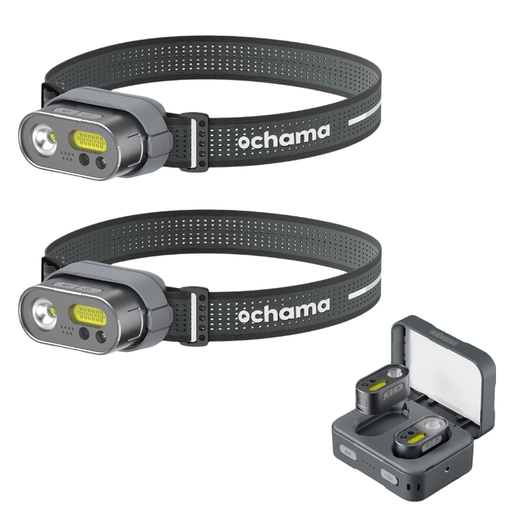
ochama MH1 head torch set with two headlamps

ochama MH1 Head Torch Set, 2 Headlamps

Consider this set if you want hands-free lighting with a gesture sensor and dimmable light for an unlit path.

The listed set contains two headlamps, one base, one strap, one Type-C charging cable and one charging box.

Check the beam pattern, runtime at your intended brightness, water-resistance rating and headband fit before choosing it for your usual walk.

View on Joybuy

Common questions

How bright should a head torch be for an unlit path?

Choose a controllable beam and sufficient runtime for your path, not just the highest lumen figure. The Great Outdoors suggests that 200–300 lumens and a 75–100 metre beam are generally sufficient for hillwalking; check how a particular torch lights both your footing and the route ahead at the setting you plan to use.

Is a head torch enough when I walk beside a road?

No: use the torch to see your path and reflective materials to help drivers see you. The UK Highway Code advises reflective materials after dark and, where there is no pavement, walking on the right-hand side so you can see oncoming traffic, with extra care in poor light.

Does a red-light mode replace reflective clothing?

No: a red mode is not a substitute for reflective materials beside traffic. Petzl also states that its ACTIK is not certified for road use, so do not treat that lamp as a replacement for standardised lights where traffic rules require them.

What water-resistance rating should I check for rain?

Check the rating and test conditions for the exact torch you plan to buy, matching them to the exposure on your route. Black Diamond states that the Spot 400-R is rated IP67 and tested to operate at 1 metre underwater for 30 minutes; this does not mean it should be charged while wet.

Should I take a backup light on a longer walk?

A separate backup light is sensible for a longer or remote walk if your main rechargeable torch could run flat. Check the main torch's runtime at your intended setting before leaving; a power bank may help with charging, but its usefulness depends on the torch's charging arrangement.