Choose a rechargeable lantern if your main job is lighting the shared tent interior; choose a rechargeable head torch if you need both hands free to pitch, unpack or move around camp after dark. Compare the low-light setting and its stated runtime, charging arrangement, placement and weather protection rather than relying on peak brightness. For lighting inside a tent, use an electric light instead of candles or fuel-burning equipment.
Who needs which kind of tent light?
Campers lighting a shared tent
If you mainly want light for changing, sorting kit or reading inside the tent, consider a dimmable lantern that can stand securely or hang from a suitable point. The aim is spread-out light rather than a beam that follows one person.
Campers arriving after dark
If you need your hands for pitching, unpacking or carrying gear, a rechargeable head torch directs light where you look. A low setting is worth checking if you will also use it around other people in the tent.
Multi-night or wet-weather campers
If the light must last across several evenings or may be exposed to rain, compare runtime at the setting you intend to use, your charging options and the protection stated for the exact model.
What matters when choosing?
Rechargeable lantern
Choose it when: Several people need spread-out light for changing, reading or finding kit inside the tent.
Bear in mind: A lantern placed in the tent will not direct light where you look when walking around camp.
Rechargeable head torch
Choose it when: Pitching, carrying gear or moving between the tent and facilities makes hands-free light the priority.
Bear in mind: Its directional beam may disturb tent-mates and is not the same as shared lantern light.
For either format, start with the task you do most often, then check the setting and power arrangement you would actually use.
| Concern | What to check | Who this matters to |
|---|
| Shared tent light |
Look for dimming or low modes, a diffuse light and a suitable hanging point or stable base. |
If I am changing or finding kit while others are in the tent, I want light spread across the space without relying on a bright beam. Around 31% of consumers put shared tent lighting first. |
| Hands-free tasks |
Check headband fit, beam adjustment and a usable low setting for nearby work. |
When I pitch or unpack after dark, I need both hands available and light that follows my gaze. Hands-free tasks come first for roughly 31% of consumers. |
| Runtime and rain exposure |
Compare runtime by brightness mode and check what the exact model's weather rating covers. |
For a longer or wetter trip, I need to know whether the light will last through the evenings and cope with its expected exposure. That is the primary concern for around 23% of consumers. |
| Packable backup power |
Check size, charging connector and whether the exact model accepts replaceable batteries. |
If charging access is uncertain, I would rather carry a compact backup or have another compatible power option. Approximately 15% of consumers make that flexibility their first priority. |
Common tent-lighting mistakes
-
Choosing by peak lumens alone
Peak output says little about how long a light lasts at the setting you will use. Alpkit lists 4.5 hours at 400 lumens and 153 hours at 10 lumens for its Tyndall Lantern.
Choose a usable low setting, then compare the manufacturer's runtime figures at that brightness.
-
Bringing flame-based lighting into the tent
Cheshire Fire and Rescue Service warns against fuel-burning devices inside tents; UK Home Office outdoor fire-safety guidance also says never to use a barbecue in a tent.
Use an electric light inside the tent. Keep candles and fuel-burning equipment out of the enclosed shelter.
-
Charging a light on bedding or while asleep
A charging fault is harder to notice if the battery is unattended. Greater Manchester Fire and Rescue Service advises against leaving a battery charging unattended or when you go to bed.
Follow the manufacturer's charging instructions, use the specified equipment and charge away from bedding and other flammable materials while you are awake.
-
Expecting one beam to do every job
A head torch follows your gaze for hands-on tasks, whereas a lantern can be positioned to light a shared space. Neither format automatically provides the other's lighting pattern.
Buy for your main task; if shared tent light and hands-free movement are both central to the trip, consider whether you need one of each.
Brands to consider
Alpkit
Alpkit offers both a camping lantern and rechargeable head torches relevant to this choice.
- Alpkit lists a 10–400 lumen dimmer, warm and white modes, a hanging clip, feet, USB-C charging and IPX5 protection for the Tyndall Lantern.
- The Tyndall's stated runtime varies substantially by setting: 153 hours at 10 lumens versus 4.5 hours at 400 lumens.
Petzl
The ACTIK CORE is a head-torch option for directional, hands-free light.
- Petzl lists USB-C charging, red lighting and compatibility with three AAA/LR03 batteries as an alternative to its rechargeable CORE battery.
- Battery choice can affect lighting performance, and a head torch does not replace a dedicated lantern for spread-out tent light.
Black Diamond
The Moji R+ is a compact rechargeable lantern with several placement and lighting options.
- Black Diamond lists magnets, RGB lighting, a digital lock, micro-USB charging and IPX4 protection for the Moji R+.
- Its published material includes both a 150-lumen LED feature statement and a 200-lumen maximum specification. Confirm the exact variant and runtime setting before comparing output claims.
Ledlenser
The ML4 is a compact lantern to consider when power flexibility matters.
- Ledlenser lists rechargeable and AA-battery power options, 300 lumens, 71 g weight and IP66 protection for the ML4.
- Confirm which ML4 version and battery are supplied, and check the brightness setting associated with its stated runtime of up to 45 hours.
Rechargeable head torches on Joybuy
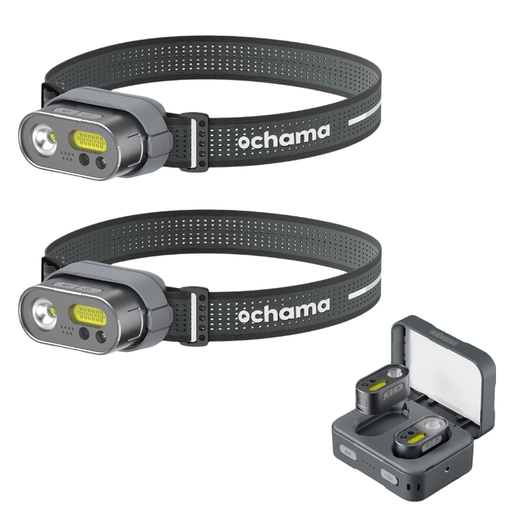
This head-torch set is relevant when hands-free light for setting up camp or reading in a tent matters more than lighting the whole tent for a group.
 No image available
ochama MH1 Smart Multi-Function Head Torch Set
A hands-free option for camp tasks after dark; the product description also names reading in a tent as a use for its dimmable light.
The set lists two headlamps, one base, one strap, a Type-C charging cable and a charging box. The product name also specifies a gesture sensor.
For use around tent-mates, on longer trips or in wet conditions, check the low-light and red-light options, runtime by mode and weather rating for this set before buying.
View on Joybuy
Questions about tent lighting
Is a lantern or head torch more useful inside a tent?
A lantern is the more relevant format for shared, spread-out tent light; a head torch suits tasks that need both hands free. If a head torch will also be your tent light, check that it has a setting comfortable for nearby people.
How should I compare battery runtime?
Compare the stated runtime at the brightness you expect to use. Alpkit lists 4.5 hours at 400 lumens but 153 hours at 10 lumens for its Tyndall Lantern, so those figures describe very different settings.
Can I use a candle or fuel-burning lantern in a tent?
Do not use flame-based lighting inside a tent. Cheshire Fire and Rescue Service warns against fuel-burning devices in tents; choose an electric light for the tent interior instead.
When should I recharge a tent light?
Charge it while you can attend to it, following the manufacturer's instructions and keeping it away from bedding. Greater Manchester Fire and Rescue Service advises against leaving a battery charging unattended or while you sleep.


