Neighbour-conscious evening listeners
If you listen while others need quiet, a turntable that transmits to Bluetooth headphones offers an alternative to room speakers. Speaker listening still requires attention to volume and placement.


Choose the listening arrangement and check your records' speeds before choosing a turntable. Bluetooth headphones let you listen without room speakers, while shared listening through speakers still calls for considerate volume and placement. An automatic 33⅓/45 RPM deck can simplify playback of LPs and singles; if you own 78 RPM shellac records, choose a deck that explicitly supports that speed and check its stylus guidance before playing them.
If you listen while others need quiet, a turntable that transmits to Bluetooth headphones offers an alternative to room speakers. Speaker listening still requires attention to volume and placement.
If your soundtrack collection consists mainly of 33⅓ RPM LPs and 45 RPM singles, automatic operation and a suitable connection to your listening equipment can make setup more straightforward.
If you own 78 RPM shellac discs rather than only later LP reissues, check for explicit 78 RPM support and follow the manufacturer's cartridge and stylus guidance before playback.
Start with how you will listen and what speeds your records require, then match the turntable's outputs to the equipment you own.
| Concern | What to check | Who this matters to |
|---|---|---|
| Private listening | Check that the deck transmits to compatible Bluetooth headphones; a Bluetooth speaker still produces room sound. | When I listen while others need quiet, I want to use headphones instead of filling the flat with music. Around 31% of consumers put private listening first. |
| Simple LP and single playback | Check the labelled 33⅓ or 45 RPM speed and whether automatic operation and a built-in phono preamp suit your setup. | If my soundtracks are LPs and singles, I want to get a record playing without a complicated setup. Roughly 31% of consumers make straightforward standard-record playback their primary concern. |
| Existing equipment | Match the deck's Bluetooth or wired output and phono/line setting to your headphones, powered speakers or amplifier. | With speakers or an amplifier already at home, I need a turntable that connects to them appropriately. Around 23% of consumers prioritise fitting a deck into their existing system. |
| 78 RPM records | Confirm explicit 78 RPM support and check cartridge and stylus guidance for the particular records. | If my collection includes original shellac discs, I need to check compatibility before playing them. About 15% of consumers put 78 RPM playback first. |
Bluetooth transmission and wired audio outputs connect a turntable to listening equipment; they do not establish that the deck has built-in speakers.
Before ordering, match the deck's outputs to the headphones, powered speakers or amplifier you intend to use.
Depending on the deck and your existing equipment, you may also need a phono stage or another suitable listening device.
A 33⅓/45 RPM deck does not provide the 78 RPM speed needed for a disc labelled 78 RPM. Audio-Technica specifies that the AT-LP120XUSB supports all three speeds, while Pro-Ject specifies 78 RPM support for its A2.
Read your records' labels or sleeves, then check both the deck's speeds and the manufacturer's stylus guidance before playing shellac discs.
Pro-Ject identifies nearby loudspeakers as a placement consideration for its A2. The arrangement of the listening area therefore matters as well as the turntable you choose.
Put the deck on a stable, level surface and separate it from speakers where practical; check playback at your usual listening level before settling on a layout.
Bluetooth changes how audio reaches a speaker, not whether other people can hear it. In England, the Department for Environment, Food & Rural Affairs says councils must look into complaints about noise that could be a statutory nuisance.
Use compatible headphones when you need to avoid room-speaker sound. When using speakers, keep the volume considerate of housemates and neighbours.
Its AT-LP60XBT and AT-LP120XUSB illustrate different approaches to soundtrack playback.
The PS-LX310BT is a Sony option for automatic playback of standard LPs and singles.
The E1 BT and A2 serve different record-format and operation needs.
These Sony turntables offer Bluetooth and automatic playback for listeners considering a simpler route to playing soundtrack LPs and singles. If your collection includes 78 RPM records, check the required speed and stylus suitability before choosing either model.
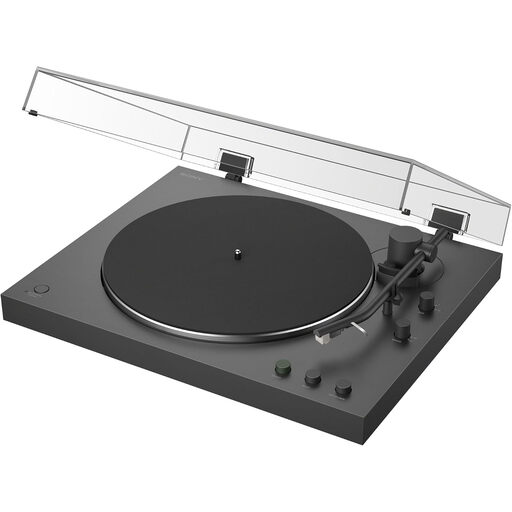 No image available
Consider this model if you want automatic playback and the option to listen through compatible Bluetooth headphones in a shared flat. Check your records' speeds, your listening equipment and the power connection for your delivery address before ordering.
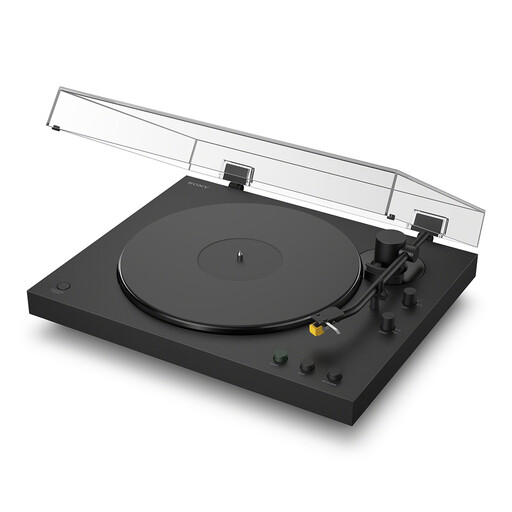 No image available
Consider this model if Bluetooth listening and automatic playback are your priorities. Check headphone compatibility, the speeds of any records you intend to play and the power connection for your delivery address before ordering.
You need a compatible way to hear the turntable, but that could be headphones rather than speakers. Check whether your chosen deck transmits to Bluetooth headphones or speakers, or needs a wired connection to powered speakers or an amplifier.
No, not at the record's intended speed. Audio-Technica specifies 78 RPM playback for the AT-LP120XUSB, and Pro-Ject specifies it for the A2; with either model, check the manufacturer's cartridge and stylus guidance for your particular record before playback.
No: a Bluetooth speaker still makes sound in the room. Headphones provide an alternative when others need quiet; if you use speakers, consider their placement and keep the volume appropriate for the people around you.
Check the product identification, whether instructions are supplied and whether the power connection suits your delivery address. The Office for Product Safety & Standards says the Electrical Equipment (Safety) Regulations 2016 set requirements for electrical equipment placed on the Great Britain market; for delivery to Northern Ireland, check the destination-specific information rather than assuming the GB requirements are identical.