What matters when choosing?
Plan the speakers and amplification first, then check how the turntable connects and which record speeds you need.
| Concern | What to check | Who this matters to |
|---|
| Stereo system and placement |
Decide between compatible active speakers and an amplifier with passive speakers. Check that the room allows a practical stereo listening position; KEF gives 1,800–2,400 mm between speakers as a starting point where space permits. |
I want sound from two speakers at my main seat, with room to adjust their positions rather than relying on the turntable alone. Around 44% of consumers would put the stereo system and placement first. |
| Connection and setup |
Match the turntable’s phono or line output to the equipment’s input. Check whether a phono stage is built in or needed separately. |
I want to connect the deck without adding an unnecessary component or working through extensive initial adjustments. Around 33% of consumers would make straightforward connection and setup their primary concern. |
| Record speeds |
Identify the speeds in your collection and check the exact model’s specification, especially for 78 RPM discs. |
Some of my older soundtrack records may be 78s, so their format could determine which deck I can use. Around 23% of consumers would prioritise vintage-format compatibility. |
Joybuy product choices
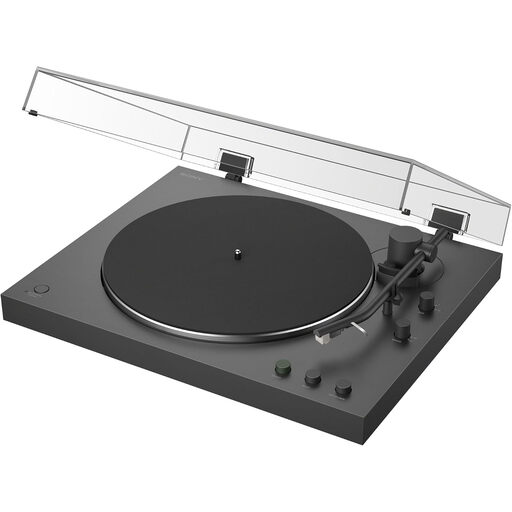
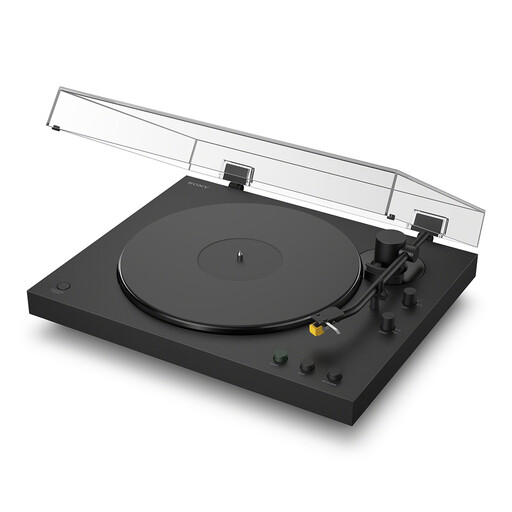
These Sony Bluetooth turntables are choices to consider if automatic playback appeals to you. Match either one to compatible speakers or amplification, and check its stated speeds against your soundtrack collection before deciding.
 No image available
Sony PS-LX3BT Bluetooth Turntable with Automatic Playback
Consider the PS-LX3BT if automatic playback and Bluetooth are priorities for your soundtrack setup.
Before buying, check its specified speeds if you own 78 RPM discs, and confirm how it will connect to the speakers or amplifier planned for your room.
Joybuy
 No image available
Sony PS-LX5BT Bluetooth Turntable with Automatic Playback
The PS-LX5BT is another option if you want automatic playback and Bluetooth in a separate turntable setup.
Check its stated record speeds, particularly for 78 RPM discs, and make sure the intended speakers or amplifier provide a compatible playback route.
Joybuy
Common questions
Do I need an amplifier for a turntable in a large living room?
You need a compatible way to amplify the turntable signal, but not necessarily a separate amplifier: suitable active speakers can take a line-level output. If you choose passive speakers instead, plan for an amplifier and check whether the system has the phono stage the turntable requires.
Do vintage soundtracks require a 78 RPM turntable?
Only if the records you intend to play include 78 RPM discs. Audio-Technica lists 33⅓, 45 and 78 RPM for the AT-LP120XUSB, while Pro-Ject lists 33 and 45 RPM for the Primary E Phono; check each record and exact deck rather than relying on the word “vintage”.
Where should I put the speakers in a large living room?
Start with the speaker maker’s placement instructions and your main listening position. KEF suggests 1,800–2,400 mm between speakers where the room permits, then adjusting their position and distance from walls; that range is a starting point, not a requirement for every speaker or room.
What if an online turntable purchase is faulty or I change my mind?
Faults and change-of-mind cancellations are separate issues. GOV.UK explains that the Consumer Rights Act 2015 covers remedies for faulty goods, while its guidance for online and distance selling describes cancellation up to 14 days after delivery under the applicable rules and exceptions. Check the retailer’s terms for any additional voluntary returns policy without treating it as a replacement for statutory rights.
Do I need a music licence to play vintage records?
Ordinary private listening at home is different from playing recorded music in public. GOV.UK says public playback usually needs a PPL PRS licence, so check the applicable requirements if the records will be played at a venue, business or public event.


