Choose the record player around the speakers and amplifier you intend to use: a turntable with a suitable built-in phono stage can simplify connection to powered speakers or a line input, while a manual component deck calls for more setup and a compatible signal chain. Speakers close to a wall need their own placement checks; changing the turntable will not, by itself, resolve bass affected by speaker position.
Who each setup suits
Listeners with speakers near a wall
If the room limits how far your speakers can sit from the rear wall, check their placement guidance as carefully as you check the record player. KEF UK notes that rear-ported speakers are particularly sensitive to wall position.
Listeners who want a simple setup
Automatic playback and a suitable built-in phono stage reduce the setup and equipment needed to feed powered speakers or an existing line input. Confirm the connection mode for the particular turntable and speakers.
Listeners building a component system
A manual deck makes sense if you are comfortable following its setup instructions and choosing amplification and speakers separately. Check where the cartridge signal will receive phono amplification before selecting the deck.
What matters when choosing
Start with the space available for the speakers, then match the turntable’s output to your powered speakers or amplifier. Decide how much manual deck setup you want after those two questions are settled.
| Concern |
What to check |
Who this matters to |
| Speaker placement and bass |
Check the speakers’ port layout and the maker’s guidance for the rear-wall space you have. KEF UK says rear-ported speakers are more sensitive to wall placement. |
If my speakers must sit close to the wall, I want to keep bass from obscuring lower instruments. Around 40% of consumers put speaker placement first. |
| Connection to the speakers |
Identify whether the destination is a powered speaker, a line input or a dedicated PHONO input; follow the turntable’s instructions for its output setting. |
I want to connect to powered speakers without adding a separate phono stage. Roughly 30% of consumers make a simple signal path their primary concern. |
| Manual setup and components |
Check the deck’s levelling and tonearm setup instructions, and confirm that the system includes an appropriate phono stage. |
I would rather choose my amplifier and speakers separately and take time setting up the deck. About 30% of consumers prioritise manual setup and component choice. |
Mistakes to avoid
-
Expecting a new turntable to cure boomy bass
Speakers close to a wall can change the bass balance. KEF UK notes that rear-ported designs are especially sensitive to rear-wall placement, so a different turntable may leave the same room issue untouched.
Check the speaker manual and try the available placement options before changing the record player.
-
Using the wrong phono or line setting
The correct setting depends on the input receiving the signal. Audio-Technica UK instructs AT-LP70XBT users to select LINE for powered speakers or an ordinary line input, and PHONO for a receiver input labelled PHONO.
Identify the destination input and follow the instructions for your exact turntable before connecting it.
-
Putting the deck where the speakers make it vibrate
Speaker vibration can interfere with playback. Audio-Technica UK advises a flat, level surface away from speakers that cause vibration; Pro-Ject Audio Systems also instructs users to level the support for its Debut Carbon EVO.
Use a stable, level support and separate the deck from the speakers where the room allows.
-
Choosing a component deck without planning the signal chain
Rega Research specifies an appropriate phono stage for the Planar 1, whereas the Planar 1 Plus has one built in. The deck alone does not establish how it will connect to your amplifier or speakers.
Trace the connection from cartridge through phono stage to amplifier or powered speakers before ordering.
Brands to consider
Audio-Technica
Its AT-LP70XBT is a reference point for an automatic turntable connected to powered speakers or an existing stereo system.
- Audio-Technica UK specifies automatic 33⅓ and 45 RPM playback and a switchable built-in phono preamp for this model.
- The stated speeds do not include 78 RPM; check your records’ speed before choosing it.
Rega
The Planar 1 and Planar 1 Plus illustrate how two manual turntables in the same range can call for different connection plans.
- Rega Research states that the Planar 1 Plus includes a moving-magnet phono stage, a factory-fitted Carbon cartridge and preset bias.
- Rega Research instructs Planar 1 owners to connect it to an appropriate phono stage; do not assume it connects directly to a line input.
Pro-Ject
The Debut Carbon EVO is an example of a manual deck for someone prepared to set up the turntable and plan the rest of the system separately.
- Pro-Ject Audio Systems lists electronic speed control, a carbon tonearm, a pre-adjusted cartridge and adjustable feet for this model.
- Its instructions cover counterweight and anti-skating components and require a level support surface.
Joybuy turntables to consider
These automatic Sony turntables are options for listeners who prefer a simpler playback routine. Check the connection required by your speakers or amplifier, and assess near-wall speaker placement separately.
 No image available
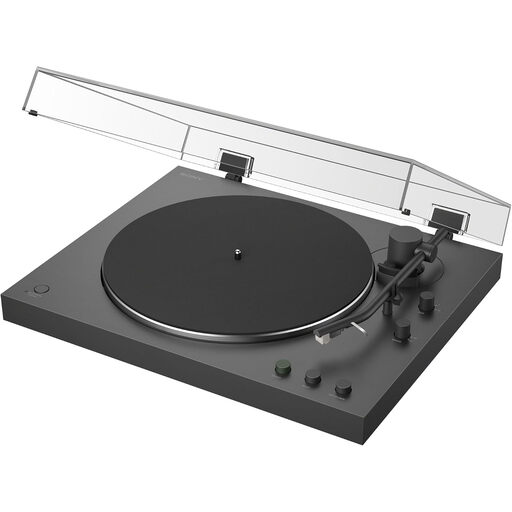
Sony PS-LX3BT automatic Bluetooth turntable
Automatic playback suits a listener who wants a straightforward routine for folk LPs. Check the output setting against your speaker or amplifier input, and keep the deck level and away from speaker vibration.
View on Joybuy
 No image available
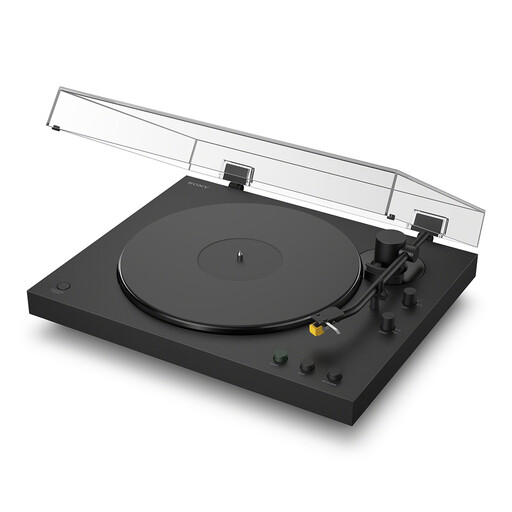
Sony PS-LX5BT automatic Bluetooth turntable
This automatic Bluetooth model is another option for a simpler playback routine. Before connecting it, confirm that its output mode suits your powered speakers or amplifier input; speaker position remains a separate consideration.
View on Joybuy
Common questions
Do I need a phono stage with powered speakers?
You need a suitable phono signal path before feeding an ordinary line-level speaker input: that can be a built-in phono stage or a separate one. For the AT-LP70XBT, Audio-Technica UK instructs users to select LINE for powered speakers; a receiver input labelled PHONO calls for its PHONO setting instead.
Are speakers near a wall a problem for folk LPs?
Not necessarily, but wall position can affect their bass balance. KEF UK notes that rear-ported speakers are more sensitive to placement near a wall, so follow the guidance for your speakers and experiment with the space available before blaming the record player.
Where should the turntable sit if the speakers are nearby?
Put the turntable on a stable, level surface away from speaker-induced vibration where practical. Audio-Technica UK gives that advice for the AT-LP70XBT, and Pro-Ject Audio Systems requires a level support surface for the Debut Carbon EVO.
How should I arrange disposal of an old record player or powered speakers?
Check which collection or take-back arrangement accepts your specific electrical item in the UK. The Office for Product Safety and Standards and the Department for Environment, Food & Rural Affairs identify the Waste Electrical and Electronic Equipment Regulations 2013 (as amended) as the UK framework; ask your local authority or retailer about the available handover route.


