Listeners with spoken-word LPs and singles
If your records are marked 33⅓ or 45 RPM, you may want a straightforward way to connect a turntable to the speakers you already use.


For spoken-word LPs and 45 RPM singles, choose a turntable with the right speed settings and an output that works with your speakers; automatic operation can make starting and finishing each side less hands-on. If your collection includes shellac 78s, check for both 78 RPM playback and a compatible 78 stylus or cartridge: a speed setting alone is not enough.
If your records are marked 33⅓ or 45 RPM, you may want a straightforward way to connect a turntable to the speakers you already use.
Automatic starting, stopping or tonearm return may appeal if you would rather handle the tonearm less often during talks, comedy records or audiobooks.
Older shellac 78 RPM discs call for the correct playback speed and a suitable larger-profile stylus. Ortofon’s guidance on its 2M 78 explains the stylus requirement for shellac records.
Start with the speeds printed on your records, then decide how much manual operation you want and how the turntable will connect to your audio equipment.
| Concern | What to check | Who this matters to |
|---|---|---|
| Record speed and format | Check record labels for 33⅓, 45 or 78 RPM. For shellac 78s, also check that a suitable 78 stylus fits the chosen cartridge and tonearm. | If my collection includes older shellac discs, I need more than the speeds used for my LPs and singles. Around 40% of consumers would put record-format compatibility first. |
| Ease of operation | Check the exact model for automatic start, stop and tonearm return; these functions are not implied by Bluetooth. | For a long spoken-word side, I would rather not cue and return the tonearm myself each time. Automatic operation would be the primary concern for around 40% of consumers. |
| Speakers and upkeep | Match the turntable’s phono or line output to your equipment, and check replacement-stylus availability for its fitted cartridge. | I want the turntable to work with my speakers and to be able to replace its stylus when needed. That setup and upkeep need would come first for around 20% of consumers. |
A 33⅓/45 RPM deck will not play a 78 at its intended speed. Ortofon’s shellac-record guidance also distinguishes the larger stylus profile needed for 78s.
Read the speeds on several record labels before choosing. If you own 78s, check both the deck’s speed setting and the availability of a compatible 78 stylus or cartridge.
Playing shellac 78s may mean obtaining a dedicated stylus or cartridge as well as a 78 RPM-capable deck.
A built-in phono preamp does not mean a turntable has speakers: Sony’s PS-LX310BT instructions, for example, state that it has none. Rega’s Planar 1 instructions call for an appropriate phono stage.
Identify the inputs on your powered speakers, amplifier or receiver, then check the chosen turntable’s output and preamp settings.
Automatic functions depend on the model. Audio-Technica describes the three-speed AT-LP120XUSB as fully manual, while Sony lists auto start, stop and return for the two-speed PS-LX310BT.
If hands-off operation matters to you, check which starting, stopping and return functions the exact model provides.
A stylus wears with use, according to Audio-Technica. The Library of Congress advises handling grooved discs by their edges and label areas rather than touching the grooves.
Check replacement-stylus availability for the fitted cartridge, follow its maker’s maintenance guidance and handle records clear of the playing surface.
Its range includes automatic two-speed models and a manual model with 78 RPM playback.
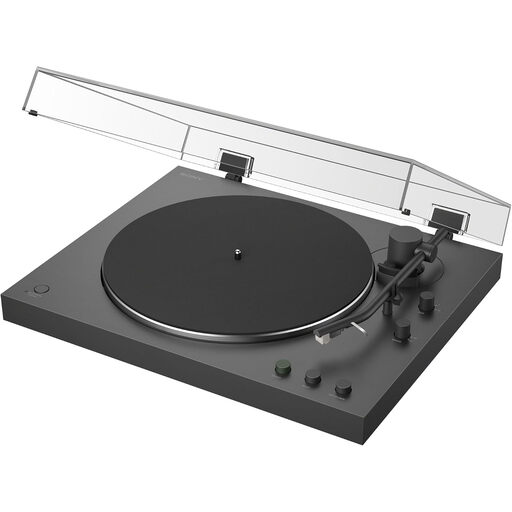
The PS-LX310BT is an example of an automatic two-speed turntable with a built-in phono preamp and Bluetooth connectivity.
The manual Planar 1 is a route for listeners using compatible hi-fi equipment.
The A2 is relevant if you want automatic operation and 78 RPM capability in the same turntable.
These Sony models are choices for listeners considering automatic playback of spoken-word records. Check each model’s speed settings and audio connections against your records and speakers before choosing.
 No image available
Consider this model if automatic playback would make listening to spoken-word records easier for you. Its title identifies Bluetooth and automatic playback; check its speed settings, audio output and compatibility with your speakers. If you own shellac 78s, also confirm 78 RPM playback and a compatible stylus.
 No image available
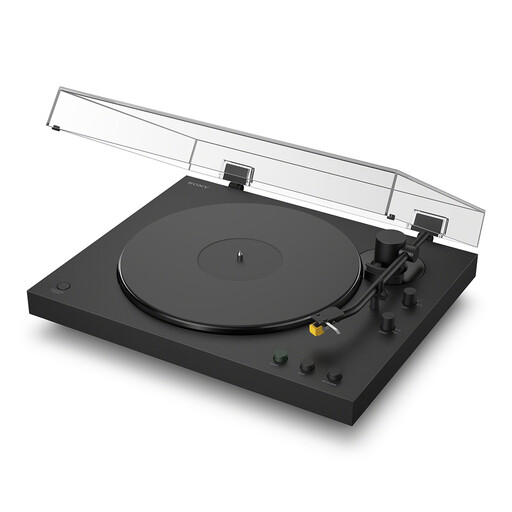
This is another option if you prefer automatic playback for spoken-word records. Its title identifies Bluetooth and automatic playback; compare its speed settings, audio output and speaker compatibility with your setup. For shellac 78s, confirm both 78 RPM playback and a suitable stylus.
Only records marked 78 RPM need that speed; spoken-word LPs commonly use 33⅓ RPM, and singles may use 45 RPM. For shellac 78s, also choose a compatible 78 stylus or cartridge rather than relying on the speed setting alone.
You can connect it to suitable powered speakers if the turntable supplies the line-level output they need. Otherwise, check whether your amplifier has a phono input or whether you need a separate phono stage; a built-in phono preamp does not mean speakers are included.
Automatic operation is useful if you want less tonearm handling at the start and end of a side, but it does not establish a sound-quality advantage. Check the exact functions: Sony lists auto start, stop and return for the PS-LX310BT, while Audio-Technica describes the AT-LP60X as fully automatic.
Handle discs by their edges and label areas, as the Library of Congress advises, and follow the cartridge maker’s guidance on stylus care and replacement. Check that a replacement fits your exact cartridge rather than assuming styli are interchangeable.