Hosts looking specifically for reduced fat
Check the claim on the exact current pack, then read its nutrition panel. Neither a small bar nor a different nutrition message establishes that it is reduced fat.


For a New Year’s Eve party, treat a cereal bar as a reduced-fat choice only when the exact current product makes that claim; a small portion, a “Light” name, or a high-fibre or protein claim does not establish it. Compare fat, saturated fat and sugars per 100g as well as per bar, then check the current ingredients and allergen warnings before serving guests.
Check the claim on the exact current pack, then read its nutrition panel. Neither a small bar nor a different nutrition message establishes that it is reduced fat.
Pack size and per-bar values help you plan what to put out. Compare the per-100g figures too: a smaller serving can have a lower amount of fat per bar without being a reduced-fat product.
Check each exact pack’s ingredients and “may contain” statements. Vegan or gluten-free wording does not answer every allergen question, particularly when several guests will share a snack table.
Start with the claim you need, compare the nutrition figures on the same basis, then check whether the pack works for the people you are serving.
| Priority | What to check | Your needs |
|---|---|---|
| Reduced-fat claim | Look for an explicit reduced-fat claim on the exact current product. Do not substitute “Light”, reduced saturated fat, high fibre or protein for a claim about reduced total fat. | I specifically want a bar presented as reduced fat, not simply one with another nutrition message. |
| Nutrition comparison | Read total fat, saturated fat and sugars per 100g for comparison, then check the figures and weight per bar for the portion served. | A small bar may suit my buffet, but I also want to know how it compares with a different-sized bar. |
| Party portions | Check the number of bars and their individual weights. Use the current per-bar nutrition declaration rather than treating a smaller serving as a reduced-fat claim. | I want to plan how many portions to put out without confusing portion size with the product’s nutrition claim. |
| Guest suitability | Read the current ingredients, declared allergens and any “may contain” warning for the exact variant. Check dietary claims separately from allergen information. | Guests may have different requirements, so I need to keep the pack information available for them to check. |
Those descriptions refer to different characteristics; they do not establish the bar’s total-fat claim. Action on Salt & Sugar’s November 2025 audit found that 55% of 458 snack bars sampled from 10 major UK retailers were high in saturated fat.
Check for an explicit reduced-fat claim on the exact pack, then compare its total fat, saturated fat and sugars per 100g and per bar.
Serving size can obscure differences between products. ASDA’s listing for Eat Natural Soft Fruit Bars Red Fruits gives 87 kcal and 1.6g fat per 25g bar, alongside 12.0g sugars per bar.
Use per-bar values to plan portions and per-100g values to compare differently sized bars.
Product ingredients and precautionary warnings vary. Nature Valley’s Apple & Cinnamon Crunchy bars, for example, may contain soya, wheat, peanuts and tree nuts, according to Nature Valley UK.
Keep the exact wrappers available and let guests with allergies check the current ingredients and warnings before choosing a bar.
Alpen’s UK FAQ lists Alpen Light Bars Chocolate & Orange among varieties no longer made. An older name is not a substitute for the details of a current pack.
Check the exact flavour, pack size and current nutrition declaration before comparing products.
Its UK range includes Crunchy and Protein bars, which offer different starting points for comparing nutrition panels.
Older Alpen bar names may appear in comparisons, so check the exact variety against a current pack.
The Frosties Cereal Milk Bar provides a small-bar example, rather than an established reduced-fat choice.
Graze discusses sugar and saturated fat in relation to its Oat Boost flapjacks.
Its bars show why portion size, sugars and allergens need checking alongside fat.
Trek protein flapjacks are relevant when vegan or protein-labelled snacks are the priority, rather than an assumed reduced-fat choice.
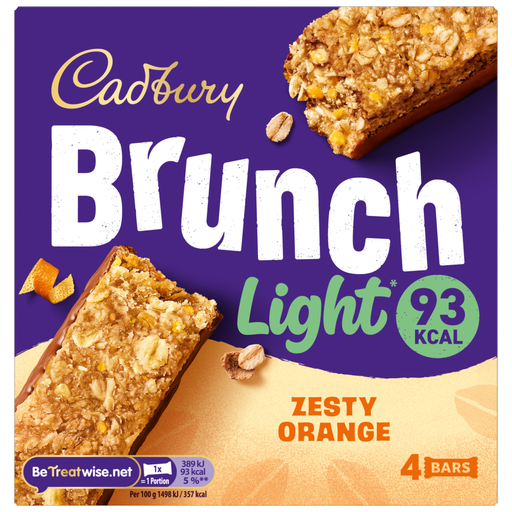
The Cadbury Brunch Light Orange four-pack is an option to examine for party portions. Check its current nutrition declaration before deciding whether it meets a reduced-fat requirement: “Light” in a product name is not, by itself, a reduced-fat claim.
 No image available
The 4pk, 104g pack gives you four bars to plan for the party. Check the exact pack’s fat and sugars per 100g, its allergen declaration and whether it explicitly makes a reduced-fat claim.
No. Saturated fat and total fat are different measures. If reduced total fat is your requirement, look for that claim on the exact current product and read its full nutrition panel rather than relying on a statement about saturated fat.
Not necessarily. Calories per bar depend in part on serving size and do not establish a reduced-fat claim. Kellogg's UK lists its Frosties Cereal Milk Bar at 99 kcal and 2.3g fat per 25g bar; check the exact product’s claims and per-100g figures separately.
Keep the current pack available so guests can check ingredients, declared allergens and any “may contain” warning. Check each flavour separately: the product examples here include bars containing or potentially containing milk, soya, cereals containing gluten, peanuts or tree nuts.
No. Those descriptions do not replace an individual allergen check. Read the exact pack’s ingredients and precautionary warnings, and let guests with allergies assess whether it meets their own requirements.