For a family curry, soup or sauce, choose a cooking coconut milk labelled reduced-fat or light if its declared fat content suits what you want to make; a carton coconut drink is not a guaranteed direct substitute. Waitrose & Partners lists essential Waitrose Reduced Fat at 6.2g fat per 100ml, and Sainsbury's lists Blue Dragon Light at the same figure and Amoy Reduced Fat at 8.8g per 100ml. Check the recipe quantity and coconut-extract content too: the fat figure alone cannot tell you how a sauce will turn out.
Who is this for?
Families making curries, soups or sauces
If coconut milk is part of dinner and you want to compare fat and saturates, start with products described as cooking coconut milk. Then check how much the recipe uses: a per-100ml label describes the product, not the whole meal.
Cooks weighing coconut content against fat
Products labelled light or reduced-fat do not all have the same composition. Sainsbury's lists 25% coconut extract for Blue Dragon Light, while Waitrose & Partners lists 23% for essential Waitrose Reduced Fat. Compare the labels if coconut content matters to your recipe, without assuming a particular texture from the percentage alone.
Households checking ingredients for guests
Check the exact pack's ingredients and precautionary allergen wording before serving someone with an allergy or intolerance. A dairy-free description does not answer questions about every other ingredient or possible allergen.
What should you check?
Choose the product type for the dish first, then compare labels using the same stated quantity and plan for the amount your recipe needs.
| Priority |
What to check |
Your needs |
| Fat and saturates |
Compare both figures per 100ml where products use that basis, then account for the amount going into the recipe. Waitrose & Partners and Sainsbury's list 6.2g fat per 100ml for essential Waitrose Reduced Fat and Blue Dragon Light; Sainsbury's lists 8.8g for Amoy Reduced Fat. |
I want to compare what goes into the dinner, not just the words 'reduced fat' on the tin. |
| Coconut content |
Read the coconut-extract percentage and the stated cooking uses. Waitrose & Partners lists 23% extract for essential Waitrose Reduced Fat, and Sainsbury's lists 25% for Blue Dragon Light; neither figure establishes how thick your finished sauce will be. |
If the sauce relies on coconut milk for body or flavour, I need to consider the recipe as well as the fat figure. |
| Cooking milk or drink |
Check whether the product is described for curries and sauces or as a coconut drink. Sainsbury's lists Koko Unsweetened as a UHT drink containing 9% coconut milk, while Alpro calls its carton product a coconut drink. |
I'm making a curry and want the ingredient the recipe calls for, rather than assuming a breakfast drink will behave the same way. |
| Recipe quantity |
Match the recipe's coconut-milk quantity to the pack size and check any serving information. Waitrose & Partners describes its 400ml reduced-fat can as two servings; that does not determine how many people a particular recipe will feed. |
Before shopping for family dinner, I want to know whether one can covers the amount in my recipe. |
| Ingredients and leftovers |
Read the current pack for ingredients, precautionary allergen wording and instructions after opening. Blue Dragon Light carries a 'may contain peanuts and nuts' statement; Joybuy's product information says to refrigerate it and use it within two days of opening. |
When serving guests with allergies, I need the exact pack information. I also want a plan for any coconut milk left after cooking. |
Common shopping mistakes
-
Assuming every reduced-fat tin has the same nutrition
The label describes each product, not a fixed level for the category. Sainsbury's lists Blue Dragon Light at 6.2g fat and 5.1g saturates per 100ml, compared with 8.8g fat and 7.7g saturates per 100ml for Amoy Reduced Fat.
Compare figures on the same per-100ml basis before considering how much the recipe uses. If a label uses per 100g instead, do not treat its number as a per-100ml figure.
-
Swapping in a carton coconut drink without checking the recipe
Alpro describes its carton product as a coconut drink, and Sainsbury's lists Koko Unsweetened as a UHT drink containing 9% coconut milk. Those descriptions do not establish a like-for-like result in a sauce made for cooking coconut milk.
For a curry or sauce, check that the product is intended for cooking. Use a coconut drink as a substitute only if the recipe allows for it or you are prepared to adjust the dish.
-
Buying a can without checking the recipe yield
A 400ml pack and a stated serving count do not tell you how much coconut milk your family's recipe requires.
Check the ingredient quantity before shopping and follow the pack's instructions for any remainder.
-
Treating dairy-free wording as a complete allergy check
Other allergen information can still matter. Blue Dragon Light has a precautionary statement that it may contain peanuts and nuts.
For anyone with an allergy, read the ingredients and precautionary wording on the pack you are serving rather than relying on a previous purchase.
Brand and product references
These references describe specific products and their labels, not every coconut product made by each brand.
Blue Dragon
Blue Dragon Light Coconut Milk is a cooking product described for curries, soups and sauces.
- Sainsbury's lists 6.2g fat, 5.1g saturates and 25% coconut extract per 100ml.
- The product carries a 'may contain peanuts and nuts' statement; check the current pack when an allergy is relevant.
essential Waitrose
The essential Waitrose Reduced Fat product is a 400ml cooking coconut milk.
- Waitrose & Partners lists 6.2g fat, 5.5g saturates and 23% coconut extract per 100ml.
- Its fat figure matches Blue Dragon Light's, but that does not establish an identical flavour or sauce texture.
Amoy
Amoy Reduced Fat is another cooking coconut milk to consider when comparing labels for a family dish.
- Sainsbury's lists 8.8g fat and 7.7g saturates per 100ml. Amoy describes this product as having 30% less fat than its own rich coconut milk.
- That brand comparison does not mean it has less fat than other reduced-fat products: the two cooking milks above each list 6.2g per 100ml.
M&S
M&S Reduced Fat Coconut Milk is a cooking-product reference with nutrition stated by weight.
- Marks & Spencer lists 9.3g fat, 8.2g saturates and 33% coconut extract per 100g.
- Its per-100g nutrition should not be presented as a per-100ml figure when comparing labels.
Koko
Koko Unsweetened Coconut UHT is a coconut-based drink rather than a directly comparable tin of cooking coconut milk.
- Sainsbury's lists 9% coconut milk in the drink and describes added calcium and vitamins D2 and B12.
- Its drink formulation does not establish how it will perform in a curry recipe calling for cooking coconut milk.
Joybuy cooking coconut milk
This reduced-fat canned coconut milk is an option to consider for curries, soups or sauces. Check its current pack against your recipe and any ingredient requirements before serving.
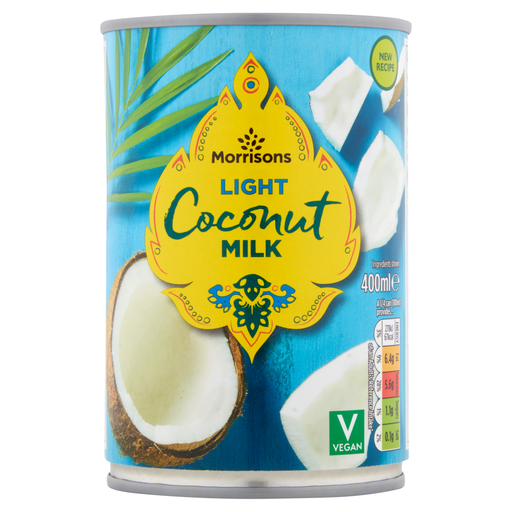 Image unavailable
Morrisons Reduced Fat Coconut Milk 400ml
A canned, reduced-fat coconut milk to consider when a family curry, soup or sauce calls for cooking coconut milk. Check the current pack's nutrition, ingredients and opened-pack instructions against your needs.
View on Joybuy
Questions about cooking coconut milk
Is reduced-fat cooking coconut milk the same as a coconut drink?
No. For a curry or sauce, look for a product described for cooking rather than assuming a carton drink will give the same result. Sainsbury's identifies the Alpro product as a coconut drink and lists Koko Unsweetened as a UHT drink containing 9% coconut milk.
Which of these cooking milks has the lowest declared fat?
In the products compared here, essential Waitrose Reduced Fat and Blue Dragon Light both declare 6.2g fat per 100ml, according to Waitrose & Partners and Sainsbury's. That is a comparison of these products, not a claim about every cooking coconut milk. Check how much your recipe uses before choosing a pack size.
How should I keep coconut milk after opening?
Follow the instructions on the pack you buy. Joybuy's product information for Blue Dragon Light says to refrigerate the contents and use them within two days of opening; do not assume the same period applies to a different product.
What should I check when serving someone with an allergy?
Read the exact pack's ingredients and precautionary allergen statement before cooking. Blue Dragon Light, for example, states that it may contain peanuts and nuts; a dairy-free description does not resolve that separate concern.


