Budget shoppers seeking reduced-fat potato crisps
Compare the total weight and number of bags you are likely to use, then read the fat figure per 100g. A reduced-fat claim describes a comparison with another product, not the amount of fat remaining.


For a budget shop, choose a pack size you will use and compare total fat per 100g rather than relying on a reduced-fat claim alone. Asda lists 13g fat per 100g for Walkers Oven Baked Sea Salt, while Waitrose lists 22.9g for its Reduced Fat Ready Salted crisps; neither meets the NHS low-fat guide of 3g or less per 100g.
Compare the total weight and number of bags you are likely to use, then read the fat figure per 100g. A reduced-fat claim describes a comparison with another product, not the amount of fat remaining.
Individual bags make portion labels straightforward to read. Asda lists Walkers Oven Baked Sea Salt as six 22g bags, with 96 kcal, 2.8g fat and 0.19g salt per bag; check the label of the flavour you choose.
If total fat is the deciding factor, compare products on the same per-100g basis. KETTLE Chips lists 29.5g fat per 100g for Lightly Salted, and Seabrook lists 30.4g for Sea Salted; those figures describe those particular products.
Start with the bags you will use, then compare nutrition panels and the ingredients for the specific flavour.
| Priority | What to check | Your needs |
|---|---|---|
| Pack format | Check the number of bags, weight per bag and total net weight. Decide whether individual portions or a case fit how you will use them. | I want enough individual bags for lunches without choosing more portions than I need. |
| Total fat | Read fat per 100g and the stated comparator for any reduced-fat claim. The NHS guide calls 3g or less per 100g low fat and more than 17.5g per 100g high fat. | A reduced-fat label is not enough for me; I want to know the fat figure in the crisps themselves. |
| Other label details | Compare salt and saturates per 100g and per bag. Check the current ingredients and allergen declaration for each flavour. | If the crisps are for someone with an allergy or intolerance, I need to check the exact pack before serving it. |
Waitrose Reduced Fat Ready Salted lists 22.9g fat per 100g. That exceeds the NHS high-fat guide of more than 17.5g per 100g, despite the product’s relative reduction claim.
Check fat per 100g alongside what the reduction is compared with. Different claims need not leave the products with the same fat content.
Six bags of 22g and six bags of 25g contain different total quantities, even though both packs have the same number of bags.
Read the total net weight and inner-bag weight, then choose the number of portions you expect to use.
Fat, saturates and salt are separate label values. Ingredients and allergen statements can also differ between flavours in a range.
Compare the nutrition panel on a per-100g and per-bag basis, and check the current pack’s allergen declaration when relevant.
Walkers Oven Baked Sea Salt is a six-pack option with a stated reduction in fat compared with regular potato crisps.
Waitrose Reduced Fat Ready Salted is a crinkle-cut potato crisp sold as six 25g bags.
Simply Roasted describes its potato crisps as roasted rather than fried and offers small bags in cases of 24 × 21.5g.
KETTLE Lightly Salted is a conventional potato-crisp reference for shoppers comparing it with a reduced-fat product.
Seabrook Sea Salted is a crinkle-cut potato crisp for comparison with products carrying a reduced-fat claim.
These two Walkers Oven Baked multipacks offer individual 22g bags in different flavour selections. Check each pack’s own nutrition and ingredients rather than applying figures for Sea Salt to the Variety Pack or Cheese & Onion flavour.
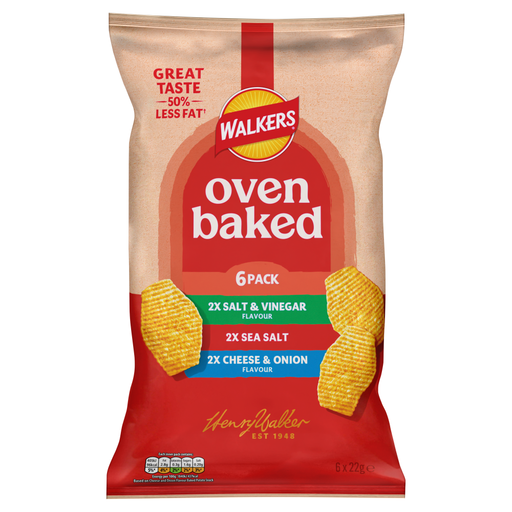 No image available
Six individual 22g bags suit shoppers choosing crisps for separate lunches or snacks. As this is a variety pack, check the nutrition, ingredients and allergen declaration for each included flavour.
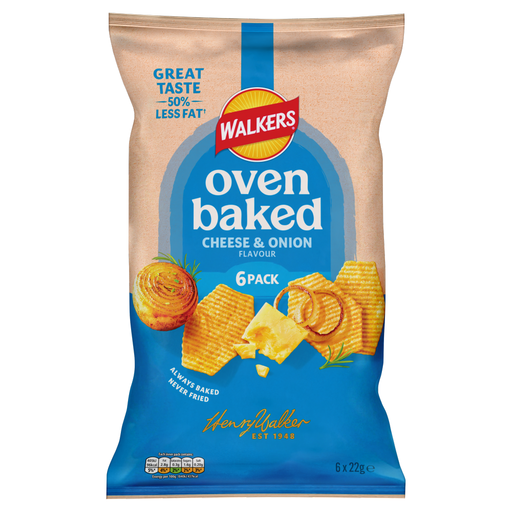 No image available
Six individual 22g bags offer the same stated bag size as the Variety Pack in a Cheese & Onion flavour. Read this flavour’s own nutrition panel and allergen declaration before choosing it.
No. The NHS guide defines low fat as 3g fat or less per 100g. Walkers lists 13g per 100g for Oven Baked Sea Salt, and Waitrose lists 22.9g for Reduced Fat Ready Salted, so neither meets that guide.
Check both the total net weight and the weight of each bag, then consider how many portions you will use. Asda lists Walkers Oven Baked Sea Salt as 6 × 22g; Waitrose lists its Reduced Fat Ready Salted crisps as 6 × 25g.
Their labels let you read the figures for one bag as well as per 100g. Asda lists 96 kcal, 2.8g fat and 0.19g salt for each 22g bag of Walkers Oven Baked Sea Salt; use the label for the flavour and bag size you are buying.
Read salt and saturates alongside total fat, and check the ingredients and allergen declaration for the exact flavour. A reduced-fat claim alone does not answer those separate questions.