What should you check first?
Filter by the exact pack’s gluten information, then compare fat on the same per-100g basis. Use serving figures to plan a portion, not to replace a like-for-like comparison.
| Priority | What to check | Your needs |
|---|
| Gluten labelling |
Read the exact flavour’s gluten-free claim, ingredients and precautionary allergen statements on the current pack. Coeliac UK warns that seasoning and cross-contact can affect crisps. |
I need to establish whether this particular pack fits my gluten-free shopping requirements before considering its fat content. |
| Fat comparison |
Check what any percentage reduction is compared with, then read fat per 100g where available. Simply Roasted’s 50% comparison is a range-level manufacturer claim against traditional fried crisps; M&S states 30% less fat for its Reduced Fat Ready Salted Crisps and lists 21.3g per 100g. |
A reduced-fat claim matters to me, but I want to know its comparison basis rather than assume different products’ percentages mean the same thing. |
| Snack type |
Check whether the product is a conventional potato crisp or a popped snack. Popchips UK describes Sea Salt & Vinegar as a popped potato snack and lists 13g fat per 100g; its page does not make a percentage reduced-fat comparison. |
I am willing to consider a different snack format if its ingredients, gluten labelling and nutrition suit what I am choosing. |
| Portion size |
Compare per-100g figures first, then check the amount in the pack or stated serving. M&S lists a 40g pack; Popchips UK lists a 23g serving for Sea Salt & Vinegar. |
For a lunchbox or a single snack, I want to understand the amount I might eat, not mistake a smaller serving for a lower fat concentration. |
Brand and product-line references
These references concern the named ranges or products, not every crisp made by each brand. A gluten-free claim and a reduced-fat claim answer different questions.
Simply Roasted
A roasted-crisp range to consider when both gluten labelling and a comparative fat claim matter.
- Simply Roasted says its crisps are gluten free and contain 50% less fat than traditional fried crisps.
- Check the chosen flavour’s current pack and per-100g panel before making a numerical comparison with another product.
M&S
Its Reduced Fat Ready Salted Crisps offer a conventional potato-crisp option with both claims stated on the product page.
- M&S labels the 40g product gluten free, states 30% less fat and lists 21.3g fat per 100g.
- M&S advises reading the pack because product information can change.
Popchips
Sea Salt & Vinegar is a popped potato snack for shoppers open to a different format from sliced potato crisps.
- Popchips UK labels this flavour gluten free and lists 13g fat per 100g and 3g per 23g serving.
- Its listed per-100g figure is not a percentage reduced-fat claim; check the current pack when comparing products.
Seabrook
A reference when stated gluten-free status matters more than finding a reduced-fat claim.
- Seabrook Crisps describes its listed crisps and snacks as gluten free and Coeliac UK accredited.
- Check the chosen pack’s fat panel separately rather than treating gluten-free accreditation as a fat comparison.
REAL Hand Cooked Crisps
A hand-cooked crisp range to assess for gluten labelling before comparing nutrition by flavour.
- REAL states that its whole range is gluten free.
- Read the selected pack’s fat value rather than assuming a gluten-free range is reduced fat.
Walkers
Its Oven Baked Sea Salt example shows why a lower-fat claim cannot stand in for gluten advice.
- Walkers states that Oven Baked Sea Salt has 50% less fat than regular potato crisps and lists 13g fat per 100g.
- The product page says it may contain wheat, gluten and barley, so its fat claim does not make this flavour a coeliac-shopping choice.
Tyrrells
The Sour Cream & Onion lentil crisp is another product whose fat claim must be considered separately from its allergen advice.
- Tyrrells states that this product contains 30% less fat than standard potato crisps on average and lists 19g fat per 100g.
- Its published allergen advice says it may contain gluten, making this flavour unsuitable for the coeliac-shopping choice described here.
Joybuy product options
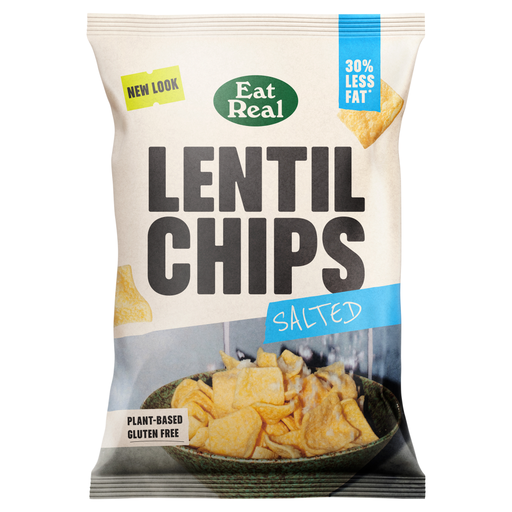
This lentil-chip option offers an alternative to potato crisps. For coeliac shopping, check the current pack’s gluten labelling and fat panel before deciding whether it meets both requirements.
 No image available
Eat Real Sea Salt Lentil Chips 95g
For a lentil-chip alternative to potato crisps, check the current pack’s gluten statement and fat per 100g against your coeliac-shopping and reduced-fat requirements. The listed pack size is 95g.
Joybuy
Questions about choosing crisps
Are ordinary potato crisps gluten free?
Not automatically. Coeliac UK says seasoning can contain wheat flour and manufacturing cross-contact can lead to a “may contain gluten” statement, so check the exact pack’s ingredients and allergen advice.
Are Walkers Oven Baked Sea Salt crisps suitable for this coeliac-shopping choice?
No: although Walkers states that this flavour has 50% less fat than regular potato crisps, its published allergen advice says it may contain wheat, gluten and barley. Check the current pack rather than relying on the fat claim.
What about Tyrrells Sour Cream & Onion Lentil Crisps?
Their lower-fat claim does not make this flavour a coeliac-shopping choice. Tyrrells states that it has 30% less fat than standard potato crisps on average, but its allergen advice says it may contain gluten.
Should I compare fat per serving or per 100g?
Use fat per 100g to compare products, then check the pack or serving size for the amount you plan to eat. M&S lists a 40g pack for its Reduced Fat Ready Salted Crisps, while Popchips UK gives a 23g serving for Sea Salt & Vinegar.
Do I need to read the label if I have bought the same crisps before?
Yes. M&S warns that ingredients, nutrition and allergen information can change; for a coeliac-shopping decision, use the current pack’s gluten and precautionary allergen statements.


