Hosts looking for less fat
Compare fat per 100g and read the basis of any reduction claim. A flavour name or a lower-salt claim does not answer the fat question.


If reducing fat is the priority, compare fat per 100g and check what any reduced-fat claim is measured against. Walkers UK lists 13g fat per 100g for Oven Baked Sea Salt and claims 50% less fat than regular potato crisps; its Lightly Salted product instead makes a lower-salt claim and lists 31g fat per 100g. Tyrrells Lentil Crisps offer a different base ingredient, so they suit a party only if guests are happy with a lentil crisp rather than a potato crisp.
The useful comparison depends on whether you want less fat, a familiar potato crisp or a product that meets guests’ dietary requirements.
Compare fat per 100g and read the basis of any reduction claim. A flavour name or a lower-salt claim does not answer the fat question.
If guests expect conventional potato crisps, check the product type before switching to a baked, formed snack or a lentil-based crisp. Dietary-suitability claims are a separate consideration from fat content.
Check the exact flavour’s current ingredients, suitability statements and precautionary allergen wording before serving it to guests with allergies or other dietary requirements.
Start with the nutrient you want to compare, then check the crisp type and the information on the pack you will serve.
| Priority | What to check | Your needs |
|---|---|---|
| Fat content | Compare fat per 100g across products, then read the comparison behind a reduced-fat claim. Walkers UK lists Oven Baked Sea Salt at 13g fat per 100g and claims 50% less fat than regular potato crisps. | I want to put out a crisp with a stated fat reduction, not rely on a name that merely sounds lighter. |
| Salt versus fat | Check the two nutrients separately. Walkers UK says Lightly Salted has 45% less salt than the average regular potato crisp, but lists 31g fat per 100g. | If salt matters more to me than fat, I’ll compare salt figures; if fat matters more, I’ll compare fat figures. |
| Portions | Use per-100g figures to compare products with different pack sizes. Use each pack’s per-serving figures when deciding how much to put out. | For a buffet where people may return for another handful, I want to understand both the product comparison and the labelled portion. |
| Crisp type | Read the product name and ingredients: a lentil crisp is not a potato crisp. Tyrrells lists 19–20g fat per 100g across its lentil flavours and claims 30% less fat than standard potato crisps on average. | I’m open to a lentil-based option, provided guests know it is different from the potato crisps they may expect. |
| Dietary suitability | Check the exact flavour’s ingredients, dietary statements and precautionary allergen label. KETTLE Chips describes Lightly Salted as gluten-free and suitable for vegans and vegetarians; Seabrook makes those statements for Sea Salted. | Some guests avoid particular ingredients, so I need to check the packs I actually serve rather than assume every flavour in a range is alike. |
Walkers UK lists 31g fat per 100g for Lightly Salted, despite its 45% less-salt claim. Its Oven Baked Sea Salt product lists 13g fat per 100g and makes a separate 50% less-fat claim.
Decide whether fat or salt is your priority, then compare that nutrient on the labels.
A figure per pack or serving reflects the amount in that portion as well as the product’s composition. It cannot replace a like-for-like per-100g comparison.
Compare products per 100g first, then use the labelled serving figures when planning what to put out.
Tyrrells’ lentil range has a different base ingredient from potato crisps. Its fat comparison does not make the products interchangeable for guests who want potato crisps.
Label the bowl clearly or serve lentil crisps alongside a potato option.
These examples illustrate different product types and label claims; a brand name alone does not establish the nutrition or suitability of every flavour.
Its Oven Baked Sea Salt and Lightly Salted products illustrate why reduced-fat and lower-salt claims need separate checks.
Its lentil range is an alternative when a non-potato crisp is acceptable.
Lightly Salted is a hand-cooked potato-crisp option for hosts considering dietary suitability alongside crisp type.
Sea Salted is a crinkle-cut potato crisp with stated dietary-suitability information.
REAL describes its hand-cooked crisp range as vegetarian and gluten-free.
Pipers describes a range of potato crisps with distinctive flavourings.
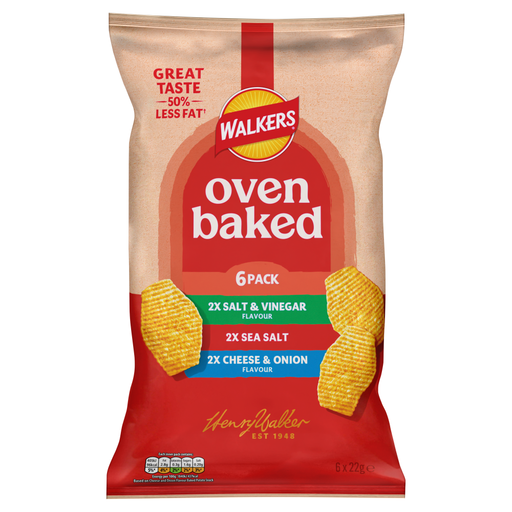
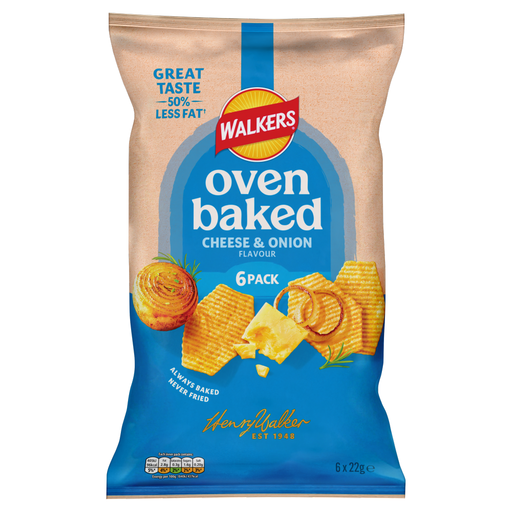
These Walkers Oven Baked multipacks offer a choice between assorted flavours and Cheese & Onion for a garden-party crisp bowl. Check the nutrition and ingredient labels for the exact pack and flavours you choose.
 No image available
The variety pack provides a choice of flavours for the party bowl. It contains six 22g packs; check each flavour’s nutrition and allergen information before serving.
 No image available
Choose this multipack if you want Cheese & Onion rather than assorted flavours. It contains six 22g packs; check this flavour’s nutrition and allergen label for your guests.
No. Walkers UK says its Lightly Salted product has 45% less salt than the average regular potato crisp, but lists 31g fat per 100g. Its Oven Baked Sea Salt product lists 13g fat per 100g and makes a separate 50% less-fat claim against regular potato crisps.
They can be another option if guests are happy with a lentil-based crisp. Tyrrells lists 19–20g fat per 100g across its lentil flavours and claims 30% less fat than standard potato crisps on average, but the products are not potato crisps. Check the chosen flavour’s label for its other nutrition figures.
Check the exact pack and flavour’s ingredients, suitability statements and precautionary allergen wording before serving. KETTLE Chips describes Lightly Salted as gluten-free and suitable for vegans and vegetarians; that statement does not establish the suitability of a different product. The Food Standards Agency explains that precautionary allergen labelling signals that an allergen could be unintentionally present.
No. England’s Food (Promotion and Placement) Regulations concern specified retail promotions, not what a host serves at a private party. Department for Education school-food guidance addresses food provided in state-funded schools in England, which is a separate setting. Neither framework makes every potato crisp subject to the same rule simply because it is a crisp.