Hosts looking for a lower-fat option
If reducing fat is the priority, compare a product-specific claim with the fat declaration per 100g. A name such as “lightly salted” describes a different attribute.


If reducing fat is your main aim, look for a product-specific comparison claim and check the fat value per 100g: Walkers says its Oven Baked Sea Salt crisps have 50% less fat than regular potato crisps and lists 13g per 100g. No-salt and lightly salted crisps address a different priority, while dietary labels and allergen information need checking on each flavour before it goes on the party table.
If reducing fat is the priority, compare a product-specific claim with the fat declaration per 100g. A name such as “lightly salted” describes a different attribute.
A no-salt or lower-salt crisp can sit alongside a reduced-fat option. Check fat and salt separately so guests can tell which choice meets their preference.
Check the exact flavour’s gluten-free, vegan or vegetarian declaration, ingredients and allergen advice. Keep the pack available when serving crisps in bowls.
Choose the attribute that matters for each bowl, then compare labels on the same per-100g basis before deciding how much to serve.
| Priority | What to check | Your needs |
|---|---|---|
| Reduced fat | Look for a product-specific reduced-fat claim and its comparison basis. Compare fat per 100g, then check the pack or serving size. | I want a lower-fat crisp, not one that merely sounds lighter. Walkers UK states that Oven Baked Sea Salt has 50% less fat than regular potato crisps and lists 13g fat per 100g. |
| Salt | Compare salt per 100g and check the stated meaning of a no-salt or lower-salt claim. Read the fat value separately. | A guest may prefer a salt-focused option. Tyrrells lists 0.06g salt and 29.5g fat per 100g for Naked (No Salt); Walkers UK lists 31g fat per 100g for Lightly Salted. Neither salt description establishes reduced fat. |
| Dietary suitability | Check the exact flavour’s dietary declaration, ingredients and allergen advice. Keep its packaging identifiable if crisps are decanted. | I need guests to be able to identify a crisp that fits their stated requirements. KETTLE Chips labels Lightly Salted gluten-free, vegan and vegetarian; Seabrook gives those declarations for Sea Salted. Check the current packs before serving. |
Salt and fat figures answer different questions. Walkers UK lists 31g fat per 100g for Lightly Salted, while Tyrrells lists 29.5g per 100g for Naked (No Salt).
If reducing fat is the aim, check the fat declaration and a product-specific comparison claim rather than relying on the salt wording.
KETTLE Lightly Salted and Seabrook Sea Salted carry dietary-suitability declarations, but their makers list 29.5g and 30.4g fat per 100g respectively.
Select for a guest’s dietary requirement using the exact product label, then assess fat and salt separately.
Guests cannot check a packet’s ingredients or warnings if different crisps are put out without identifiable packaging.
Check each current pack before serving, identify the bowls and retain the packs for anyone who needs to read them.
These examples show why the exact product matters: reduced-fat claims, salt figures and dietary declarations are not interchangeable.
Oven Baked Sea Salt offers a product-specific fat comparison; Lightly Salted follows a separate salt-focused route.
Naked (No Salt) is a salt-focused choice, made with potatoes and sunflower oil.
Lightly Salted is a hand-cooked option with product-level dietary declarations.
Sea Salted provides a plain-flavour option with dietary declarations on the product.
Pipers describes its range as boldly flavoured crisps, making flavour the relevant reason to consider it for a party selection.
REAL describes its range as vegetarian and gluten-free; check the particular flavour for the rest of the label information.
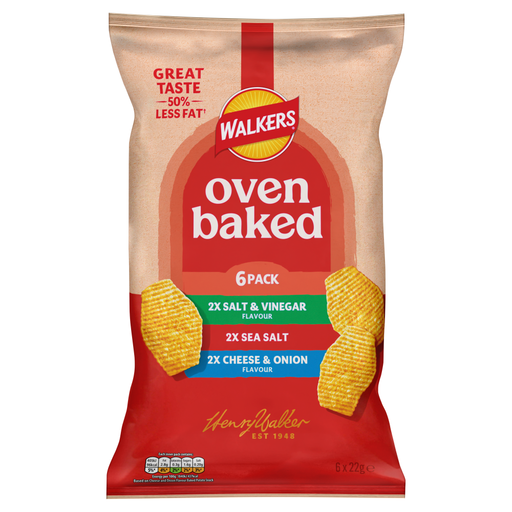
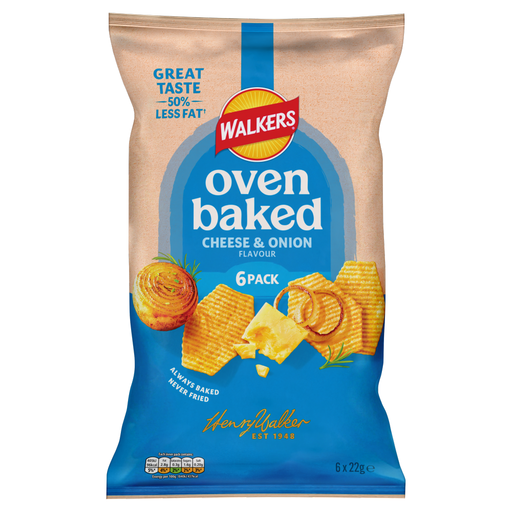
These Walkers Oven Baked multipacks offer different ways to put individually packed crisps on a party table. Check each current pack’s nutrition, ingredients and allergen advice against your guests’ needs.
 No image available
The 6 x 22g variety pack provides individually packed crisps for a party table. Check the fat and salt values and the allergen advice for each flavour on the current pack.
 No image available
This 6 x 22g pack gives guests individually packed Cheese & Onion crisps. Check its current fat and salt declarations and allergen advice before offering it to guests with dietary requirements.
No: it describes salt, not fat. Walkers UK states that its Lightly Salted crisps have 45% less salt than the average regular potato crisp, but lists 31g fat per 100g. Check the fat value and a product-specific reduced-fat claim if fat is your priority.
Not necessarily. Tyrrells lists 0.06g salt and 29.5g fat per 100g for Naked (No Salt). Choose it on the basis of its salt information, not as a substitute for a reduced-fat claim.
Check each current pack’s ingredients and allergen advice first, keep flavours identifiable and retain the packaging for guests who need to read it. Do not assume that the declarations for one flavour apply to another.