Snackers comparing fat content
If you want a crisp-style afternoon snack with less fat than a conventional fried potato crisp, compare the figures per 100g and for the bag you expect to eat.


If cutting fat is your main aim, compare oven-baked potato crisps on a per-100g basis rather than relying on a smaller bag of ordinary crisps: Walkers UK lists 13g fat per 100g for its Oven Baked Sea Salt and Salt & Vinegar varieties, against 31g per 100g for its Ready Salted crisps. A smaller bag changes the amount you eat, not the product’s per-100g figure. Check salt, allergens and the size of the bag you plan to eat before choosing.
If you want a crisp-style afternoon snack with less fat than a conventional fried potato crisp, compare the figures per 100g and for the bag you expect to eat.
A lower-fat option is not necessarily a lower-salt one. Check both entries on the nutrition label for the exact flavour.
Ingredients and may-contain statements can differ between flavours. Read the current pack if milk, barley or other declared allergens affect your choice.
Start with the type of snack you want, then compare nutrition per 100g and the amount in the bag. A smaller portion and a lower-fat recipe answer different questions.
| Priority | What to check | Your needs |
|---|---|---|
| Fat and bag size | Compare fat per 100g on the same basis, then check fat per bag and the bag’s weight. Walkers UK lists 13g fat per 100g for Oven Baked Sea Salt and Salt & Vinegar, versus 31g per 100g for Ready Salted. | I want to cut fat while keeping a crisp-style afternoon snack. If I would rather have ordinary crisps, I can choose the amount I eat without treating that as a lower-fat recipe. |
| Salt | Read salt per 100g for the exact product. Seabrook Crisps lists 2.18g per 100g for Salt & Vinegar Crunchies; Walkers UK lists 0.85g per 100g for Oven Baked Sea Salt. A less-salt claim describes salt, not fat. | Salt matters to me as well as fat, so I want to compare both figures rather than choose by the word ‘baked’ or ‘lightly’. |
| Snack format | Check whether the label describes potato crisps, potato snacks or lentil crisps. Seabrook describes Crunchies as potato snacks; Tyrrells’ lentil range is not a potato-crisp range. | I want to know whether I am buying conventional crisps or a different type of savoury snack. |
| Ingredients | Check the ingredients and allergen statement for each flavour. Walkers UK lists milk and barley malt vinegar in Oven Baked Salt & Vinegar; Seabrook Crisps gives a may-contain statement for several allergens on Salt & Vinegar Crunchies. | Before choosing a flavour, I need to check whether its current label suits my ingredient and allergen requirements. |
| School settings | Check the applicable nation, school setting and exact product against current requirements. Department for Education guidance addresses food provided in state-funded schools in England; Department of Health and Social Care guidance addresses HFSS retail promotions and placement for businesses selling to England. | If the snack is for a school setting, I cannot use a reduced-fat claim alone to decide whether it meets the relevant requirements. |
Fat and salt can tell different stories. Seabrook Crisps lists 16.4g fat and 2.18g salt per 100g for Salt & Vinegar Crunchies.
Compare fat, saturates, salt and energy on the same per-100g basis, then check the bag size.
Walkers UK lists 31g fat per 100g for Lightly Salted, despite its less-salt claim. That is the same fat figure listed for Walkers Ready Salted.
Choose according to the measure you actually want to compare, and read its value on the nutrition table.
Seabrook Crunchies are labelled potato snacks, while Tyrrells’ lentil crisps use a different main ingredient from potato crisps.
Check the product description and ingredients before comparing alternatives with conventional crisps.
Nutrition and allergen declarations need to be read for the flavour being bought. Walkers Oven Baked Salt & Vinegar, for example, lists milk and barley malt vinegar.
Use the current pack to confirm ingredients, allergens, nutrition and bag weight.
Its Oven Baked Sea Salt and Salt & Vinegar products provide potato-based, crisp-style options for comparing fat content.
Salt & Vinegar Crunchies are labelled potato snacks rather than conventional potato crisps.
Its lentil crisps offer a different snack format for buyers willing to move beyond potato crisps.
Its potato crisps are relevant if flavour is the deciding factor rather than a reduced-fat claim.
A hand-cooked crisp range to consider when its stated ingredients and dietary attributes matter to your choice.
These Walkers Oven Baked multipacks are options for an afternoon snack when you want individual bags. Compare the nutrition and allergen information for the exact flavour rather than assuming every multipack has the same figures.
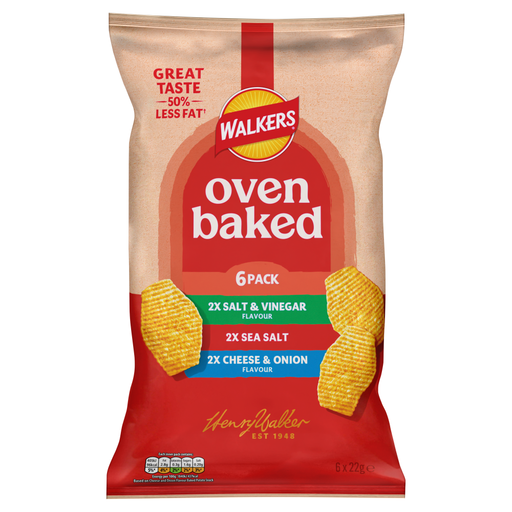 No image available
The individual bags offer a choice of flavours for an afternoon snack. Check the nutrition and allergen statement for the flavour you select, particularly if choosing Salt & Vinegar or Cheese & Onion.
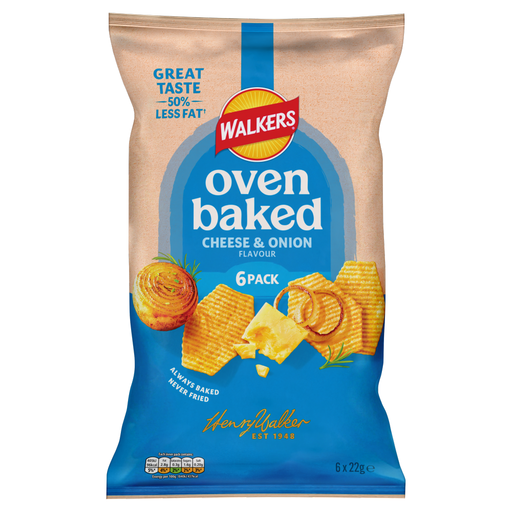 No image available
The six individual bags let you choose a single 22g bag for an afternoon snack. Check the current Cheese & Onion pack’s nutrition, ingredients and allergen declaration before buying.
No. A baked or reduced-fat description does not settle the salt comparison. Walkers UK lists 0.85g salt per 100g for Oven Baked Sea Salt, while Seabrook Crisps lists 2.18g per 100g for Salt & Vinegar Crunchies; check the exact product’s label.
No. Walkers UK says Lightly Salted has 45% less salt than average regular potato crisps, but lists 31g fat per 100g. Compare the fat figure separately if cutting fat is your aim.
Check the declaration for the exact flavour. Walkers Oven Baked Salt & Vinegar lists milk and barley malt vinegar; Seabrook Salt & Vinegar Crunchies carries a may-contain statement for milk, soya, sulphites and cereals containing gluten.
No. For England, Department for Education school-food guidance concerns food provided in state-funded schools, while Department of Health and Social Care HFSS guidance concerns retail promotion and placement for businesses selling to England. Check the applicable nation, setting, current requirements and exact product rather than treating a reduced-fat claim as permission.