Snackers comparing fat and portion size
If you want crisps in an individual mid-morning portion, compare the fat figure per 100g before looking at the bag size. Walkers lists 13g fat per 100g and 2.8g per 22g serving for Oven Baked Cheese & Onion.


For a mid-morning portion, compare fat per 100g first, then check the amount in the bag you intend to eat. Walkers lists 13g fat per 100g and 96 kcal per 22g serving for its Oven Baked Cheese & Onion crisps; Tyrrells’ lentil crisps offer a different format, with the listed flavours at 19g to 20g fat per 100g. A reduced-fat claim compares products against a benchmark: it does not, by itself, establish that a crisp is low fat, non-HFSS or suitable as school-provided food.
If you want crisps in an individual mid-morning portion, compare the fat figure per 100g before looking at the bag size. Walkers lists 13g fat per 100g and 2.8g per 22g serving for Oven Baked Cheese & Onion.
These formats need a like-for-like comparison. Tyrrells lists 19g to 20g fat per 100g for the lentil flavours covered here, while Walkers lists 13g per 100g for Oven Baked Cheese & Onion; their stated serving sizes also differ.
A retail snack and food provided by a school raise different questions. Department for Education guidance addresses school-provided food in England; check the rules and school policy that apply to the particular setting rather than relying on a reduced-fat claim.
Start with the per-100g nutrition panel to compare different pack sizes, then look at the portion you would actually eat.
| Priority | What to check | Your needs |
|---|---|---|
| Fat comparison | Compare total fat per 100g on the exact flavours. Check what a reduced-fat claim is compared with; it is not the same as a low-fat classification. | I want to compare crisps fairly even when the bags are different sizes. Walkers lists 13g fat per 100g for Oven Baked Cheese & Onion; Tyrrells lists 19g to 20g per 100g for the lentil flavours covered here. |
| Snack portion | Read the stated serving weight, fat and energy per serving, then compare that weight with the amount you plan to eat. The NHS notes that a manufacturer’s portion may differ from yours. | A single bag may suit my mid-morning break, but I want its nutrition figures to reflect the amount I will eat. Walkers lists 96 kcal per 22g serving for Oven Baked Cheese & Onion. |
| Salt | Compare salt per 100g and per serving alongside fat. Do not infer salt content from a reduced-fat claim or a flavour name. | Fat is not my only comparison point. Tyrrells lists 0.63g salt per 30g serving for Sweet Chilli & Red Pepper Lentil Crisps. |
| Ingredients and dietary labels | Check the current pack for ingredients, allergens and may-contain statements. Confirm any vegan, vegetarian or gluten-free label on the exact flavour. | If an ingredient or dietary label affects my choice, I need to check the particular bag rather than assume every flavour in a range is the same. |
| School setting | Establish which UK nation’s rules apply and whether the snack is provided by the school or packed from home. Do not use a reduced-fat claim to decide school-food suitability. | If I am choosing a snack for school, I need to distinguish an ordinary retail purchase from food supplied under the school’s rules. |
A relative claim describes a comparison, not an absolute fat level. The NHS uses 3g fat or less per 100g as its low-fat guide for solid foods; Walkers Oven Baked Cheese & Onion lists 13g per 100g despite its stated 50% less-fat comparison.
Use the claim to identify a product worth comparing, then read fat per 100g and the figures for your intended serving.
Salt varies between the named products. Tyrrells lists 0.63g per 30g serving for Sweet Chilli & Red Pepper Lentil Crisps, so its reduced-fat claim does not answer the salt question.
Compare salt on the same per-100g basis, then check the amount in the portion you expect to eat.
Manufacturer panels list 29.5g fat per 100g for KETTLE Lightly Salted, 30.4g for Seabrook Sea Salted, 32g for McCoy’s Salted and 30.0g for REAL Sea Salt. Those named products serve as different comparison points from Walkers Oven Baked Cheese & Onion at 13g per 100g.
Read the nutrition panel for the exact product instead of judging fat content from “lightly salted”, “sea salted” or “hand cooked”.
Department of Health & Social Care guidance describes restrictions on certain retail and online promotions in England. Department for Education guidance and the School Food Regulations address food provided in relevant English schools: the two frameworks answer different questions.
For a school-provided snack, check the applicable school-food rules and the school’s policy. A reduced-fat claim alone does not settle that decision.
These manufacturer figures refer to the named products and flavours, not every crisp sold under each brand.
Oven Baked Cheese & Onion is a baked potato-crisp option for comparing fat per 100g and a stated 22g serving.
The lentil crisps offer a different format for shoppers comparing reduced-fat claims.
Lightly Salted is a hand-cooked crisp to compare when its stated dietary labels matter more to your choice than a reduced-fat claim.
Sea Salted is a standard potato crisp with product-specific dietary labels.
Salted is a ridged standard crisp for shoppers considering that format rather than selecting by a reduced-fat claim.
REAL Sea Salt is a hand-cooked option for shoppers comparing ingredients and the stated vegetarian label.
These options include two Walkers Oven Baked multipacks and one 85g PopChips bag. Compare the exact pack’s nutrition panel and the amount you intend to eat; the larger bag calls for particular attention to serving size.
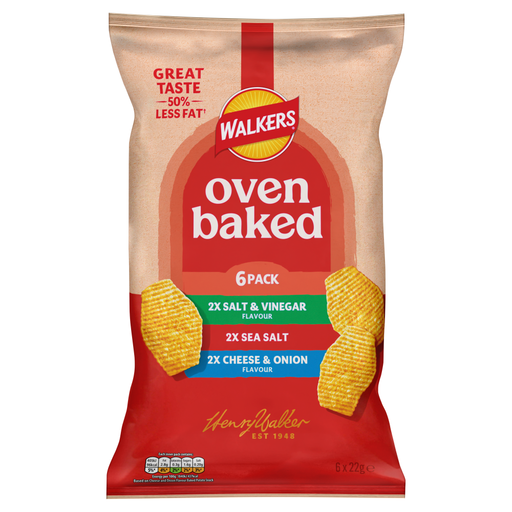 No image available
Six individually packed 22g bags give you a defined pack size for a mid-morning snack. Check the nutrition and allergen information for each flavour in the variety pack rather than applying figures from one flavour to them all.
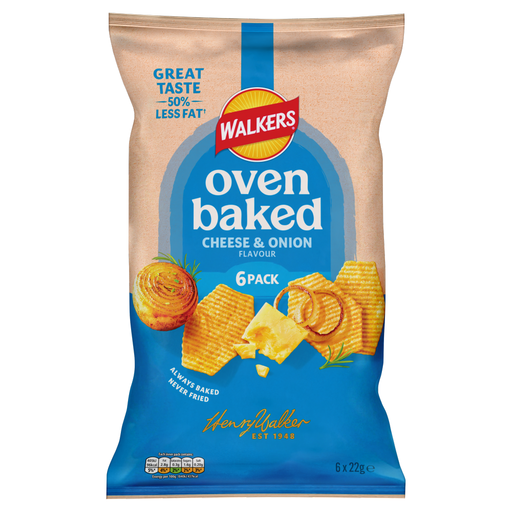 No image available
Six 22g bags make the stated serving size straightforward to compare with your planned snack. Walkers lists 13g fat per 100g, and 2.8g fat and 96 kcal per 22g serving for Oven Baked Cheese & Onion; the flavour contains milk, so check the current pack’s full allergen statement.
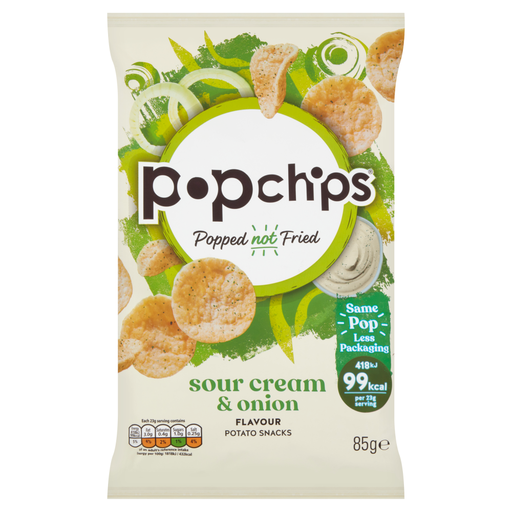 No image available
The 85g bag gives you a different pack format from the individual 22g Walkers bags. Before choosing it for one mid-morning snack, check its nutrition panel and decide how much of the bag you plan to eat; check the current pack for allergens too.
No. “Reduced fat” is a comparison claim. The NHS low-fat guide for solid foods is 3g fat or less per 100g, while Walkers lists 13g per 100g for Oven Baked Cheese & Onion despite its stated 50% less-fat comparison. Read the per-100g panel as well as the claim.
Compare fat, saturated fat, salt and energy per 100g, then check the stated serving weight against the amount you will eat. The NHS notes that a manufacturer’s suggested portion may differ from your own.
No. Department of Health & Social Care guidance for England’s retail and online promotion restrictions concerns products classified under the applicable HFSS framework. A reduced-fat claim alone does not establish an individual crisp’s classification; that requires the applicable method and current product information.
No. England’s retail HFSS promotion restrictions and its school-food requirements address different settings. Department for Education guidance covers food provided in state-funded schools in England; for a school snack, check the applicable school-food rules and local policy, and distinguish school-provided food from a home-packed lunch. Do not assume the same rules apply throughout the UK.
Read the ingredients and may-contain statement on the exact current pack. Walkers lists milk for Oven Baked Cheese & Onion and gives precautionary allergen information; a label for another flavour or brand is not a substitute.