What should you check?
Compare nutrition per 100g before using the pack figures to decide what fits a particular coffee break. Keep fat, salt and portion size as separate checks.
| Priority | What to check | Your needs |
|---|
| Flavour |
Choose between plain ready salted and flavours such as vinegar, chilli or onion. Read the exact product name; a fat claim does not tell you how it will taste. |
I want a flavour I would choose alongside coffee, not one selected solely for its front-of-pack claim. |
| Fat content |
Check the reduced-fat wording and fat per 100g. Simply Roasted lists 13.1g per 100g for Sea Salt & Cider Vinegar; M&S lists 21.3g per 100g for Reduced Fat Ready Salted. These are different products and pack sizes. |
For a reduced-fat choice, I want to compare the nutrition panels rather than assume every crisp labelled “lightly salted” has less fat. |
| Salt |
Read salt independently of fat, using the same per-100g basis when comparing products. Walkers lists 0.17g salt per 25g pack for Less Salt Salt & Vinegar, alongside 30g fat per 100g. |
Salt matters to me too, so I need to check both figures before choosing a pack. |
| Pack size |
Check whether the nutrition figure describes a serving or the whole pack. Simply Roasted lists a 21.5g serving; the M&S Ready Salted pack is 40g. Compare per 100g first, then the amount you intend to eat. |
I would rather take a defined amount on my commute than mistake a per-serving figure for a whole-pack figure. |
| Ingredients |
Read the current ingredients, emphasised allergens and any may-contain advice for the exact flavour. Check dietary statements on that product rather than across a brand range. |
If an ingredient or dietary statement affects my purchase, I need information for the pack in my hand. |
Brand and product-line references
These examples illustrate different product choices; a brand name alone does not establish a reduced-fat claim for every flavour.
Walkers
Less Salt Salt & Vinegar is a 25g-pack option for comparing salt, rather than a reduced-fat example.
- Walkers states 45% less salt than the average for regular potato crisps and lists 0.17g salt per 25g pack.
- The same product lists 30g fat per 100g and may-contain advice for milk, wheat, gluten, barley, soya, celery and mustard.
Tyrrells
Its Lentil Crisps offer a different base from conventional potato crisps.
- Tyrrells claims 30% less fat than standard potato crisps on average, using a comparison conducted in March 2021. The listed lentil flavours contain 19g–20g fat per 100g.
- Those flavours also list 2.0g–2.1g salt per 100g; check the particular flavour when comparing salt.
KETTLE Chips
Lightly Salted is a potato-crisp option with specific dietary suitability statements, not a reduced-fat example.
- KETTLE states that Lightly Salted is gluten-free and suitable for vegans and vegetarians.
- It lists 29.5g fat and 0.7g salt per 100g. “Lightly Salted” does not describe its fat content.
Seabrook
Sea Salted is a crinkle-cut potato crisp with product-specific dietary statements.
- Seabrook states that Sea Salted is gluten-free and suitable for vegetarians and vegans.
- It lists 30.4g fat and 1.3g salt per 100g; assess it by those figures rather than treating its dietary suitability as a fat claim.
McCoy’s
Salted is a ridged potato crisp to compare by its own nutrition and allergen information.
- McCoy’s lists nutrition for Salted, including 32g fat per 100g.
- The product lists 1.3g salt per 100g and may contain milk, soya, gluten and mustard.
Real Crisps
Assess a Real Crisps product by its exact flavour and current pack rather than by the brand name.
- For a reduced-fat choice, check the pack’s fat per 100g, any comparative claim, ingredients and allergen advice.
Joybuy snack options
These Joybuy options include crisp and cracker snacks in sharing packs, multipacks and smaller packs. If reduced fat is your main reason for buying, compare the exact pack’s claim and nutrition panel; a product name or pack format alone does not establish its fat content.
 No image available
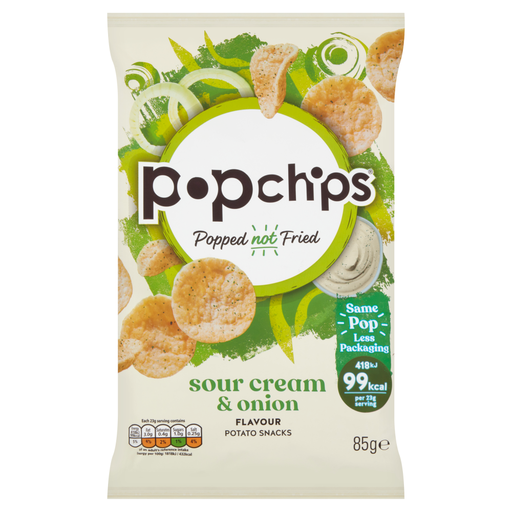
PopChips Sour Cream & Onion 85g
The 85g pack gives you a sour cream and onion option to portion out for a coffee break. Check the pack’s serving size, fat figure and ingredients if those determine your choice.
View on Joybuy
 No image available
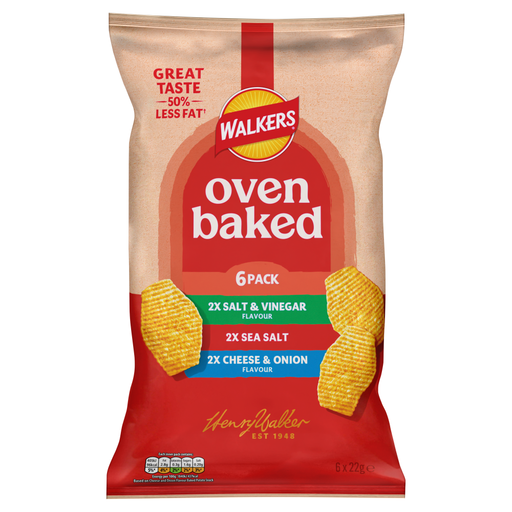
Walkers Oven Baked Variety Pack Crisps 6 × 22g
Six 22g bags make it possible to take one pack on a commute. This is a variety pack, so check each flavour’s nutrition and allergen information rather than assuming the bags are identical.
View on Joybuy
 No image available
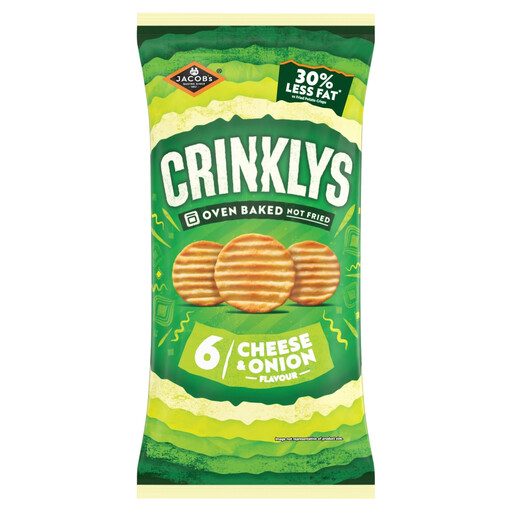
Jacob’s Crinklys Cheese & Onion Snacks 6 × 23g
The multipack contains six 23g bags, a format that lets you take one for a coffee break. Check the exact snack’s fat per 100g and ingredient list if you are comparing it with potato crisps.
View on Joybuy
 No image available
Orion Crackers Low Sugar, Seaweed Flavour 33g
This 33g seaweed-flavour cracker pack is a different snack format from conventional crisps. Its low-sugar name is not a reduced-fat claim; use the fat figure on the pack for that comparison.
View on Joybuy
 No image available
Orion Crackers Low Sugar, Tomato Sauce + Seaweed 2 × 33g
The two 33g packs offer tomato sauce and seaweed flavours for separate snack breaks. Check each flavour’s ingredients and nutrition panel; the low-sugar wording does not establish a reduced-fat claim.
View on Joybuy
Questions about crisps and labels
Does “reduced fat” mean “low fat”?
No. “Reduced fat” describes a comparison, not the same thing as a “low fat” description. Simply Roasted claims 50% less fat for its Sea Salt & Cider Vinegar crisps and lists 13.1g fat per 100g; use the nutrition figure to understand the particular product.
Are Walkers Less Salt crisps reduced fat?
Walkers’ Less Salt Salt & Vinegar product is presented as a salt comparison: Walkers claims 45% less salt than the average for regular potato crisps and lists 0.17g salt per 25g pack. It also lists 30g fat per 100g, so the salt claim does not answer a reduced-fat brief.
How do I compare a 21.5g serving with a 40g pack?
Compare fat per 100g first, then check the amount for the serving or pack you intend to eat. Simply Roasted lists 13.1g fat per 100g and 2.8g per 21.5g serving; M&S lists 21.3g fat per 100g for its Reduced Fat Ready Salted crisps, sold in a 40g pack.
Should I check allergens if I buy the same brand regularly?
Yes—read the current information for the exact product and flavour. Walkers lists may-contain advice for milk, wheat, gluten, barley, soya, celery and mustard on its Less Salt Salt & Vinegar product; do not assume another flavour has the same advice.
Are vegan or gluten-free crisps necessarily reduced fat?
No. Dietary suitability and fat content are separate product details. KETTLE says Lightly Salted is gluten-free and suitable for vegans, while listing 29.5g fat per 100g; Seabrook says Sea Salted is gluten-free and suitable for vegans, while listing 30.4g fat per 100g.


