Parents choosing individual snack packs
An inner bag has a stated weight, making it easier to check the portion and its nutrition information. A baked label alone does not tell you the fat, salt or allergen details for every flavour.


If crisps are the occasional packaged snack a child wants, a clearly labelled reduced-fat multipack gives you a stated portion to compare: Walkers says its Oven Baked Sea Salt crisps have 50% less fat than regular potato crisps and lists 2.8g fat and 0.19g salt per 22g bag. Check salt and allergens on the exact pack too; for routine snacks, NHS Healthier Families recommends fruit and vegetables.
An inner bag has a stated weight, making it easier to check the portion and its nutrition information. A baked label alone does not tell you the fat, salt or allergen details for every flavour.
A reduced-fat claim answers only part of the question. Compare fat per 100g on like-for-like labels, then check salt for the particular crisp and portion you are considering.
Check the ingredients and precautionary allergen statement for each current flavour. Vegetarian, vegan and gluten-free descriptions apply to the labelled product, not automatically to every crisp from the same brand.
For a reduced-fat half-term crisp snack, compare fat on the same weight basis before checking salt, the inner-bag size and the exact flavour.
| Priority | What to check | Your needs |
|---|---|---|
| Fat comparison | Look for a quantified claim with a named comparator, then compare fat per 100g. Walkers says Oven Baked Sea Salt has 50% less fat than regular potato crisps and lists 13g fat per 100g. | I want to know what a lower-fat claim is being compared with, rather than choosing by a lighter-sounding name. |
| Salt | Read salt per 100g and per bag on the exact flavour. Walkers lists 0.85g per 100g and 0.19g per 22g bag for Oven Baked Sea Salt; those figures should not be applied to other flavours. | Reducing fat matters to me, but I also want to compare the salt in the bag being served. |
| Portion size | Check the weight of each inner bag, not just the number of bags in a multipack. Use per-100g figures to compare products and per-bag figures to understand that portion. | For a half-term snack, I would rather know the amount in one bag than treat a multipack or sharing bag as one serving. |
| Snack choice | Consider whether crisps are being chosen for an occasional savoury packaged snack or as a routine snack. NHS Healthier Families recommends fruit and vegetables for children’s snacks and suggests plain popcorn, plain rice cakes or raisins as swaps for crisps. | Sometimes crisps are what my child wants; on other days, a different snack would meet the need. |
| Ingredients and allergens | Read the ingredient list and any may-contain statement on each current flavour. Do not extend one flavour’s vegetarian or other dietary label to the whole range. | If an allergy or dietary preference affects the choice, I need to check the particular pack before serving it. |
A baking description does not tell you the salt content or portion size. Walkers lists 13g fat and 0.85g salt per 100g for Oven Baked Sea Salt, so both figures matter when comparing it with another product.
Check the quantified fat claim, then read fat and salt per 100g and per inner bag on the flavour you are buying.
A 22g baked-crisp bag and a 30g lentil-crisp serving contain different amounts of food. Their per-bag figures alone are not a like-for-like product comparison.
Compare labels per 100g first, then use each bag’s weight and per-serving figures to assess the portion.
A reduced-fat claim compares fat with another product; it does not make crisps interchangeable with fruit or vegetables. NHS Healthier Families recommends fruit and vegetables for children’s snacks.
Choose crisps when an occasional packaged savoury snack is wanted, and consider the NHS-suggested alternatives for other snack occasions.
The Requirements for School Food Regulations 2014 concern food provided to pupils in specified schools and pupil referral units in England. That is a different setting from a parent buying a half-term snack for home.
If food is being provided at school, check the school-food requirements that apply to that setting rather than assuming a retail reduced-fat claim establishes menu suitability.
These labelled examples show why the product and flavour matter more than the brand name when comparing reduced-fat crisps with other savoury snacks.
Walkers Oven Baked Sea Salt is a potato-crisp-style option with a stated fat comparison.
Tyrrells lentil crisps are an alternative for families willing to choose a different base ingredient from potato.
Lightly Salted is a conventional potato-crisp reference when comparing labels.
Sea Salted is a crinkle-cut potato-crisp example with nutrition stated both per bag and per 100g.
Anglesey Sea Salt is another conventional potato-crisp label to compare on a per-100g basis.
Sea Salt is a conventional potato-crisp example rather than a stated reduced-fat choice.
These individual-bag multipacks offer baked or popped-style crisps for the occasional half-term snack. Compare each flavour’s current label rather than assuming the Sea Salt figures above apply to the other packs.
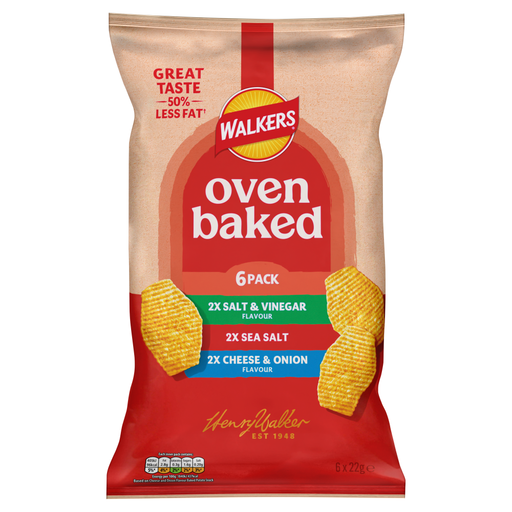 No image available
The 22g inner bags give you a stated portion for an occasional crisp snack. As this pack contains several flavours, check each one’s fat, salt, ingredients and allergen statement rather than applying a single flavour’s figures to the whole pack.
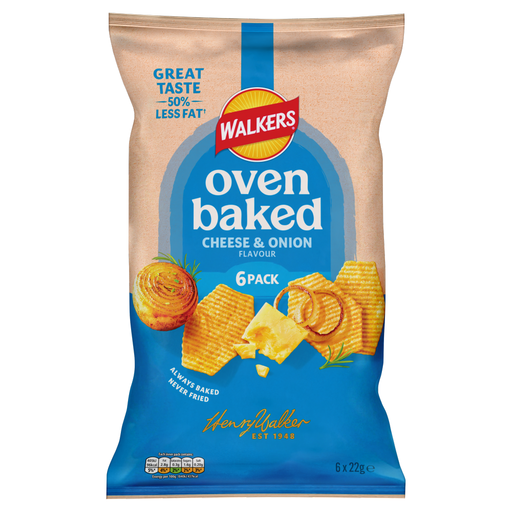 No image available
This multipack has six 22g bags of Cheese & Onion crisps. Check this flavour’s own fat and salt values and its ingredient and allergen information, particularly if the snack must meet a dietary requirement.
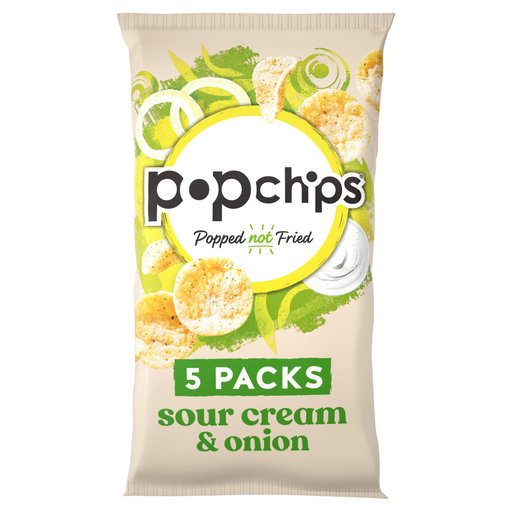 No image available
The five 17g bags offer a smaller stated inner-pack weight than the two 22g Walkers multipacks shown here. Compare fat and salt per 100g before comparing per-bag values, and check the current pack for ingredients and allergens.
No. A quantified claim helps you compare crisps when a packaged savoury snack is wanted, but it says nothing by itself about salt or the broader snack choice. NHS Healthier Families recommends fruit and vegetables for children’s snacks and advises aiming for no more than two packaged snacks a day.
Use fat per 100g to compare products with different bag sizes, then read the per-bag values for the portion you plan to serve. Walkers lists 2.8g fat and 0.19g salt per 22g bag for Oven Baked Sea Salt; check other flavours separately.
No. Read the ingredients and precautionary allergen statement on the exact current pack. Do not assume that a plain-sounding flavour, or a dietary label on another product from the brand, settles the question.
The Requirements for School Food Regulations 2014 address food provided to pupils in specified schools and pupil referral units in England, not snacks a parent buys to eat at home. If you are choosing food to provide at school, check the requirements applicable to that setting rather than relying on a retail reduced-fat claim.
They are an option if a different base ingredient and flavour are acceptable, but they are not potato crisps. Tyrrells says its cited lentil flavours have 30% less fat than standard potato crisps on average; their listed 30g servings contain 0.60g to 0.63g salt, so compare the exact variant before choosing.