Revision snackers comparing fat content
If you want potato crisps at your desk but are looking to reduce fat, compare an exact product’s nutrition label with a regular crisp on a per-100g basis. A salt-focused name does not answer the fat question.


If reducing fat is the priority, look for a potato crisp with a stated comparison rather than relying on words such as “lightly salted”. Walkers says its Oven Baked Sea Salt crisps have 50% less fat than regular potato crisps; its labels list 13g fat per 100g, against 31g per 100g for Walkers Ready Salted. Check the exact pack’s salt, calories, portion size and allergens too—the Sea Salt figures do not automatically apply to other flavours or variety packs.
If you want potato crisps at your desk but are looking to reduce fat, compare an exact product’s nutrition label with a regular crisp on a per-100g basis. A salt-focused name does not answer the fat question.
Individual pack size and clear nutrition and allergen labelling can help when choosing a packaged snack. The NHS also suggests fruit and vegetables as snack choices for children, so crisps need not be the only option available during a study day.
A lower-fat comparison does not settle whether a particular flavour meets your other requirements. Read its salt figure and its own ingredients and allergen statement before choosing it.
Start with the fat comparison for the exact crisp you want, then check the rest of that pack’s label and the portion you intend to eat.
| Priority | What to check | Your needs |
|---|---|---|
| Fat comparison | Compare fat per 100g and read what a reduced-fat claim uses as its comparator. Walkers lists 13g per 100g for Oven Baked Sea Salt and 31g per 100g for its regular Ready Salted crisps. | I want a potato crisp with a stated fat reduction, not a different type of snack or a name that merely sounds lighter. |
| Salt and calories | Read fat, salt and calories on the same per-100g basis when comparing products. Then check the figures for the pack you will eat; Walkers lists 96kcal and 0.19g salt per 22g pack of Oven Baked Sea Salt. | Fat matters to me, but I also want to know what one snack pack contains during a revision session. |
| Snack format | Check the ingredient base if you are comparing potato crisps with lentil crisps, and note the size of each individual pack in a multipack. | I might consider a different crisp texture, or I may want to stick with potato crisps in a clearly labelled portion. |
| Allergens | Read the ingredients and precautionary allergen statement on the exact flavour and pack. Do not carry a Sea Salt flavour’s details over to a Cheese & Onion or variety pack. | I need to know whether the particular flavour I am buying fits my ingredient or allergen requirements. |
A fat comparison describes one aspect of a product. Walkers Oven Baked Sea Salt still lists 96kcal and 0.19g salt per 22g pack.
Read both the per-100g figures and the figures for the portion you plan to eat, particularly when comparing individual packs with sharing bags.
Salt wording does not describe fat content. KETTLE Chips lists 29.5g fat per 100g for Lightly Salted, while Seabrook lists 30.4g per 100g for Sea Salted.
Use the fat row of each nutrition table to make a fat comparison.
Tyrrells’ claim of 30% less fat than standard potato crisps on average concerns its lentil crisps, not a reduced-fat version of its potato crisps.
If the potato-crisp format matters to you, check a reduced-fat claim on an exact potato-crisp product. Consider lentil crisps separately if you are open to a different base ingredient.
These brand examples help distinguish specific reduced-fat claims from flavour names and other crisp formats; they do not describe every product in each range.
Its Oven Baked Sea Salt product provides a named reduced-fat potato-crisp comparison.
Tyrrells offers potato crisps as well as a separate lentil-crisp range.
Lightly Salted is an example where the product name describes salt, not a reduction in fat.
Seabrook provides flavour-specific nutrition information for its Sea Salted crisps.
Pipers describes its crisps in terms of potato ingredients and distinctive flavourings.
REAL presents a hand-cooked crisp range centred on flavours.
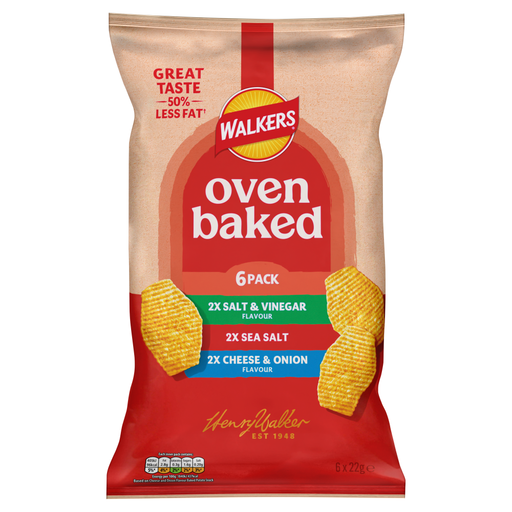
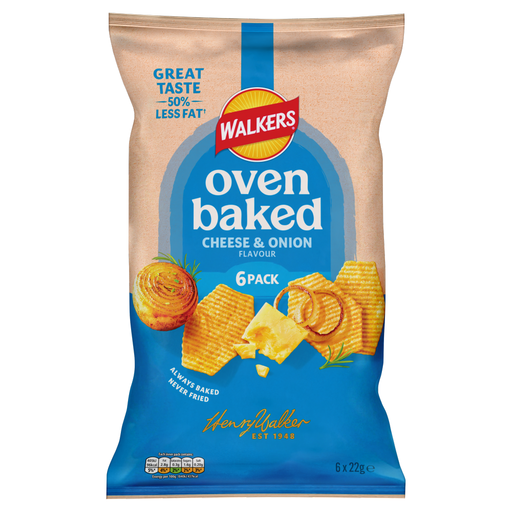
These Walkers Oven Baked multipacks offer individual 22g bags for revision snacking. Check each flavour’s own label before applying the Oven Baked Sea Salt nutrition comparison elsewhere in the range.
 No image available
Six individual 22g bags provide labelled portions for desk snacks. As this is a variety pack, check the nutrition and allergen information for each flavour rather than assuming the Sea Salt figures apply throughout.
 No image available
This Cheese & Onion option comes in six individual 22g bags. Check its own fat, salt and calorie figures; it contains milk, and its pack should be checked for further allergen information.
No: check the claim and nutrition panel of the exact product. For one documented comparison, Walkers lists 13g fat per 100g for Oven Baked Sea Salt and 31g per 100g for its regular Ready Salted crisps; those figures do not establish the values for every baked flavour.
No. Salt and fat are separate figures: KETTLE Chips Lightly Salted lists 29.5g fat per 100g, so read the fat row rather than drawing a conclusion from the name.
You can compare their labels per 100g, but they are different types of crisp. Tyrrells’ stated 30% fat reduction applies to its lentil crisps against standard potato crisps on average; it is not a claim about Tyrrells potato crisps.
Consider the snack choice as well as the pack label. The NHS suggests fruit and vegetables for children’s snacks and recommends using nutrition labels when choosing packaged snacks; for a crisp, check the labelled portion and the exact flavour’s allergen statement.