Calorie and fat trackers
If you plan snacks around a daily food intake, check kcal and fat for the whole bar. Compare fat per 100g as well when the bars have different serving sizes.


Start with the fat and calories in the whole bar you would eat, then use fat per 100g to compare different bar sizes. Among the named examples, Myprotein lists 3.4g fat and 138 kcal per 40g Lean Layered Bar, but its 8.6g fat per 100g is above the NHS guide of 3g or less per 100g for a low-fat food. Protein and low-sugar wording do not, by themselves, tell you whether a bar fits your planned food intake.
The useful comparison depends on whether your main constraint is the bar’s fat content, its portion size or its ingredients.
If you plan snacks around a daily food intake, check kcal and fat for the whole bar. Compare fat per 100g as well when the bars have different serving sizes.
A 40g bar may suit someone who wants a smaller portion than a 55g or 64g bar. Myprotein lists 15g protein and 138 kcal for its 40g Lean Layered Bar; check whether that portion and its ingredients meet your needs.
Vegetarian or vegan suitability, allergens and sweeteners are separate checks from fat content. Read the exact flavour’s label, particularly before buying a multipack.
Check the portion you expect to eat before making a like-for-like comparison per 100g. The NHS explains that nutrition information is given per 100g and sometimes per portion.
| Priority | What to check | Your needs |
|---|---|---|
| Whole-bar calories | Read the labelled kcal per bar and its serving weight. The named examples range from Myprotein’s 138 kcal per 40g Lean Layered Bar to 245–250 kcal per 64g PhD Smart Bar in the flavours listed by PhD. | I want to know what the whole snack adds to my planned daily intake, rather than judging it by the front of the pack. |
| Total fat | Compare grams per bar and per 100g. Myprotein lists 3.4g per 40g bar and 8.6g per 100g for Lean Layered; the NHS guide for a low-fat food is 3g fat or less per 100g. | Fat reduction matters to me, so I need to distinguish a bar marketed as reduced fat from one that meets the NHS low-fat guide. |
| Saturates and sugars | Read these as separate entries from total fat. A low-sugar or no-added-sugar description cannot establish the fat content; compare the exact flavour’s nutrition panel. | I may care about sugar too, but I do not want a sugar claim to stand in for a fat comparison. |
| Protein per portion | Compare protein for the whole bar alongside its fat and kcal. The named product pages list 15g for Myprotein Lean Layered, 16g for Barebells Cinnamon Bun and 21–22g for the specified PhD Smart Bar flavours. | If I choose a smaller bar, I still want to check whether its labelled protein amount meets what I am looking for. |
| Ingredients and warnings | Check the exact flavour’s allergens, dietary suitability and polyol or sweetener warnings. Formulations and warnings can differ between products. | Before buying several bars, I need to know whether the specific flavour suits my ingredient requirements and preferences. |
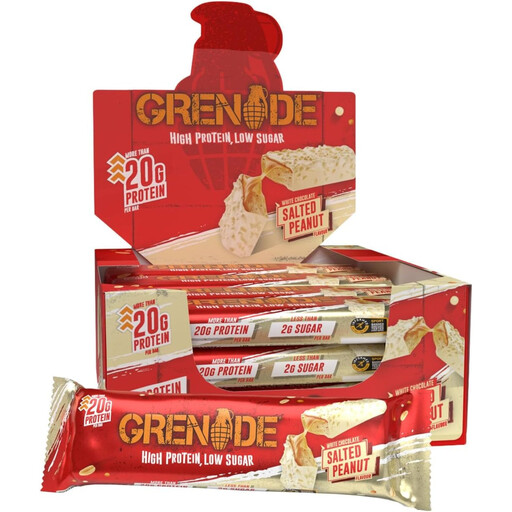
The Grenade White Chocolate Salted Peanut bar is described as containing 2g sugars per 60g bar, while a Joybuy listing for that variant gives 12g fat and 242 kcal per bar. The figures answer different questions.
Compare total fat, saturates and kcal on the nutrition panel separately from sugars, using per-100g values when bar sizes differ.
Per-100g values help compare fat concentration, but the portion you eat may be a 40g, 55g, 60g or 64g bar. Its whole-bar kcal may therefore affect your choice differently.
Use per 100g to compare products, then check the labelled fat and kcal for the entire bar.
The named bars have different allergen statements and dietary suitability. Some product labels also warn that excessive consumption may cause a laxative effect.
Read the exact variant’s ingredients, allergen statement and warnings before choosing a multipack; do not assume another flavour has the same formulation.
Protein content does not cancel out the bar’s energy content. NHS Better Health explains weight loss in terms of taking in less energy than the body uses.
Account for the bar’s labelled kcal within your overall food intake rather than automatically adding it to your usual snacks.
Brand ranges cover different portions and formulations, so use these as starting points and compare the exact bar and flavour.
Myprotein has a low-fat protein-bar category that includes its Lean Layered Bar.
PhD lists Smart Protein Bar and a separate Smart Plant Protein Bar range.
Grenade sells layered protein bars, including White Chocolate Salted Peanut.
Barebells offers soft-format protein bars, including Cinnamon Bun.
Quest presents its protein bars as high-protein, low-sugar options on its US-facing site.
Tesco is a grocery retailer, not a protein-bar manufacturer; its protein-bar category includes named brands such as Grenade.
These Grenade bars offer flavour and pack-size choices for shoppers comparing protein snacks. Check each variant’s fat and kcal before treating it as a reduced-fat choice; the products below do not represent every route discussed above.
 No image available
The 50g bar size is relevant if you plan snacks by portion. Compare its labelled fat per 100g and kcal per bar with a specifically reduced-fat alternative before choosing this 12-bar pack.
 No image available
Choose between flavours only after checking the nutrition panel for this 50g Golden Caramel variant. For a fat-focused choice, compare total fat per 100g as well as the whole-bar portion before buying the 12-bar pack.
 No image available
This Peanut Butter variant comes as twelve 50g bars. Check its fat and kcal figures for the whole bar and read the exact pack’s peanut and other allergen information before choosing it.
 No image available
The four-pack gives you 60g bars rather than the 50g Soft Core portions above. If portion energy or fat reduction drives your choice, compare the exact variant’s per-bar kcal and per-100g fat before buying.
 No image available
This 12-pack contains 60g bars. Grenade lists 20g protein and 2g sugars for the named bar, while a Joybuy listing for the same flavour gives 12g fat and 242 kcal per bar; low sugar does not make it a reduced-fat choice. Check the pack’s peanut and other allergen warnings.
No. A reduced-fat description involves a comparison, whereas the NHS guide identifies a low-fat food as containing 3g fat or less per 100g. Myprotein lists 8.6g per 100g for its Lean Layered Bar, so it does not meet that NHS guide even though the brand compares it with other bars.
Start with kcal and total fat for the whole bar you expect to eat. Then compare fat and saturates per 100g across different bar sizes, and check protein and sugars as separate figures. NHS food-label guidance explains the distinction between per-100g and per-portion information.
Yes. Grenade lists 2g sugars for its White Chocolate Salted Peanut bar, while a Joybuy listing for that 60g variant gives 12g fat and 242 kcal. Check all three figures rather than using sugars as a proxy for fat or energy.
No protein-bar label can establish that outcome. NHS Better Health explains weight loss in terms of an energy deficit, so use the bar’s labelled kcal to see how it fits into your overall food intake rather than treating its protein content as a weight-loss claim.
Read the exact flavour’s ingredients, allergen statement, dietary-suitability information and sweetener warnings. The named bars differ on these points, and some labels warn that excessive consumption may have a laxative effect; a different flavour in the range may have a different formulation.