A protein bar can be a packed-lunch snack if the pupil’s age, the school’s rules and the exact product label make it appropriate, but ‘high protein’ or ‘low sugar’ does not mean reduced fat. Grenade says its protein bars are not suitable for children under 14; for an older pupil, compare fat and saturated fat per 100g and per bar, and check allergens. If reduced fat is essential, look for an explicit claim with a comparable-product basis rather than assuming either Joybuy option below qualifies.
Who is choosing the bar?
Parents of pupils aged 11 to 13
Check the exact product’s age guidance before considering its nutrition panel. Grenade’s UK product guidance says its protein bars are not suitable for children under 14; that warning should not be assumed to apply to every brand.
Parents of pupils aged 14 to 18
For an older pupil who wants a portable snack, check the school’s policy, the portion and the full ingredient and allergen statement. Compare fat and saturated fat rather than relying on ‘high-protein’ or ‘low-sugar’ wording.
Shoppers looking specifically for reduced fat
Treat reduced fat as a comparative claim, not a description of a small bar or one with less sugar. Check the claim and its comparison basis on the exact product before buying it for this purpose.
What should you check first?
Decide whether a packaged snack fits the lunch, then check age guidance and school rules before comparing the nutrition panels of suitable products.
| Priority | What to check | Your needs |
|---|
| Place in lunch |
Keep the main lunch and fruit or vegetables in view when deciding whether to add a packaged snack. The NHS names fruit and vegetables as its preferred snacks for children. |
I’m looking for a convenient extra snack, not something to replace the rest of the packed lunch. |
| Fat comparison |
Compare fat and saturated fat per 100g, then check the amount per bar. If reduced fat is required, look for an explicit claim and its comparable-product basis. |
A smaller bar may show fewer grams of fat per bar without meeting my reduced-fat requirement. |
| Age and ingredients |
Read the exact range’s age guidance and the flavour’s ingredient and allergen statement. Check any warning about polyols. |
For a younger secondary-school pupil, I need to rule out a bar with an applicable age warning before comparing flavours or portions. |
| School policy |
Check the pupil’s school policy for packed lunches and allergens, then compare it with the exact bar’s label. |
I want to know whether this particular bar can go into the pupil’s lunchbox at their school. |
Packed-lunch mistakes to avoid
-
Equating low sugar or a small portion with reduced fat
These describe different things. A smaller bar can contain fewer grams of fat per bar simply because the portion is smaller.
Compare fat and saturated fat per 100g and per bar. If a reduced-fat claim is important, check what similar product the claim compares it with.
-
Overlooking an age warning
Secondary school includes children under 14, and Grenade’s UK product guidance says its protein bars are not suitable for that age group.
Check the manufacturer’s guidance for the exact bar and the pupil’s age; do not extend Grenade’s warning to unrelated products.
-
Letting the bar replace the lunch
A packaged bar does not serve the same purpose as the main lunch and its fruit or vegetables. The NHS identifies fruit and vegetables as its preferred snacks for children.
If you include a bar, treat it as an additional snack rather than the centre of the packed lunch.
-
Checking the front of the pack but not school rules
A product can conflict with an individual school’s packed-lunch or allergy policy regardless of its protein content.
Read the policy and the exact flavour’s ingredient and allergen statement before packing the bar.
Brand and retailer references
These references illustrate label checks; they do not establish that any named bar is reduced fat or stocked by Joybuy.
Grenade
Grenade’s Carb Killa range includes a Salted Caramel bar listed by Tesco Groceries in a 35g portion.
- Tesco Groceries lists 5.4g fat and 12g protein per 35g Salted Caramel bar, and 16g fat per 100g.
- Grenade’s UK guidance says its protein bars are not suitable for children under 14. Check the exact flavour’s allergens and polyol warning.
PhD
PhD lists Smart Bar variants in 64g portions.
- PhD’s listed Choc Brownie and Strawberries and Cream variants contain 8.5g to 9.2g fat per 64g bar.
- A per-bar figure from a 64g product should not be compared alone with one from a smaller bar. Check the chosen variant’s per-100g panel and warnings.
Myprotein
Myprotein has a UK category labelled low-fat protein bars.
- Use an individual product’s current pack claim and nutrition panel to decide whether it meets a reduced-fat requirement; a category name does not describe every bar.
Barebells
Barebells presents several protein-bar formats on its UK range page and describes the range as having no added sugar.
- No-added-sugar wording does not establish reduced fat. Check the exact UK pack’s fat, age guidance and allergens for a school lunch.
Quest
Quest describes protein bars on its own site, but that description is not a substitute for a UK product label.
- For a UK packed lunch, check the exact pack’s formulation, fat figures, ingredients and any age guidance rather than applying claims from another market.
Tesco
Tesco Groceries lists protein bars from other brands, including the 35g Grenade Salted Caramel bar.
- Its individual Grenade listing gives per-bar and per-100g nutrition figures for comparing portion sizes.
- A Tesco listing describes the named product, not every bar in its protein-bar category.
Protein-bar options for packed lunches
These Joybuy nut and peanut protein bars come in 42g and 40g portions. Consider them only after checking the pupil’s school policy and the exact labels; neither product name establishes a reduced-fat claim.
 No image available
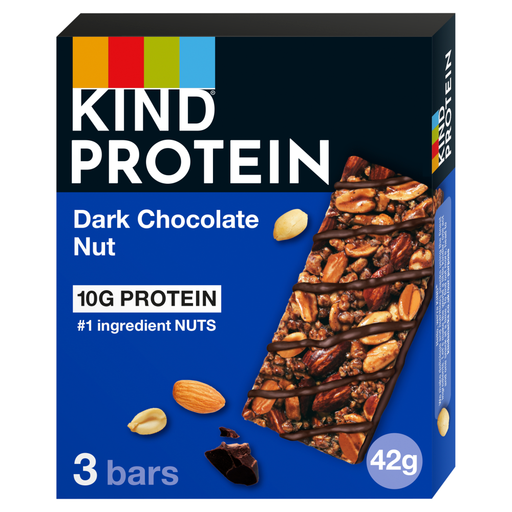
KIND Protein Dark Chocolate Nut Bars, 3 × 42g
Each 42g bar could be considered as an additional packed-lunch snack, subject to the school’s policy. Check the current label for fat and saturated fat per 100g, ingredients and any age guidance; the product name does not establish reduced fat.
View on Joybuy
 No image available
Nature Valley Protein Peanut & Chocolate Bar, 4 × 40g
A 40g bar is another portion to consider alongside, rather than instead of, the main lunch. Check the current pack’s fat and saturated fat per 100g, peanut and other allergen information, and any age guidance before comparing it with the school’s policy; do not assume it is reduced fat.
View on Joybuy
Questions about protein bars in packed lunches
Does ‘low sugar’ mean a protein bar is reduced fat?
No. The two descriptions concern different nutrients. If reduced fat is your requirement, look for an explicit claim with a comparison to a similar product, and check the fat figures on the exact pack.
Can an 11-to-13-year-old take a Grenade protein bar to school?
Do not choose a Grenade protein bar for that age group: Grenade’s UK product guidance says its protein bars are not suitable for children under 14. This is guidance for that range, not an age rule for every protein bar.
Should I compare fat per bar or per 100g?
Use both: per 100g puts different-sized bars on the same comparison basis, while per bar shows the amount in the portion. Tesco Groceries lists 5.4g fat in its 35g Grenade Salted Caramel bar; PhD lists 8.5g to 9.2g in cited 64g Smart Bar variants, so their per-bar amounts alone do not make an equal-size comparison.
How do I know whether a protein bar is allowed in a packed lunch?
Check the pupil’s school’s current packed-lunch and allergy policy, then read the exact bar’s ingredients and coating description against it. Do not assume that requirements for food provided by a school answer what that school accepts in lunches brought from home.
Which ingredient warnings should I read?
Read the exact flavour’s allergen statement and any polyol warning, alongside the school’s allergy policy. Grenade’s UK product guidance warns that excessive consumption of its bars may cause laxative effects; do not assume another bar has the same ingredients or warning.


