Low-fat lunch packers
If you take lunch to work, on a commute or to school, plain or lightly salted rice cakes can provide a portable starchy base. Check fat per 100g on the exact pack, then plan what else you will eat with them.


For a reduced-fat choice, check that the exact rice cake variety contains no more than 3g fat per 100g: that is the low-fat claim threshold for solid foods in the Annex to Regulation (EC) No 1924/2006. Kallo, Tesco and M&S list lightly salted varieties at 2.8g, 2.9g and 2.5g fat per 100g respectively, but a few plain cakes alone need not be the whole lunch. Use them as a starchy base alongside a protein food and fruit or vegetables, in line with NHS balanced-diet guidance and the British Dietetic Association packed-lunch fact sheet; check flavoured varieties and chilled toppings separately.
If you take lunch to work, on a commute or to school, plain or lightly salted rice cakes can provide a portable starchy base. Check fat per 100g on the exact pack, then plan what else you will eat with them.
A per-cake or per-pack nutrition panel can help you work out the portion you are carrying. Reduced fat or a small portion does not, by itself, tell you whether you have packed the rest of lunch.
Some lightly salted rice cakes are presented as gluten free or suitable for vegan diets. Check the current ingredients and allergen statement for the precise variety, as well as any toppings you add.
Start with the fat figure for the exact variety, then consider the other food and storage arrangements your lunch requires.
| Priority | What to check | Your needs |
|---|---|---|
| Fat per 100g | The Annex to Regulation (EC) No 1924/2006 sets the low-fat claim threshold for solid foods at no more than 3g fat per 100g. Check the precise flavour or coating: Kallo lists 2.8g for its standard Lightly Salted cakes, Tesco lists 2.9g and M&S lists 2.5g for their lightly salted varieties. | I want a reduced-fat rice cake, so I need the per-100g figure for the variety I will actually pack. |
| The rest of lunch | Consider a protein food and fruit or vegetables alongside the rice cakes. NHS balanced-diet guidance and the British Dietetic Association packed-lunch fact sheet describe these as components of meals and packed lunches. | A few dry cakes would leave out the other foods I intend to have at lunchtime. |
| Salt and flavour | Compare salt using the same basis on each label. Snack a Jacks lists 0.63g salt per 23g pack for its Salt & Vinegar and Sour Cream & Chive multipacks; Tesco lists 0.02g per Lightly Salted cake. | If I choose a flavoured pack, its salt figure matters alongside any salty toppings or other lunch foods. |
| Dietary labels | Read the ingredients and allergen statement for the exact pack. Tesco’s listing for Kallo Organic Lightly Salted says it may contain milk, sesame and soya. | I need to check whether both the cakes and my toppings fit my dietary requirements. |
| Chilled toppings | Keep foods that spoil quickly, including dairy and meat, cold until eaten. Safefood advises an insulated lunchbox or bag for these foods in a packed lunch; carry toppings separately from dry cakes where practical. | If I add a chilled topping, I need a way to carry it cold and assemble lunch when I eat it. |
Flavour and ingredients change the nutrition figure. M&S lists 16.2g fat per 100g for its Barbecue High Protein Rice Cakes, whereas the low-fat claim threshold for solid foods in the Annex to Regulation (EC) No 1924/2006 is no more than 3g per 100g.
Check fat per 100g for the exact flavour and format rather than relying on the words ‘rice cake’ or ‘high protein’.
Reduced fat describes one aspect of the cakes, not the composition of a packed lunch. NHS and British Dietetic Association guidance includes protein foods and fruit or vegetables alongside starchy foods.
Plan a suitable protein food and some fruit or vegetables to take with the cakes.
Snack a Jacks lists 0.63g salt per 23g pack for both Salt & Vinegar and Sour Cream & Chive multipacks. The product page shows this as 11% of the adult reference intake.
Read the salt figure for your chosen flavour and consider it alongside the rest of your lunch.
Safefood advises keeping foods that spoil quickly, such as dairy and meat, as cold as possible until a packed lunch is eaten.
Use an insulated bag or box for chilled foods, and keep the topping separate from the rice cakes until lunchtime where practical.
An insulated bag or cool pack may be another item to carry when your topping needs chilling.
Kallo’s lightly salted rice cakes include standard and organic varieties with distinct nutrition figures. Check which pack you are choosing.
Tesco’s own-label Lightly Salted Rice Cakes offer a brown-rice option for a lunch you assemble yourself.
M&S has lightly salted wholegrain cakes and a separate high-protein flavoured variety; their nutrition figures differ substantially.
Snack a Jacks offers flavoured multipacks when carrying a sealed individual portion is useful.
These options include a lightly salted cake to use as a lunch base and a ready-flavoured cake. Check each pack against your reduced-fat and dietary requirements rather than assuming the two serve the same needs.
 No image available
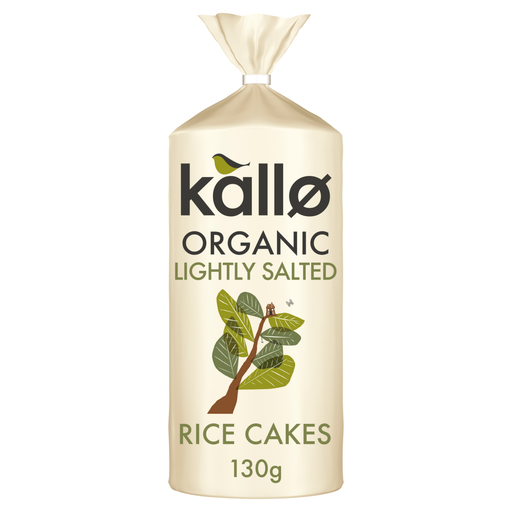
A lightly salted rice cake to pack as a base for toppings. Tesco’s listing for this organic variety gives 2.7g fat per 100g and 27 kcal per cake, and says it may contain milk, sesame and soya; check the current pack if these allergens matter to you.
 No image available
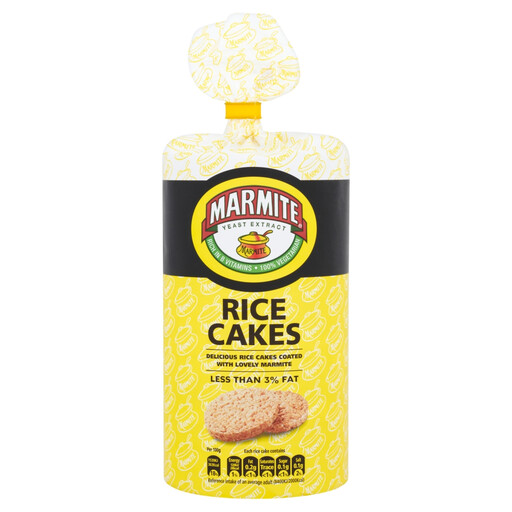
A ready-flavoured option for a packed lunch. If reduced fat or gluten avoidance matters to you, check the exact pack’s fat per 100g and ingredient statement; the supplied product information identifies barley and wheat among its ingredients.
For solid foods, the Annex to Regulation (EC) No 1924/2006 sets the low-fat claim threshold at no more than 3g fat per 100g. Read the per-100g panel for the exact variety: a per-cake figure alone does not establish whether it meets that threshold.
Use them as a starchy part of lunch rather than assuming a few cakes cover the whole meal. NHS balanced-diet guidance and the British Dietetic Association packed-lunch fact sheet also include protein foods and fruit or vegetables; choose additions that suit what you can carry and store.
Carry the dry cakes separately and keep foods that spoil quickly cold until eaten. Safefood advises using an insulated lunchbox or bag for packed-lunch foods such as dairy and meat that need to stay cold.
No. Read the current ingredient and allergen statement for the precise pack and your toppings. For example, Tesco’s listing for Kallo Organic Lightly Salted Rice Cakes says they may contain milk, sesame and soya.
No: you can pair a plain rice cake with a separate protein food. If reduced fat is your priority, check the high-protein variety’s fat figure too; M&S lists 24.8g protein and 16.2g fat per 100g for its Barbecue High Protein Rice Cakes.