Late-night eaters comparing fat content
If rice cakes will form the base of your supper, compare plain and coated varieties by their fat and saturated-fat values. Consider the cakes and anything you add to them as one portion.


If reducing fat is the main consideration for a late-night supper, start with a plain, uncoated rice cake and compare fat and saturates per 100g rather than relying on its name or calories per cake. Choose an unsalted version if salt matters too; a lightly salted cake offers a different flavour, while toppings and the number of cakes change what is in the finished supper.
If rice cakes will form the base of your supper, compare plain and coated varieties by their fat and saturated-fat values. Consider the cakes and anything you add to them as one portion.
Unsalted, lightly salted and flavoured rice cakes have different salt declarations. Check the exact product and the amount you expect to eat rather than using its fat content as a guide to salt.
If an ingredient, allergen or dietary label affects your choice, read the current pack for the particular variety. A plain rice cake and a coated or flavoured one need not have the same ingredients or allergen statement.
For a reduced-fat supper, compare the cake itself on a per-100g basis, then work out what changes when you choose a flavour, eat several cakes or add toppings.
| Priority | What to check | Your needs |
|---|---|---|
| Fat and saturates | Compare both values per 100g, then check the figure per cake or serving. The NHS defines low fat as no more than 3g fat per 100g and low saturated fat as no more than 1.5g saturates per 100g. | I want to compare an uncoated cake with flavoured or coated options on the same weight basis, not assume that every rice cake has similar fat content. |
| Salt | Read salt per 100g and per cake. Kallo UK lists trace salt for Organic Unsalted; Tesco Groceries lists 0.02g per Lightly Salted cake, while Snack a Jacks lists 0.26g per Salt & Vinegar Jumbo cake. | If salt matters to me too, I need to distinguish unsalted from lightly salted and check the particular flavoured variety. |
| Portion and toppings | Count the cakes you plan to eat and check the serving information. Consider the ingredients and nutrition of toppings separately from the rice-cake label. | A per-cake figure does not describe my whole supper if I have several cakes or add something on top. |
| Ingredients and allergens | Check the ingredients and allergen statement on the current pack, especially when changing flavour or choosing a coated cake. Marks & Spencer states that its Dark Chocolate Rice Cakes are not suitable for people with a milk allergy. | I need the exact variety's current label to answer an allergy or dietary question, rather than relying on the rice-cake category. |
Marks & Spencer lists 2.5g fat per 100g for its Lightly Salted Rice Cakes, compared with 15.2g for its Sweet and Salty variety and 20.9g for its Dark Chocolate variety. The coating or seasoning changes the comparison.
If fat content drives your choice, compare the nutrition panels of the exact varieties before choosing a flavoured or coated cake.
A figure for one cake does not include additional cakes or toppings.
Check how many cakes you intend to have and account for anything you put on them.
These descriptions identify different products. Kallo UK lists trace salt for Organic Unsalted, while Tesco Groceries lists 0.02g salt per Lightly Salted cake.
If salt is part of your decision, compare the salt declaration per 100g and for your intended portion.
Ingredients and allergen statements can differ between varieties and may change when a product is reformulated.
Read the current physical pack before eating when an allergen or strict dietary requirement matters.
Compare named varieties rather than treating a brand's entire rice-cake range as nutritionally alike.
Kallo UK lists plain lightly salted and organic unsalted rice cakes that can be compared when both fat and salt matter.
Tesco Lightly Salted Rice Cakes provide a plain brown-rice example for comparing per-cake values.
Marks & Spencer lists plain lightly salted rice cakes alongside sweet and chocolate varieties, making the exact product type important.
Snack a Jacks offers flavoured rice cakes and multipacks for shoppers who want a seasoned option.
This lightly salted option is relevant if you want an uncoated rice cake as a supper base. Compare its current pack with unsalted and flavoured varieties if fat or salt content will determine your choice.
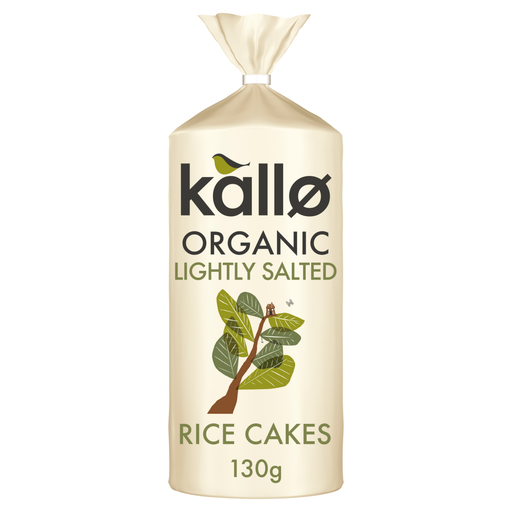 No image available
A lightly salted rice cake to consider as a plain supper base. The pack is 130g; check its current nutrition panel for fat, saturates and salt per 100g and for the portion you intend to eat.
The NHS defines low fat as 3g or less of fat per 100g and low saturated fat as 1.5g or less of saturates per 100g. Use the per-100g values to compare varieties, then check the amount you plan to eat.
No. Fat and salt are separate values to check. Kallo UK lists trace salt for Organic Unsalted rice cakes, Tesco Groceries lists 0.02g per Lightly Salted cake, and Snack a Jacks lists 0.26g per Salt & Vinegar Jumbo cake; compare the exact products and portion sizes.
Yes. The cake's nutrition label describes the cake, not a finished supper with toppings. Count the cakes you expect to eat and consider the toppings separately.
Read the ingredients and allergen statement on the current pack of the exact variety. Coatings and flavours can change what a product contains: for example, Marks & Spencer states that its Dark Chocolate Rice Cakes are not suitable for people with a milk allergy.