Campers comparing fat content
If fat content guides your choice, compare the figures per 100 g before looking at portion size. A bar with less fat than another bar does not necessarily qualify as low fat.


None of the five bars compared by declared fat meets the UK low-fat threshold of no more than 3 g per 100 g for solid foods, as set out by Business Companion. Eat Natural lists 6.4 g per 100 g for its Red Fruits Soft Fruit Bar, making it the lower-fat choice within that five-bar comparison—not a low-fat bar. For camping, compare fat per 100 g and per bar, then check the current wrapper for allergens and storage instructions.
If fat content guides your choice, compare the figures per 100 g before looking at portion size. A bar with less fat than another bar does not necessarily qualify as low fat.
Fruit-and-nut and oat bars may offer these options, but check the exact flavour and its current allergen statement. Vegan or gluten-free labelling does not rule out nuts or other relevant allergens.
Check protein per bar alongside total fat and allergens. The protein bars in the five-bar fat comparison are not low-fat options.
Start with the nutrition panel for the exact bar, then check whether its ingredients and packaging work for the people and trip you are planning.
| Priority | What to check | Your needs |
|---|---|---|
| Fat content | Compare total fat per 100 g, then fat and saturated fat per bar. Business Companion gives 3 g fat per 100 g as the maximum for a low-fat claim on solid food; a relatively lower figure alone does not establish a reduced-fat claim. | I’m comparing bars for a fat-conscious camping-food plan, rather than relying on words such as “protein” or “vegan”. |
| Allergens and dietary labels | Read the ingredients and “may contain” statement on the current wrapper. Check vegan or gluten-free labelling for the exact flavour, not just the brand. | Everyone sharing the camping food needs a bar they can safely eat. |
| Packing and storage | Check whether bars are individually wrapped, follow the pack’s storage instructions and confirm the best-before date covers the trip. | I’d like portions that are straightforward to carry and handle away from washing facilities. |
| Protein and fibre | Compare the stated amounts per bar with fat and saturated fat on the same product’s panel. Neither protein nor fibre content establishes that a bar is low fat. | If I’m choosing a bar for its protein or fibre, I still want to see the fat figure and allergen information. |
Among the compared bars, declared fat ranges from 6.4 g to 27.1 g per 100 g. Business Companion states that solid food needs no more than 3 g per 100 g for a low-fat claim.
Read total fat per 100 g and per bar before deciding whether a protein, vegan or fibre-labelled bar fits your plan.
Bars in this comparison contain nuts or have precautionary statements covering allergens such as peanuts, milk and soya. A vegan or gluten-free label does not replace those checks.
Check every exact flavour’s current wrapper and keep it with the bar so the information remains available at camp.
Alpen’s product FAQ lists Alpen Light Bars Chocolate & Orange among lines no longer being made.
Confirm the exact product and pack before including it in a camping-food plan.
The Waitrose & Partners listing presents inconsistent fat values in its nutrition displays, so it cannot support a clear fat comparison for this product.
Use the current wrapper or a consistent manufacturer nutrition panel before comparing it with another bar.
These references concern particular bars and ranges, not every product made by each brand.
Its Red Fruits Soft Fruit Bar has the lowest declared fat figure in the five-bar comparison.
Berry Delight and Cocoa Delight are fruit-and-nut options to assess against dietary labels and allergen needs, rather than assume are low fat.
Cocoa Oat is a protein-flapjack option for campers choosing by its stated protein content.
Its Protein + Fibre Chocolate & Orange and Peanut & Chocolate bars offer different protein-and-fibre choices.
Cocoa Vanilla Oat Boosts are an oat-based bar option with pack-specific storage guidance.
Historic Alpen Light references are not a dependable basis for choosing a current camping snack.
These fruit-and-nut and protein-bar options suit different camping-food priorities. Compare the current pack’s fat figures and allergen statement before choosing any of them for a reduced-fat plan.
 No image available
A fruit-and-nut multipack to consider for portioned camping snacks; check the current pack’s fat content and nut-allergen statement.
 No image available
A flapjack multipack for campers considering a protein bar rather than choosing solely by fat content; read the exact variant’s nutrition and allergen panels.
 No image available
A 12-bar protein multipack for group or multi-day packing; compare its fat per 100 g and per bar, and check the wrapper for milk and soya.
 No image available
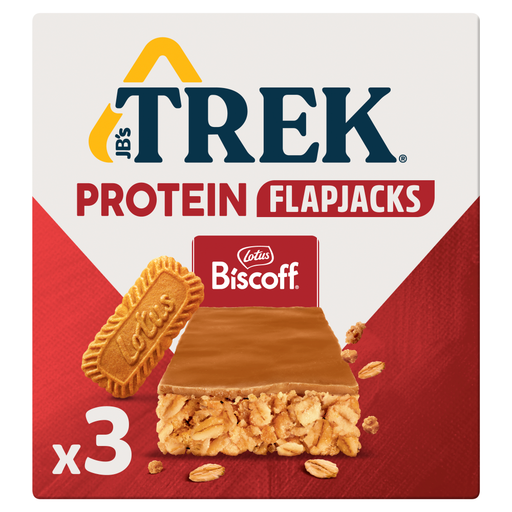
A three-pack of flapjacks for portioned snacks; check this flavour’s fat figure and wheat, soya and precautionary-allergen information before packing it.
 No image available
A 12-bar protein multipack to assess by its per-bar nutrition rather than the word “protein”; check fat content and the current milk and soya declaration.
No. Business Companion gives no more than 3 g fat per 100 g as the low-fat threshold for solid foods; the lowest figure in this five-bar comparison is Eat Natural’s 6.4 g per 100 g for Red Fruits Soft Fruit Bar. That makes it relatively lower in fat within this comparison, not low fat.
No. TREK lists 22 g fat per 100 g for Cocoa Oat, while Nature Valley lists 27.1 g for Protein + Fibre Chocolate & Orange and 28.3 g for Peanut & Chocolate. Compare the fat panel for the exact bar rather than using its protein or fibre description as a substitute.
Read the current wrapper’s ingredients and “may contain” statement for every flavour. For example, Eat Natural Red Fruits contains almonds and has precautionary statements for other allergens; keep its wrapper available until the bar is eaten.
Follow the instructions for each exact pack rather than assuming every bar has the same storage requirements. The Waitrose & Partners listing says Graze Cocoa Vanilla Oat Boosts should be kept in a cool, dry place; also check the best-before date before departure.