If reducing fat is your priority, compare tortilla snacks per 100g rather than relying on words such as “popped” or “lightly salted”: Tesco lists Well & Truly corn tortilla chips at 14g fat per 100g, while ASDA lists its lightly salted corn chips at 22g. Waitrose & Partners lists its popped paprika tortilla-style snack at 13.8g fat per 100g, but its ingredients include soya. For a midnight portion, check the serving size, energy, salt and current allergen label before choosing.
Who is this choice for?
Late-night snackers comparing fat
If you want tortilla chips but are paying attention to fat, compare products per 100g first. Then check the stated serving against the amount you intend to eat; a single bag and a sharing bag need not represent the same portion.
Shoppers choosing between corn and popped snacks
Conventional corn chips and popped lentil- or soya-based tortilla-style snacks have different ingredients and allergen information. Decide whether the corn-chip format matters to you before comparing their nutrition panels.
Shoppers checking allergens
Read the label for the exact flavour and pack. Tesco’s Well & Truly listing warns of possible milk and soya traces, while the Waitrose & Partners paprika popped tortilla listing identifies soya in the ingredients and a possible sesame presence.
What should you compare?
Start with the fat figure on a common per-100g basis, then look at the portion and the other label details that matter to your choice.
| Priority |
What to check |
Your needs |
| Fat and product type |
Compare total fat per 100g. If a pack says “less fat”, read what product it uses for the comparison; “popped” and “lightly salted” describe different things. |
I want a corn tortilla chip with a stated fat comparison, or I am open to a popped tortilla-style snack with different ingredients. |
| Portion and energy |
Check energy and fat per stated serving, the serving weight and how many servings the pack contains. GOV.UK’s label guidance recommends using nutrition information to compare products. |
A small late-night portion matters to me, so I need to know whether the figures describe one bag or only part of a sharing bag. |
| Salt |
Read salt per 100g and per serving alongside fat. Tesco lists Well & Truly tortilla chips at 1.4g salt per 100g; ASDA lists its lightly salted tortilla chips at 0.66g per 100g. |
I do not want a fat-focused choice to distract me from the salt figure in the portion I plan to eat. |
| Ingredients and allergens |
Check the current ingredient list, highlighted allergens and “may contain” statements for the exact flavour. Do not use a popped or gluten-free description in place of the allergen label. |
If milk, soya or sesame matters to me, I need to check the particular pack rather than assume every tortilla snack has the same ingredients. |
What is easy to overlook?
-
Reading “reduced fat” as an absolute fat figure
A comparison claim describes a difference from another product, not the amount of fat you will eat. Waitrose & Partners lists Doritos Protein Sizzling Steak at 11g fat per 100g alongside its “30% less fat” claim, which compares it with the average for regular tortilla chips.
Read both the stated comparator and total fat per 100g, then compare that figure with the corn chips you would otherwise buy.
-
Treating a sharing bag as one serving
ASDA lists its 180g lightly salted tortilla-chip bag as eight servings, with 107kcal and 5g fat per stated serving. Those serving figures do not describe the whole bag.
Use the pack’s serving weight to work out which nutrition figures correspond to the amount you intend to have.
-
Assuming “popped” or “gluten-free” settles the choice
These descriptions do not tell you every nutrition or allergen detail. Waitrose & Partners lists soya in its popped paprika tortillas and a possible sesame presence; Tesco’s Well & Truly listing warns of possible milk and soya traces.
Check fat, salt, ingredients and allergen statements on the current pack for the exact product you choose.
Brand and retailer examples
These product-specific examples show why a brand name alone cannot tell you whether a tortilla snack meets your fat, portion or ingredient preferences.
Doritos
The retailer listings distinguish a popped tortilla-style product from regular corn tortilla chips.
- Waitrose & Partners lists Doritos Protein Sizzling Steak at 11g fat and 405kcal per 100g, with a “30% less fat” claim against average regular tortilla chips.
- Tesco lists Doritos Lightly Salted at 23.4g fat per 100g. The Protein product’s claim should not be applied to other Doritos varieties.
Well & Truly
A corn tortilla-chip example with an explicit fat-comparison claim in Tesco’s listing.
- Tesco lists 14g fat per 100g and states “40% less fat” than average tortilla chips.
- The same listing gives 1.4g salt per 100g and warns that the product may contain milk and soya traces.
Waitrose
Its paprika popped tortillas use lentil, soya, tapioca flour and red rice rather than a conventional corn-chip recipe.
- Waitrose & Partners lists 13.8g fat, 428kcal, 22g protein and 6.9g fibre per 100g.
- The listed ingredients include soya and the allergen information says the product may contain sesame. “Popped” is not itself a reduced-fat claim.
M&S
Its smoked paprika popped red lentil tortillas offer another tortilla-style format to compare by the nutrition panel.
- Marks & Spencer lists 15g fat, 439kcal, 24.8g protein and 6.5g fibre per 100g.
- The popped format does not by itself establish a reduced-fat comparison; check the current pack for ingredients and allergens.
ASDA
Its lightly salted corn tortilla chips provide a regular-chip example for comparing both per-100g and serving figures.
- ASDA lists 22g fat, 477kcal and 0.66g salt per 100g; its stated one-eighth-pack serving contains 5g fat and 107kcal.
- “Lightly salted” does not describe the product’s fat content, and the 180g bag contains eight stated servings.
A Joybuy snack option
This is a potato-based alternative for someone open to a different snack; it is not a corn or lentil tortilla chip.
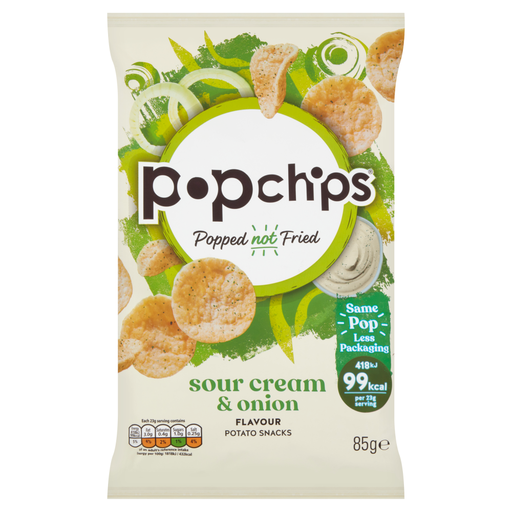 Image unavailable
PopChips Sour Cream & Onion 85g
If you are open to a potato-based snack instead of tortilla chips, this is an 85g Sour Cream & Onion option. Compare its current nutrition panel per 100g and per serving with the tortilla snacks you are considering, and check the label for milk and soya information.
View on Joybuy
Questions about choosing tortilla snacks
Does a reduced-fat claim tell me how much fat is in the snack?
No. It describes a comparison, so read the actual fat figure as well as the stated comparator. For example, Tesco lists Well & Truly tortilla chips at 14g fat per 100g alongside a “40% less fat” claim comparing them with average tortilla chips.
Should I compare tortilla chips per 100g or per serving?
Use both: per 100g puts different products on the same basis, while the serving figures describe the pack’s stated portion. ASDA lists its 180g lightly salted tortilla-chip bag as eight servings, so its single-serving figures do not describe the whole bag.
Are popped tortilla snacks automatically lower in fat?
No. “Popped” describes the format; check total fat on the nutrition panel before comparing products. Waitrose & Partners lists its popped paprika tortillas at 13.8g fat per 100g, while Marks & Spencer lists its popped red lentil tortillas at 15g per 100g.
Which allergens should I check on these examples?
Check the current label for the exact product and flavour. Tesco’s Well & Truly listing warns of possible milk and soya traces; the Waitrose & Partners paprika popped tortilla listing identifies soya in the ingredients and says the product may contain sesame.


