For a reduced-salt weekend breakfast, choose a plain oat product with a nutrition panel showing no more than 0.3g salt per 100g. nidirect uses this as the guide figure for low salt; the compared Quaker Original sachets list 0g per 100g, while Sainsbury’s Original sachets and Flahavan’s Quick Oats list less than 0.01g per 100g. Choose sachets for a fixed microwave portion, bulk oats for adjustable servings, and a pot only when boiling-water preparation suits your plans.
Who these oats suit
Salt-conscious weekend porridge eaters
Choose a plain instant oat breakfast with a salt value that is easy to compare on the label, rather than relying on flavour names or health positioning. nidirect defines low salt as 0.3g salt or less per 100g, and several compared plain oat products are below that figure.
Households choosing between sachets and a bulk oat pack
Pick the format that fits the morning: sachets offer a fixed portion and simple microwave preparation, while bulk oats allow more flexible quantities for more than one person. The compared plain formats have very low declared salt, but their portioning differs.
Shoppers needing gluten-free or allergen verification
If gluten avoidance or an oat allergy matters, look for an explicit claim and check the exact allergen statement. Ordinary oat products can carry gluten or cross-contact warnings.
What to check before buying
Plain original microwave sachets
Choose this when: You want a controlled single serving and a quick warm breakfast.
Keep in mind: Individual sachets offer less flexibility over portion size than a bulk pack, and milk or toppings change the finished bowl.
Bulk quick oats
Choose this when: You are serving more than one person or want to tailor the bowl size.
Keep in mind: You measure each serving yourself, and a bulk pack is less portable than sachets or pots.
Just-add-water porridge pots
Choose this when: Boiling-water preparation matters more than having a multi-serve pack.
Keep in mind: Pot instructions can differ from sachets, so check the exact product for salt, allergens and microwave suitability.
| Priority |
What to check |
Your needs |
| Salt on the label |
Compare salt per 100g on the dry product; use 0.3g salt or less per 100g as the low-salt guide figure; check the current pack rather than relying on the product name. |
I want a plain original oat product whose salt value is directly comparable. nidirect’s low-salt guide uses 0.3g salt or less per 100g. |
| Preparation format |
Check whether the product needs a microwave, hob or boiling water; confirm the stated preparation time; compare sachet size with the amount you plan to eat. |
A fixed sachet suits a quick individual bowl, while a bulk pack lets me measure a shared or larger serving. A pot may be useful where a kettle is available instead of a microwave. |
| Allergens and gluten-free status |
Read the exact allergen and cross-contact statement; look for an explicit gluten-free claim where required; check each variant separately. |
If I need gluten-free oats or have an oat allergy, I cannot assume an ordinary porridge product will suit me. The Food Standards Agency defines a gluten-free claim as no more than 20mg/kg gluten in the food sold. |
Common buying pitfalls
-
Treating “original” or “plain” as proof of the same salt level
Salt values and serving formats can differ by exact product. The compared plain products list between 0g and 0.03g salt per 100g, so a per-100g comparison keeps the basis consistent.
Read the current nutrition panel and, if low salt is your goal, choose a product at or below 0.3g salt per 100g. Then check the amount for the portion you expect to eat.
-
Comparing sachets, pots and bulk oats only by the pack front
A sachet gives a fixed dry portion, whereas bulk oats need measuring and a pot may use different water and heating instructions.
Choose sachets for fixed portions, bulk oats for flexible or shared servings, and a pot only when its preparation method suits the equipment available.
-
Assuming oat products suit everyone avoiding gluten
Oats are an allergen, and ordinary oat products can carry gluten or cross-contact warnings. A gluten-free claim has a specific legal threshold.
For coeliac disease, gluten intolerance or an oat allergy, verify the exact pack’s gluten-free claim and allergen statement before purchase.
-
Using a promotion as a long-term value conclusion
Retailer listings can cover different pack sizes and formats, so one pack does not necessarily represent the same number of servings or the same preparation method.
Compare the number of servings and the exact nutrition label when choosing between packs, rather than treating a temporary offer as a lasting comparison.
Relevant brand references
Quaker
Quaker Oat So Simple Original is a portioned microwave-sachet option for shoppers who want plain wholegrain oats prepared in about two minutes.
- The compared Original sachets list 100% wholegrain oats and 0g salt per 100g on the cited ASDA nutrition panel.
- This applies to Original sachets, not automatically to flavoured, protein or pot variants; check the pack for oat and possible wheat, barley and soya cross-contact information.
Sainsbury’s
Sainsbury’s offers Original portioned porridge sachets and Ready Oats in a larger instant hot-oat cereal pack.
- The compared Original sachets list less than 0.01g salt per 100g and per 27g sachet, while Ready Oats list 0.03g salt per 100g.
- The cited Original sachets are not suitable for people allergic to peanuts, nuts, milk, wheat or barley because of manufacturing methods.
Flahavan’s
Flahavan’s Irish Quick Oats are a measured bulk quick-oat option for microwave preparation rather than individually portioned sachets.
- The cited Irish Quick Oats list 100% wholegrain rolled oats, less than 0.01g salt per 100g and preparation in about two minutes.
- Serving size is measured by the shopper. A separate Quick Oats Pot is stated by Flahavan’s to be available only in Tesco Northern Ireland.
M&S
M&S Traditional Porridge sachets are a portioned option with a stated three-minute microwave method.
- The cited M&S product page describes 10 individually portioned packs that can be prepared with water or milk.
- Compare the exact pack’s nutrition information before using it as a reduced-salt choice.
Tesco
Tesco is a UK grocery retailer with a porridge-sachet range that includes Quaker and Tesco Easy Oats products.
- The cited Tesco listing includes original and flavoured porridge sachet options.
- Compare each exact product label rather than assuming all own-label or flavoured versions have the same salt value.
Joybuy product options
Joybuy product options for a plain reduced-salt oat breakfast, including portioned sachets and bulk packs for flexible weekend servings.
 Image unavailable
Quaker Oat So Simple Big Bowl Original 6 Pack 231g
For a fixed larger breakfast portion when a microwave is available.
Six 38.5g sachets; 100% rolled oats; 0g salt per 100g; stated microwave preparation time of 2½ minutes.
Contains oats. Check the exact pack allergen statement for an oat allergy or gluten-free diet, and follow current preparation directions if using other equipment.
View on Joybuy
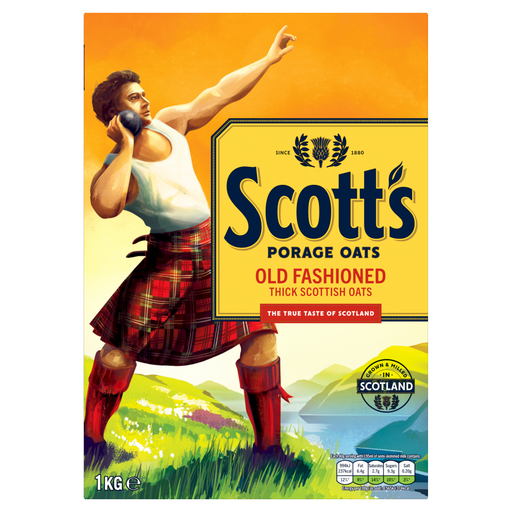 Image unavailable
Scotts Porage Oats Old Fashioned Porridge Oats 1kg
For adjustable or shared weekend portions with microwave or hob access.
1kg bulk pack; 100% rolled oats; 0g salt per 100g; stated 40g serving method and 2–3 minute microwave preparation.
May contain wheat and barley. Portions need measuring rather than coming in individual sachets.
View on Joybuy
 Image unavailable
Flahavan’s Organic Porridge Oats 1kg
For a plain bulk oat option when you want to portion the bowl yourself.
1kg bulk pack; 100% organic wholegrain oat flakes; less than 0.01g salt per 100g.
Contains oats and is described as containing gluten. Check the current pack instructions for equipment and preparation time before buying.
View on Joybuy
Frequently asked questions
What counts as low salt on a UK food label?
For foods, 0.3g salt or less per 100g is the guide figure for low salt, according to nidirect. Compare dry products per 100g where possible, as a serving figure alone can be difficult to compare when serving sizes differ.
Does a low-salt instant oat product make the finished porridge low in salt?
No. The label describes the product as sold; milk, flavoured toppings, nut butters, syrups and any salt added during preparation can change the finished bowl. The NHS states that adults should have no more than 6g of salt a day from all food and added salt.
Can I microwave every instant porridge pot?
No. The cited Sainsbury’s Original porridge pot instructs you to add boiling water, stand for 2–3 minutes and not microwave it. Follow the directions on the exact pot rather than using sachet instructions.
Are ordinary oats automatically gluten-free?
No. Under UK food rules, a gluten-free claim is conditional on the food containing no more than 20mg/kg gluten, and oats remain an allergen in their own right. Choose a specifically labelled gluten-free product where required and check the exact allergen statement.


