Hosts looking for reduced-sugar custard creams
Compare sugars per 100g, but check the product’s claim separately. Being lower in sugar than another conventional biscuit does not make a custard cream a reduced-sugar product.


Neither Tesco, Asda nor Sainsbury’s presents its standard custard creams as reduced sugar; their listings give 26.5–29g sugars per 100g and mark sugars per biscuit as high. If a reduced-sugar product is the requirement for your festival table, look for an explicit claim on the product and compare its nutrition information. A lower figure in a comparison of ordinary biscuits, a smaller pack or a free-from label does not establish that claim.
The first decision is whether your festival table needs a biscuit with a reduced-sugar claim, a conventional custard cream, or an option for particular dietary requirements.
Compare sugars per 100g, but check the product’s claim separately. Being lower in sugar than another conventional biscuit does not make a custard cream a reduced-sugar product.
Per-100g figures help you compare biscuits on the same basis; the per-biscuit figure helps you read the information for a serving. Do not assume a product described informally as suitable for diabetes has a special benefit.
Check sugar and allergen suitability separately. The standard Asda, Tesco and Sainsbury’s products checked contain wheat and milk or whey-containing ingredients; the Schär listing describes its custard creams as wheat-free, lactose-free and vegan.
Start with the reason for choosing a different biscuit, then compare the relevant label information on the exact product you plan to serve.
| Priority | What to check | Your needs |
|---|---|---|
| Reduced-sugar claim | Look for an explicit reduced-sugar claim on the product. Read the sugars figure per 100g and the serving information; do not substitute a free-from claim for a sugar claim. | I’m choosing biscuits specifically for a sugar-reduction requirement, so a lower number than another standard biscuit is not enough. |
| Conventional biscuits | Sainsbury’s lists 26.5g sugars per 100g, Tesco 28.3g and Asda 29g. Their retailer listings each mark sugars per biscuit as high; none of these three listings presents the product as reduced sugar. | If I’m serving conventional custard creams, I can compare these three on a per-100g basis without treating the lowest figure as a reduced-sugar claim. |
| Serving information | Check both the per-100g and per-biscuit figures. Sainsbury’s lists 3.3g sugars per biscuit, while Tesco and Asda each list 3.4g. | I want to know what the label says for a biscuit as well as how the products compare by weight. |
| Dietary suitability | Read the exact pack’s ingredients and allergen declaration. The Schär custard creams listing says wheat-free, lactose-free and suitable for vegans, and gives 23g sugars per 100g; it does not make a reduced-sugar claim. | For a shared table, I need to check each guest’s dietary requirements without assuming that free-from also means reduced sugar. |
Sainsbury’s has the lowest sugars per 100g of the three standard own-label listings compared here, but its listing still marks sugars per biscuit as high. A relative comparison is not a reduced-sugar claim.
If that claim matters to your choice, check for it explicitly on the product and read the current nutrition panel.
Schär’s wheat-free, lactose-free and vegan labelling addresses different requirements from sugar reduction. Its listing gives 23g sugars per 100g but does not present the biscuits as reduced sugar.
Choose a free-from biscuit for the relevant dietary requirement, then assess its sugar information separately.
An online listing may not be the label on the exact pack placed on a shared table. That distinction matters when guests need to avoid particular ingredients.
Before serving, read that pack’s ingredients, allergen declaration, best-before date and storage instructions.
These references describe the particular custard-cream products or ranges in the cited listings, not every biscuit made by each brand.
The Sainsbury’s 200g listing is for standard own-label custard creams.
The Tesco listing is for a 400g pack of standard custard cream biscuits.
The Asda listing is for a 400g pack of standard custard creams.
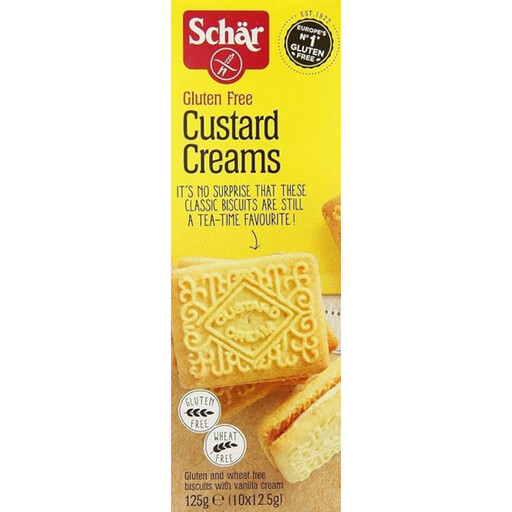
The Schär Gluten-Free Custard Creams listing describes a 125g free-from biscuit.
The Marks & Spencer biscuit catalogue includes custard creams and chocolate-coated custard creams.
This custard-cream option is relevant when a festival guest needs a gluten-free or vegan biscuit. Its free-from positioning should not be mistaken for a reduced-sugar claim.
 No image available
For a shared table where gluten-free or vegan biscuits are needed, the listing describes these custard creams as wheat-free, lactose-free and suitable for vegans. It gives 23g sugars per 100g, but does not make a reduced-sugar claim. Check the exact pack’s allergen declaration before serving.
Not on that basis alone. A lower per-100g figure in a comparison of standard products does not establish a reduced-sugar claim. Check the current product label for an explicit claim and compare its nutrition information; the Tesco, Asda and Sainsbury’s listings considered here do not present their custard creams as reduced sugar.
Sainsbury’s lists 26.5g sugars per 100g, against Tesco’s 28.3g and Asda’s 29g for the three standard own-label products compared. Sainsbury’s still marks sugars per biscuit as high and does not present the product as reduced sugar.
Not necessarily. The Schär Gluten-Free Custard Creams listing describes them as wheat-free, lactose-free and vegan and gives 23g sugars per 100g, but does not make a reduced-sugar claim. Check dietary suitability and sugar information as separate questions.
Keep the pack available so guests can read the per-biscuit and per-100g figures, and make portion sizes clear. Diabetes UK advises against relying on snacks labelled “diabetic” as offering a special benefit.
Read the allergen declaration on the exact pack you will serve. The standard Asda, Tesco and Sainsbury’s custard creams checked list wheat and milk or whey-containing ingredients; a different product’s free-from label should not be assumed to describe them.