Planners seeking a reduced-sugar biscuit
You want a familiar rich tea biscuit for a conference break, with a clear account of what its reduced-sugar description means. Sugar and energy need separate checks.


Choose McVitie’s Rich Tea The Light One if the conference break calls for a biscuit specifically described as reduced sugar: McVitie’s lists 12.8 g sugars per 100 g, compared with 18.6 g for its Classic rich tea, but lists 38 kcal per biscuit for both. If reduced-sugar labelling is not essential, standard rich tea remains an option; compare sugars per 100 g, then check allergens and the number of portions needed before ordering.
You want a familiar rich tea biscuit for a conference break, with a clear account of what its reduced-sugar description means. Sugar and energy need separate checks.
You need to identify each biscuit served and keep its ingredient and allergen information available to attendees, particularly if several products share a serving area.
You need enough biscuits for the intended servings. Pack counts help with ordering, while figures per biscuit and per 100 g answer different nutrition questions.
Decide whether a reduced-sugar description matters for the break, then compare the products on a common weight basis before planning servings and allergen information.
Choose when: The menu needs a biscuit identified as reduced sugar; McVitie’s describes The Light One this way.
Keep in mind: McVitie’s lists 38 kcal per biscuit for both The Light One and Classic, so the sugar description does not establish a lower-energy serving.
Choose when: Reduced-sugar labelling is not essential and a conventional round biscuit suits the serving plan.
Keep in mind: The checked Tesco, Asda and McVitie’s Classic products have different listed sugar figures and are not identified here as reduced-sugar products.
Choose when: Smaller individual pieces suit the way biscuits will be offered at the break.
Keep in mind: Waitrose lists 1.0 g sugars per finger but 19.3 g per 100 g; a smaller piece does not establish a reduced-sugar recipe.
| Priority | What to check | Your needs |
|---|---|---|
| Sugar and energy | Compare sugars per 100 g before comparing differently sized biscuits. McVitie’s lists 12.8 g for The Light One and 18.6 g for Classic; both list 38 kcal per biscuit. Its 30% less-sugar claim uses a typical semi-sweet biscuit as the comparator. | I want to describe the biscuit accurately without treating reduced sugar as a promise of fewer calories. The NHS’s food-label guide sets its low-sugar threshold at 5 g or less per 100 g, which The Light One exceeds. |
| Allergens | Check the current pack’s ingredients and precautionary statements for every product served. Keep each product identifiable when transferring biscuits to a serving area. | Attendees need to be able to check the biscuits they are offered. The Food Standards Agency says food businesses must provide allergen information for prepacked and non-prepacked food. |
| Portions | Work from the intended number of biscuits per serving and the pack’s approximate count, not its weight alone. McVitie’s lists about 36 The Light One biscuits per 300 g pack; Waitrose lists about 50 fingers per 250 g pack. | I need to estimate enough servings for the breaks planned, including whether people will be offered one biscuit or more than one. |
| Serving and storage | Check the required quantity and delivery arrangements for the event. Follow the selected pack’s storage instructions; Tesco and Waitrose advise airtight storage after opening. | If biscuits will be offered over several breaks, I need a way to keep opened packs stored as instructed while retaining their product information. |
McVitie’s lists 12.8 g sugars per 100 g for The Light One, above the NHS food-label guide’s low-sugar threshold of 5 g or less. McVitie’s also lists the same 38 kcal per biscuit for The Light One and Classic.
Use the product’s stated sugar comparison when describing it, and check its energy figure separately.
Waitrose lists 1.0 g sugars per rich tea finger and 19.3 g per 100 g. McVitie’s lists 1.1 g per The Light One biscuit and 12.8 g per 100 g. The individual pieces are not the same size.
Use per-100 g figures to compare the products, then use per-biscuit figures for the portions you intend to serve.
The checked products have different ingredients and precautionary statements. Without a clear link between each serving dish and its pack, attendees cannot readily identify which information applies.
Record the product name and current pack details before setting out biscuits, and keep that information available at the serving point.
These product-page figures help compare particular rich tea biscuits; they do not mean every product from a retailer has the same recipe or allergen advice.
The Light One provides a specifically reduced-sugar rich tea alongside McVitie’s Classic.
Its 300 g own-label rich tea biscuits offer a standard round-biscuit comparison.
Its 300 g own-label rich tea pack includes a suggested serving count.
Its own-label 200 g rich tea pack provides another standard-biscuit comparison.
Its rich tea fingers offer a smaller individual shape for serving.
Its 300 g rich tea biscuits provide a standard-product comparison.
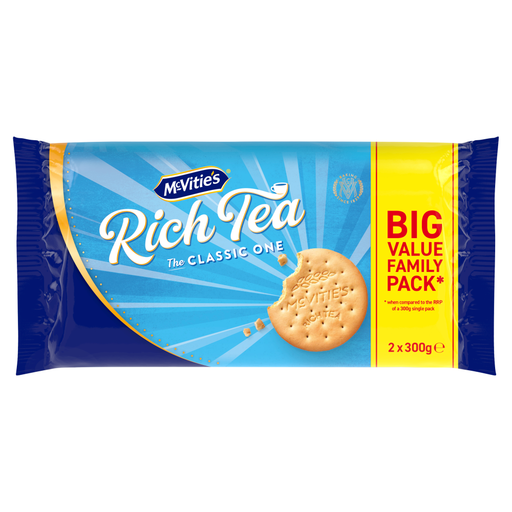
This twin pack is a standard McVitie’s rich tea option for planning a larger biscuit order; it is not The Light One reduced-sugar product.
 No image available
The twin-pack format may suit an event needing more than one pack of standard rich tea. It contains two 300 g packs; it is not The Light One reduced-sugar variant. Check the biscuit count and current pack’s ingredient and allergen details against your serving plan.
No. McVitie’s compares The Light One’s sugar content with a typical semi-sweet biscuit, but lists 38 kcal per biscuit for both The Light One and its Classic rich tea. Check energy separately from the sugar claim.
Start with the number of servings you plan to offer and the number of biscuits in each, then use the chosen pack’s approximate count to work out whole packs. McVitie’s lists about 36 The Light One biscuits per 300 g pack; Waitrose lists about 50 fingers per 250 g pack. Neither count sets a serving allowance for your event.
No. Check the ingredients and precautionary statements on the particular pack. McVitie’s The Light One has wheat and barley ingredients and says it may contain soya; other rich tea products have different statements.
The Food Standards Agency says food businesses must provide allergen information for both prepacked and non-prepacked food. Keep the information for each biscuit identifiable and available to attendees; for non-prepacked food, the agency recommends written information supported by a conversation.
Follow the selected product’s storage instructions. Tesco and Waitrose product pages advise cool, dry storage and an airtight container once opened. Retain the original pack details so the biscuits can still be identified for ingredient and allergen checks.