Hosts seeking a reduced-sugar rich tea
If you want a familiar biscuit for a shared tea break, check whether a reduced-sugar claim applies to the product itself. A smaller biscuit can show less sugar per piece without having less sugar per 100g.


Choose McVitie’s Rich Tea The Light One if you want a rich tea sold with a reduced-sugar claim: Tesco Groceries lists 12.8g sugars per 100g, while the maker’s 30%-less-sugar comparison is with a typical semi-sweet biscuit. If that claim is not essential for your book club, compare ordinary rich teas by sugars per 100g, then check biscuit size, ingredients and the current pack information before serving guests.
If you want a familiar biscuit for a shared tea break, check whether a reduced-sugar claim applies to the product itself. A smaller biscuit can show less sugar per piece without having less sugar per 100g.
If guests have allergies or other ingredient restrictions, keep the packaging available and check its ingredients and allergen information before putting biscuits out.
Start with the claim on the pack, use per-100g figures to compare different biscuits, and use per-biscuit figures to plan what to serve.
| Priority | What to check | Your needs |
|---|---|---|
| Sugar comparison | Read exactly what any reduced-sugar claim compares. Compare sugars per 100g across products, then use sugars per biscuit alongside biscuit size when planning servings. Tesco Groceries lists McVitie’s The Light One at 12.8g per 100g and 1.1g per biscuit; its maker compares it with a typical semi-sweet biscuit. | I want a rich tea sold with a reduced-sugar claim, not just a small biscuit with a low per-piece figure. |
| Other nutrition | Check energy separately from sugars; a reduced-sugar claim does not state that energy is reduced. Check which nutrient a “reduced fat” claim concerns: Tesco Groceries lists its Reduced Fat Rich Tea at 20.1g sugars per 100g. | If energy matters to my choice too, I want to read both figures rather than treat “reduced fat” as another way of saying “reduced sugar”. |
| Ingredients and allergens | Read the current pack’s ingredients, emphasised allergens and any relevant precautionary warnings. The McVitie’s listing includes wheat and barley; Ocado lists nut, peanut and milk allergy warnings for M&S Rich Tea. | Guests may have different restrictions, so I need the pack information at hand when serving them. |
| Group servings | Check pack weight and the stated biscuit count where available. Tesco Groceries lists approximately 36 biscuits in the 300g The Light One pack; Waitrose & Partners lists approximately 50 smaller Fingers in its 250g pack. Follow the pack’s storage directions after opening. | For a shared plate, I want enough individual biscuits and a way to store any left over. |
Tesco Groceries lists 20.1g sugars per 100g for Tesco Reduced Fat Rich Tea; its stated 30% reduction concerns fat. McVitie’s The Light One is separately described as reduced sugar.
Read which nutrient the claim names, then compare sugars per 100g.
Waitrose & Partners lists 1.0g sugar per Rich Tea Finger and 19.3g per 100g. Tesco Groceries lists 1.1g per McVitie’s The Light One biscuit and 12.8g per 100g. The per-piece figures alone give a different impression.
Use per-100g figures for the product comparison and per-biscuit figures when planning servings.
A reduced-sugar description says nothing about allergen suitability. The listed products include allergenic ingredients or warnings that guests may need to see.
Ask about relevant restrictions and keep the current packaging available so guests can check it before eating.
These listings illustrate different claims, biscuit sizes and label details; a brand name alone does not establish a reduced-sugar choice.
Tesco Groceries lists Rich Tea The Light One as a reduced-sugar biscuit. Its maker’s 30%-less-sugar comparison is with a typical semi-sweet biscuit.
Tesco’s ordinary Rich Tea and separate Reduced Fat Rich Tea show why the wording of a claim matters.
Sainsbury’s lists an ordinary Rich Tea in a 200g pack.
Ocado lists M&S Rich Tea as an ordinary round biscuit in a 300g pack.
Waitrose Rich Tea Fingers offer a smaller-biscuit format rather than an established reduced-sugar option.
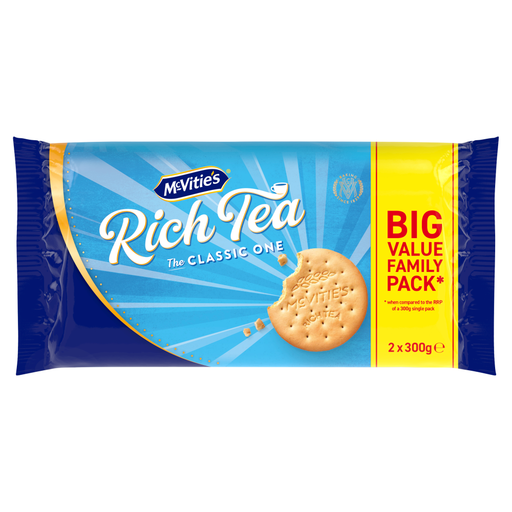
This twin pack is an ordinary rich tea option for sharing at a book club when a reduced-sugar claim is not required.
 No image available
The 2x300g twin pack is an option for serving ordinary rich tea biscuits to a group; it is not the reduced-sugar The Light One variant. Check the current pack’s nutrition and allergen information against your guests’ needs.
The UK nutrition-claims rule requires a reduction of at least 30% against a similar product for a “reduced sugar” claim. Tesco Groceries states that McVitie’s comparison for Rich Tea The Light One is with a typical semi-sweet biscuit, not every other rich tea.
No: a reduced-sugar claim does not establish a reduction in energy. The listed McVitie’s The Light One contains 452kcal per 100g, so compare the energy figures separately if they matter to your choice.
Ask guests about relevant restrictions and check the current pack’s ingredients and allergen information before serving. A reduced-sugar description does not establish allergen suitability; the listed McVitie’s The Light One contains wheat and barley.
Follow the pack directions: keep McVitie’s Rich Tea The Light One in a cool, dry place and use an airtight container after opening. Keep the packaging available if guests need to check its ingredients.