Hosts offering a lower-sugar choice
If sugar content matters to your guests, compare both the per-100g figure and the amount per biscuit. A reduced-sugar claim does not, by itself, mean a biscuit is low in sugar.


If offering a biscuit with less sugar is the priority, compare sugars per 100g before choosing a Rich Tea pack: Tesco Groceries lists 12.8g for McVitie’s The Light One and 16.0g for its standard Rich Tea. The Light One is not classified as low in sugar under the NHS guide of 5g or less per 100g. A reduced-fat label answers a different question; check the actual pack’s ingredients and allergen advice for your guests.
If sugar content matters to your guests, compare both the per-100g figure and the amount per biscuit. A reduced-sugar claim does not, by itself, mean a biscuit is low in sugar.
Read the ingredients and precautionary allergen advice on the pack you intend to serve. Neither a reduced-sugar description nor a vegan description settles an individual guest’s allergy requirements.
Standard, reduced-sugar and reduced-fat Rich Tea packs answer different preferences. Check which nutrient matters to your guests, then consider biscuit size and how many people you are serving.
Start with the nutrient you want to compare, using the per-100g label for like-for-like figures. Then check the amount per biscuit, the ingredients and the pack format for your coffee morning.
| Priority | What to check | Your needs |
|---|---|---|
| Sugar content | Compare total sugars per 100g, then per biscuit. Tesco Groceries lists McVitie’s The Light One at 12.8g per 100g and 1.1g per biscuit, against 16.0g and 1.5g for its standard Rich Tea. McVitie’s 30%-less-sugar claim compares its biscuit with a typical semi-sweet biscuit, not every Rich Tea pack. | I want to offer a biscuit with less sugar than the standard pack I am considering, without assuming that a reduced-sugar claim means low sugar. The NHS guide defines low sugar as 5g or less of total sugars per 100g. |
| Other nutrition figures | Check fat and energy separately from sugars. Tesco Groceries lists 8.7g fat and 20.1g sugars per 100g for its reduced-fat Rich Tea, versus 14.2g fat and 16.0g sugars for its standard pack. Its listings give 452kcal per 100g for McVitie’s The Light One and 449kcal for standard Tesco Rich Tea. | If fat content matters more to my guests than sugar content, I need to compare fat figures directly. I would not assume that a reduced-fat or reduced-sugar pack also has less of every other nutrient. |
| Ingredients and allergens | Read the actual pack’s ingredients and precautionary advice. The researched McVitie’s The Light One lists wheat and barley ingredients; the M&S Rich Tea listing carried milk, nut and peanut allergy precautions, according to Ocado’s product information. | Before putting out a shared plate, I need to know whether each guest can have the particular biscuits I bought. |
| Serving format | Check pack weight and the stated biscuit count, then use per-biscuit figures for the portion you plan to serve. Tesco Groceries lists approximately 36 biscuits in a 300g pack of McVitie’s The Light One. Waitrose lists its Rich Tea fingers as a 250g pack with approximately 50 fingers. | I want enough biscuits for the gathering, and a smaller biscuit may suit how I plan to serve them. I would still use per-100g figures to compare the recipes. |
Tesco Groceries lists 20.1g sugars per 100g for its reduced-fat Rich Tea, compared with 16.0g for its standard Rich Tea.
Decide whether fat or sugar is the figure you want to compare, then read that figure on both packs.
Waitrose lists 1.0g sugars per Rich Tea finger but 19.3g per 100g. Biscuit size changes the per-piece figure.
Use sugars per 100g to compare products, then the per-biscuit figure to plan what you will serve.
The researched M&S Rich Tea listing includes precautions for people with milk, nut and peanut allergies. A description addressing another dietary preference does not replace those warnings.
Check the pack you have bought and ask affected guests about their requirements before serving.
These figures describe the specific Rich Tea products named below, not every biscuit made by each brand.
The Light One is the researched reduced-sugar Rich Tea option.
Its researched standard and reduced-fat Rich Tea packs show why the nutrient named on the pack matters.
The researched 300g Rich Tea is a standard-pack comparison.
The researched Rich Tea comes in a 200g standard pack.
The researched Rich Tea listing is another standard-biscuit reference, with allergy advice worth reading before serving.
The researched Rich Tea fingers offer a different biscuit size from the round-biscuit packs.
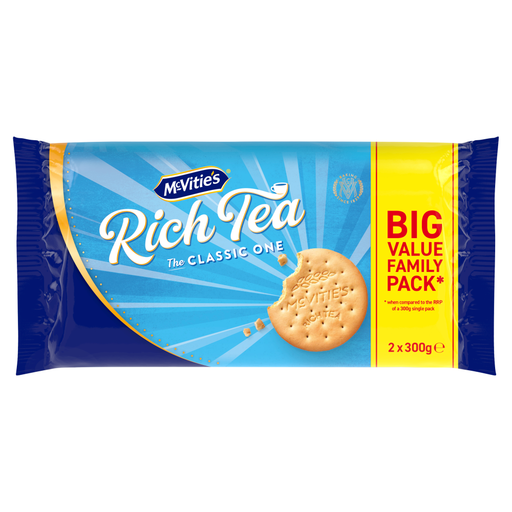
This standard Rich Tea twin pack is an option when you want biscuits to share at a coffee morning. Choose by the pack’s sugar information if offering a reduced-sugar biscuit is your priority.
 No image available
A standard Rich Tea choice for a coffee morning where a reduced-sugar biscuit is not the priority. The twin pack contains 2x300g; check its nutrition and allergen information on the pack before serving.
No. McVitie’s compares The Light One with a typical semi-sweet biscuit, and Tesco Groceries lists 12.8g total sugars per 100g for it. The NHS guide describes food with 5g or less total sugars per 100g as low in sugar.
No. East Lancashire Hospitals NHS Trust’s children’s diabetes service advises using total carbohydrate, rather than “of which sugars”, when counting carbohydrates. Let the guest use the pack label and their own dietary plan to decide what to have.
Read the actual pack’s ingredients and precautionary allergen advice, and check the guest’s requirements. The researched Rich Tea listings include wheat and barley ingredients, while the M&S listing also gives milk, nut and peanut precautions. A vegan description does not override allergy advice.
Follow the instructions on the particular pack. The researched McVitie’s reduced-sugar Rich Tea and Waitrose Rich Tea fingers both direct buyers to use an airtight container after opening.