Family-meal reheaters
Consumers reheating peas, leftovers or plated food who need their regular dishes to fit comfortably inside the microwave.


For reheating cooked peas alongside a family meal, start with a freestanding solo microwave that accommodates your usual serving bowl or dinner plate. Check that the dish fits and, if the microwave has a turntable, rotates freely; choose extra cooking modes or built-in installation only if you need them for other tasks. Whatever the heating features, stir the peas partway through reheating and check that they are piping hot throughout.
Consumers reheating peas, leftovers or plated food who need their regular dishes to fit comfortably inside the microwave.
Consumers concerned about unevenly heated food who want adjustable settings or are considering model-specific inverter and sensor-reheat features.
Consumers who also want grill or convection functions, or need a microwave that fits into kitchen cabinetry.
Check the dish you use most often and how you prefer to control reheating before deciding whether additional cooking functions are worth considering.
| Concern | What to check | Who this matters to |
|---|---|---|
| Dish and portion fit | Compare your widest bowl or plate with the internal dimensions and turntable diameter; allow for free rotation. | If I serve peas in a large bowl, I need it to fit without catching the sides. Around 34% of consumers put dish and portion fit first. |
| Reheating control | Check the adjustable power settings and controls; stir food partway through heating and check it is piping hot throughout. | When reheating cooked vegetables, I want to avoid a hot edge and a cool centre. Reheating control is the primary concern for around 33% of consumers. |
| Daily use and cleaning | Try the control layout and check whether the turntable is removable and suitable for dishwasher cleaning. | For a side dish I reheat regularly, I want controls I can use easily and a straightforward clean-up. Around 20% of consumers prioritise daily use and cleaning. |
| Other cooking needs | Choose grill or convection functions only if you will use them; for a built-in model, check the specified cabinet opening and installation requirements. | If the appliance must also handle other cooking tasks or fit into cabinetry, those requirements shape my choice. Around 13% of consumers put additional functions or integrated installation first. |
Microwaves with similar litre capacities can have different turntable sizes. Your regular serving bowl may not rotate freely in every model.
Measure the bowl or plate and compare it with the turntable diameter and internal clearance before buying.
Inverter or sensor-reheat features do not replace food-safety checks. Guy's and St Thomas' NHS Foundation Trust advises stirring food partway through microwave heating and not reheating cooked food more than once.
Stir the peas halfway through, then check they are piping hot throughout before serving.
Grill, convection and built-in installation serve purposes beyond reheating peas and bring different space or installation requirements.
Choose a solo model if reheating is your main task; consider a combination or built-in model when you will use its other functions or need an integrated fit.
An integrated model also requires a suitable cabinet opening and, where specified by its manufacturer, installation by a suitably qualified person.
Containers not designed for microwave use can create safety or appliance-damage risks. Electrical Safety First advises using items clearly marked microwave-safe.
Check the container's microwave-use instructions before heating; do not use unsuitable foam trays or plastic storage bags.
The NN-ST65QB is a larger solo-microwave example for consumers considering a roomy turntable and automatic reheat controls.
Its cited range includes a 25L solo microwave and a built-in combination model for different kitchen arrangements.
The K25MS24 is a 25L solo-microwave specification example with physical controls.
The MCG 25 is a 25L flatbed combination-microwave example for consumers who also need other cooking modes.
These solo microwaves are options to consider when reheating is the main task. Compare the size of your usual serving dish with each model's internal clearance before choosing.
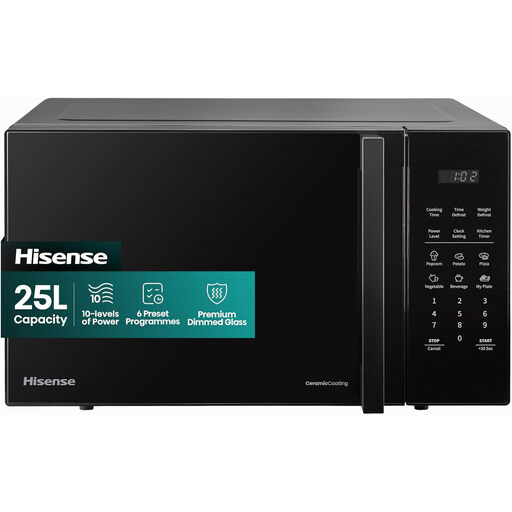 Image unavailable
Consider this model for family-meal reheating if your serving bowl fits and rotates freely.
The product title specifies a 25L cavity, 900W microwave output and auto defrost.
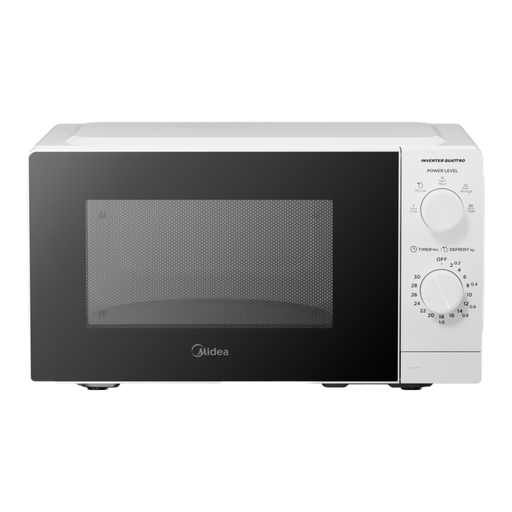 Image unavailable
This 20L model is worth considering if you prefer manual controls and your serving bowl fits inside.
The product title specifies 700W output, MET Inverter Technology and an energy-saving mode. Confirm the turntable diameter and internal clearance against your dish.
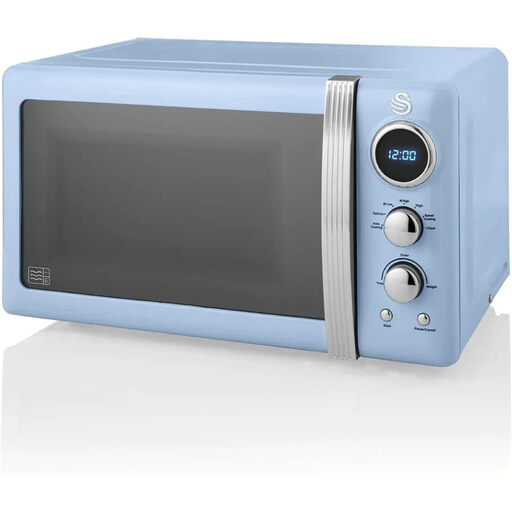 Image unavailable
Consider this model if you want digital controls for reheating and your family serving dish fits.
The product title specifies 800W output, five power levels, a glass turntable and a defrost setting. Check the turntable diameter and internal clearance for your bowl.
Choose by the size of your regular bowl or plate, not capacity alone. Roughly 20–25L is a typical family-sized range, but you still need to check the internal clearance and whether your dish can rotate freely.
No. Those features do not replace checking the food: Guy's and St Thomas' NHS Foundation Trust advises stirring food partway through microwave heating, checking it is piping hot throughout and not reheating cooked food more than once.
Use a container clearly marked microwave-safe. Electrical Safety First advises against using foam trays or plastic storage bags that are not specifically designed for microwave use; follow any instructions supplied with your container.
Check whether the turntable is removable and whether its manufacturer permits dishwasher cleaning. Clean the microwave and turntable according to the model's instructions after splatters or spills.