Quick leftover reheaters
You usually want to warm one baked potato using straightforward time and power controls, without extra cooking functions.


For reheating an already-cooked baked potato, choose a solo microwave if you mainly want to warm it through; a potato programme is optional. Consider a microwave with a grill if you also want to brown the skin, and check that your usual plate fits whichever model you choose. The Food Standards Agency advises reheating food thoroughly until the centre reaches a safe temperature.
You usually want to warm one baked potato using straightforward time and power controls, without extra cooking functions.
You want a browned finish as well as a hot centre, so a model with a separate grill function is worth considering.
You need a microwave that fits your available space while still taking the plate you use for a baked potato.
Decide whether you want to brown the potato after reheating, then check plate fit and the controls you would use day to day. A potato programme can offer a starting setting, but it does not replace checking the centre.
| Concern | What to check | Who this matters to |
|---|---|---|
| Simple reheating | Check the timer, power settings and whether the controls make it easy to add a little more time. | If I mostly warm leftover potatoes, I want to set the time without navigating extra cooking modes. Around 40% of consumers put simple reheating first. |
| A browned finish | Look for an explicitly stated grill function and check the instructions for suitable accessories. | If the skin's finish matters to me, warming the centre alone will not meet that preference. Roughly 30% of consumers prioritise browning. |
| Fit and guided use | Compare your plate with the turntable and cavity, measure the available worktop space, and check what any potato programme is designed to do. | With limited worktop space, I need my usual plate to fit; a guided setting would be useful too. About 30% of consumers place fit and guided use first. |
A solo microwave does not have the additional grilling element used to brown suitable foods. Which? distinguishes grill microwaves on that basis.
If a browned finish matters, check that the exact model has a grill and follow its instructions for the grill and any rack.
Programmes vary between models and food conditions. Finishing a preset does not replace checking the potato itself.
Use the programme as a starting setting, follow any standing-time instructions and check that the centre is thoroughly hot before eating.
Capacity does not tell you whether your plate fits on the turntable or whether the appliance fits your worktop.
Measure your plate and available space, then check the exact model's turntable, cavity, external dimensions, door clearance and ventilation instructions.
The Food Standards Agency advises reheating food thoroughly until it reaches a safe temperature in the centre.
Reheat the portion you plan to eat and check the centre rather than judging it only by the surface.
Panasonic offers examples of compact solo and microwave-and-grill models relevant to this choice.
Russell Hobbs has 20L, 800W solo models with different approaches to controls and programmes.
Samsung's MS23DG4504ATE3 is a 23L solo-microwave example for buyers considering more cavity space.
The Sharp YC-MS02U-B is a compact solo-microwave example with a jacket-potato programme.
These choices include solo microwaves for straightforward reheating and a combination model with a grill for a separate browning step. Compare the stated size and functions with your plate, worktop and preferred way of reheating.
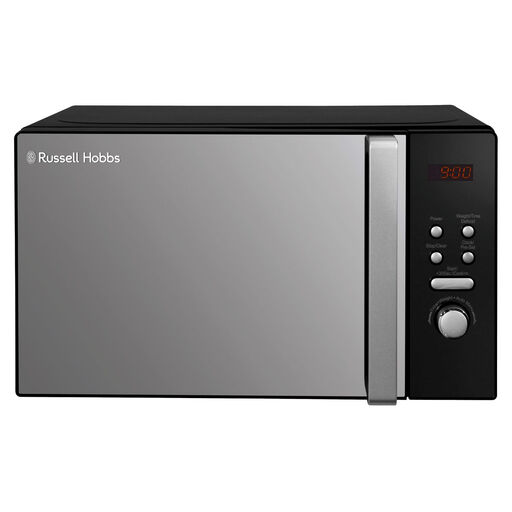 No image available
Consider this model if you want timed reheating with a choice of power settings. Its stated microwave output is 800W, and its name specifies five power levels; check the plate and cavity measurements against your usual dish.
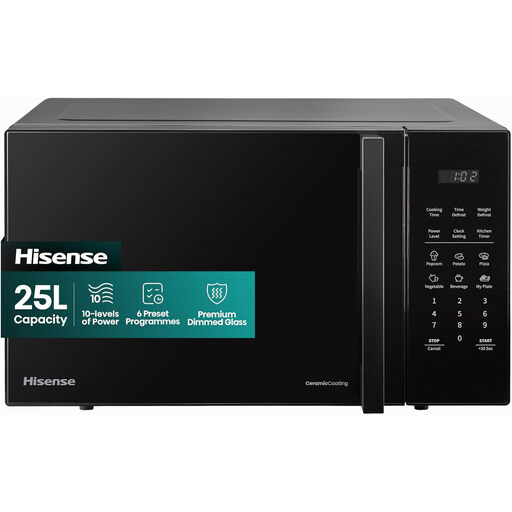 No image available
Consider this solo model if you want a 25L cavity for reheating. Its stated microwave output is 900W; if a guided potato setting matters, check the exact programme names and instructions.
 No image available
Consider its grill if you want a browning step after reheating; the additional cooking modes are not needed simply to warm a potato. The stated outputs are 900W for the microwave and 1000W for the grill. Check the instructions before using grill accessories or presets.
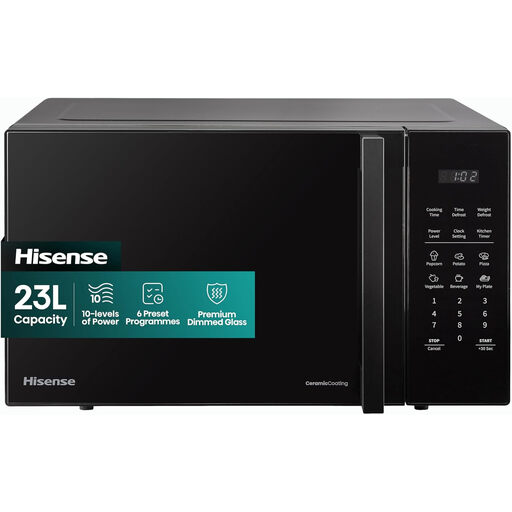 No image available
This solo model is an option for reheating without a grill. Its stated microwave output is 800W; confirm the control layout before buying, as the product title and descriptions differ on that detail.
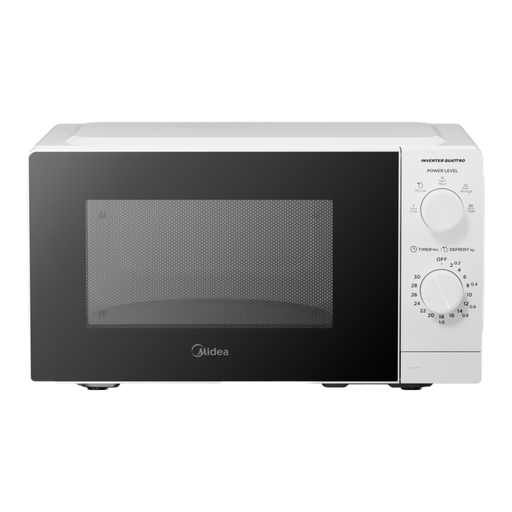 No image available
Consider this model if manual time and power controls suit the way you reheat leftovers. Its stated microwave output is 700W; check the cavity and turntable measurements against your plate before choosing it.
No: a solo microwave can warm an already-cooked potato. Choose a grill model if you also want a browning step; Which? describes its built-in grilling element as useful for crisping suitable dishes.
No: it is an optional starting setting rather than a requirement for reheating. Programme names and intended uses vary by model, so check the exact instructions and make sure the centre is thoroughly hot.
Check that it is thoroughly hot through the centre, not merely warm on the outside. The Food Standards Agency advises reheating food thoroughly until the centre reaches a safe temperature; follow any standing-time directions for your microwave too.
Check your local authority's or retailer's current electrical-equipment collection arrangements before disposing of it. GOV.UK explains that UK waste electrical and electronic equipment regulations aim to reduce electrical waste sent to landfill or incineration and encourage recovery, reuse and recycling.