
24/7 Customer Support

Free returns

Same-day & Next-day Delivery

Quality Guaranteed

Unlock Your Welcome Offers: FREE Delivery | Up to 80% OFF | Free 30-day JoyPlus trial
Download the APP
Buying replacement water filter cartridges should be straightforward: match the cartridge to your system, install it and continue using filtered water. In practice, incorrect compatibility, unclear lifespan claims and misunderstood filtration measurements can turn a routine water filter replacement into wasted money.
This guide explains what UK households, renters, offices and coffee machine owners should check before ordering. It also highlights our top recommendations for different usage profiles, from tap water refills to a countertop RO filter replacement.
A cartridge may look the right size but still have a different locking mechanism, connector or internal flow path. A replacement designed for one countertop, under-sink or reverse osmosis system may not seal correctly in another.
Always check the complete model number, not just the brand name. For example, a filter for the Waterdrop WD-G3-W is not automatically suitable for every Waterdrop RO system. Coffee machine filters also require careful matching because fittings vary between Siemens, Bosch, De’Longhi, Jura, Philips, Melitta and other models.
A stated lifespan such as six or 12 months usually depends on water quality, household consumption and the cartridge’s litre capacity. A busy office may reach the volume limit before the calendar replacement date, while a lightly used household may not.
Compare both measurements where available:
Replacing on schedule is important, but do not ignore a reduced flow rate, unusual taste or the system’s filter indicator.
Total dissolved solids, or TDS, measures dissolved substances in water. A low TDS reading does not automatically describe every contaminant category, and a filter that retains minerals may not reduce TDS significantly.
An RO cartridge is designed for a different purpose from an activated carbon water filter or an ultrafiltration water filter. Check the stated filtration method and the specific reduction claims rather than relying on phrases such as “pure” or “advanced”.
Start with the appliance or system manual, then compare its model number with the cartridge listing. Check:
This is particularly important when selecting an under-sink water filter replacement, where a cartridge may connect to a dedicated cold-water tap or housing.
Different materials address different requirements:
A coffee machine water filter is not a substitute for a drinking water filter, and a tap cartridge is not necessarily suitable for a plumbed-in RO unit.
When comparing an NSF-certified water filter, check exactly what the certification covers. NSF/ANSI 42 generally relates to aesthetic effects such as chlorine and taste, while NSF/ANSI 53 concerns specific health-effect contaminants. NSF/ANSI 58 is associated with reverse osmosis systems.
Certification should be read alongside the model, tested claims and installation instructions. A listing that mentions IAPMO, TÜV SÜD, SGS or NSF standards does not mean every contaminant is reduced by every cartridge in the range. Also look for food-contact materials, BPA-free construction where stated and clear warnings about microbiologically unsafe or unknown water.
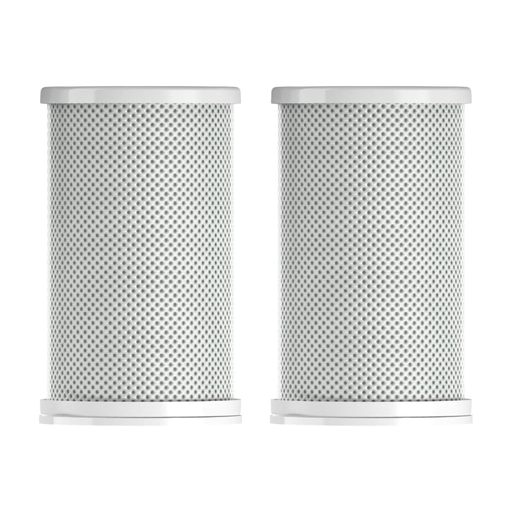
Why This Fits Their Persona: A practical choice for renters or smaller households using a compatible EcoPro or TAPP 2 tap filtration system. The two-pack covers up to six months when each cartridge is used for approximately three months.
The listing gives a defined three-month replacement interval per cartridge instead of relying only on vague “long-life” wording.
Twin-pack format; carbon-fibre filtration; stated flow rate of approximately 4 litres per minute.
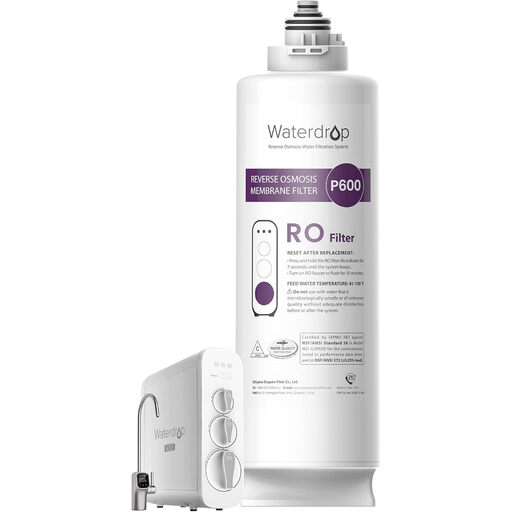
Why This Fits Their Persona: Suitable for owners of the WD-G3P600 reverse osmosis system who prioritise a longer replacement interval and documented standards.
It identifies the exact compatible system and states that it is not suitable for WD-G3P800-W or WD-G3-W models.
Listed with NSF/ANSI 58 and 372 certification; stated life of up to 24 months or 8,328 litres.
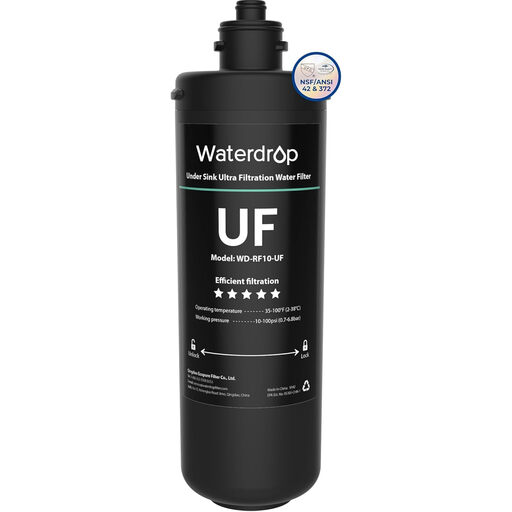
Why This Fits Their Persona: Designed for households or offices with compatible Waterdrop under-sink systems and relatively high daily water consumption.
The listing clearly states that this ultrafiltration cartridge does not reduce TDS, preventing the common confusion between fine filtration and RO performance.
0.01-micron UF membrane; stated capacity of up to one year or 30,000 litres with municipal water.
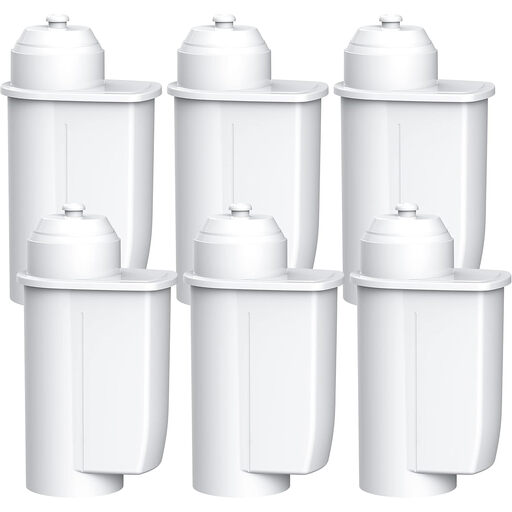
Why This Fits Their Persona: A six-pack option for compatible Siemens EQ, Bosch and Brita Intenza coffee machines, useful for frequent coffee drinkers who want planned refills.
The compatible model references are stated clearly, and the instructions specify soaking the cartridge for five to ten minutes before use.
Ion-exchange resin and granular activated carbon; recommended replacement every two months or approximately 100 litres.
We have compiled a complete, real-time list of products that fully satisfy these strict selection criteria and UK safety regulations.
Do not use a cartridge with hot water unless the instructions specifically permit it. Filters should not be used with microbiologically unsafe or unknown water without suitable disinfection.
It depends on the cartridge and usage. Tap cartridges may last two to three months, coffee machine filters often require replacement every two months, while some under-sink and RO filter cartridges are rated for six, 12 or 24 months. Follow the manufacturer’s schedule and capacity limit.
Compatibility and material safety are separate checks. Choose a cartridge that explicitly lists your appliance model and review any stated food-contact, NSF, IAPMO, TÜV SÜD or other certification details. Certification normally applies to particular materials or reduction claims, not every possible contaminant.
No. Ion-exchange coffee filters are commonly intended to reduce hardness-related scale, while activated carbon filters mainly target taste and odour. An ultrafiltration filter may retain minerals, and an RO cartridge is designed for a different filtration process. Check the exact specification before buying.