
24/7 Customer Support

Free returns

Same-day & Next-day Delivery

Quality Guaranteed

Unlock Your Welcome Offers: FREE Delivery | Up to 80% OFF | Free 30-day JoyPlus trial
Download the APP
Resistance bands can support strength training, mobility work, yoga, Pilates and home workouts without taking up much storage space. However, choosing the right set involves more than selecting a colour or the largest number of bands.
Marketing descriptions often leave out practical details such as band dimensions, material sensitivity and how resistance levels are measured. A suitable resistance band set should match your exercises, experience and available space while remaining comfortable and straightforward to maintain.
“Light”, “medium” and “heavy” are useful labels, but they are not universal measurements. A heavy mini loop resistance band may feel very different from a heavy flat resistance band or a tube with handles. Band width, thickness, length and stretch all affect the tension you feel.
Treat resistance labels as a guide within one set rather than a direct comparison between different products. A set with several levels is generally more practical for progression than one band with a fixed tension.
Loop resistance bands, flat resistance bands and handled tubes serve different purposes:
A band designed for hip abductions may not provide the length or grip needed for upper-body pulling exercises.
Latex resistance bands are elastic and widely used, but natural latex may cause allergic reactions in some people. TPE resistance bands are a latex-free option, while fabric or cotton glute bands can offer a different feel and may be less likely to roll during leg exercises.
Check the full material description rather than relying on phrases such as “skin-friendly” or “odourless”. Also inspect every band for cuts, cracks or thinning before use.
For beginners, a resistance band set with light, medium and heavy options can make it easier to learn movement control before increasing tension. More experienced users may prefer interchangeable bands or a wider range of levels for strength training.
Remember that increasing the stretch also increases tension. Do not extend a band beyond the supplier’s stated limit. Controlled movement is more useful than simply applying maximum force.
Dimensions affect usability:
If you plan to exercise in a small flat or take bands to work, a storage bag and compact format can make regular use more convenient.
Latex and TPE bands should be kept away from sharp objects, excessive heat and direct sunlight. Wipe them with a damp cloth after use and allow them to dry before storage. Fabric hip bands should be kept in their storage bag to help prevent tangling.
For handled bands, ensure clips are fully attached and maintain a stable stance. When using an anchor or door attachment, follow the product instructions and check that the connection is secure. Anyone undertaking rehabilitation or returning to exercise after an injury should follow suitable professional guidance rather than treating a resistance band as a medical device.
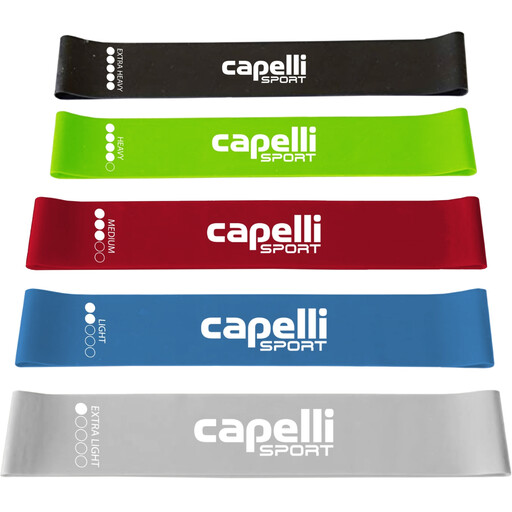
Why This Fits Their Persona: Five colour-coded levels provide a straightforward starting point for home workouts, yoga, Pilates and leg training without requiring separate purchases for each intensity.
The set states five distinct resistance levels and gives precise dimensions, rather than relying only on vague intensity wording.
Five latex mini loops; 5 cm width, 60 cm circumference and a portable travel bag.
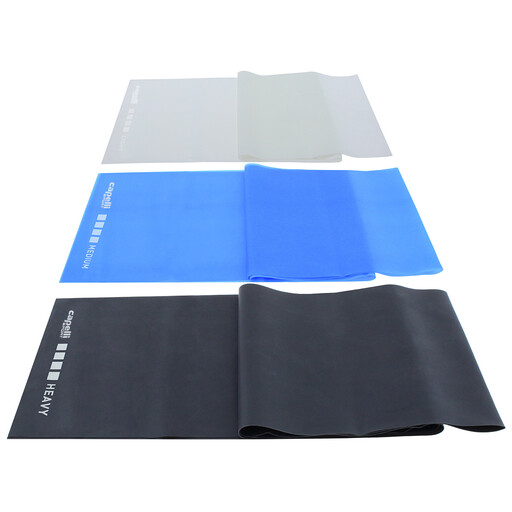
Why This Fits Their Persona: Its broad, 15 cm format suits users who want one set for Pilates, stretching, physiotherapy routines and general upper- or lower-body exercise.
The product description identifies the material, 120 cm length and three resistance levels, helping buyers compare like with like.
Light, medium and heavy latex bands; storage bag included and compatible with Pilates circles and balls.
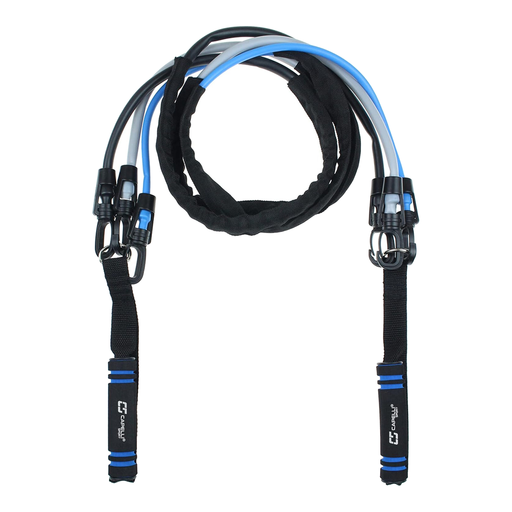
Why This Fits Their Persona: Users focused on arm curls, triceps work and progressive strength training can adjust the setup by adding or removing bands from the handles.
The interchangeable design avoids locking the user into one fixed tension, while clips can be checked before each session.
TPE construction, three resistance options, two foam handles, adjustable clips and storage strap.
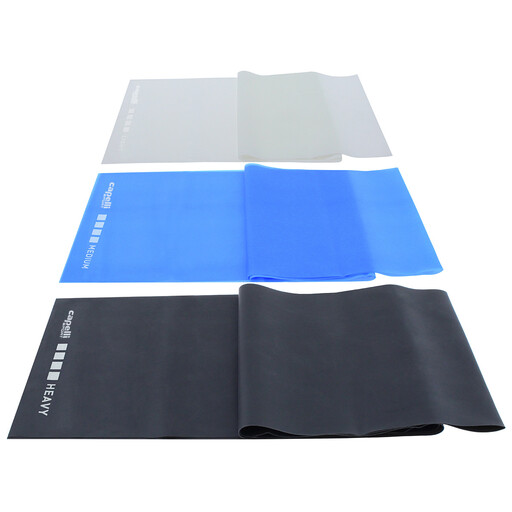
Why This Fits Their Persona: This option suits people seeking latex-free elastic exercise bands for yoga, Pilates, rehabilitation or low-impact home routines.
The material is specified as TPE and latex-free, addressing a key consideration for buyers who wish to avoid natural latex.
Three resistance levels, 15 cm by 120 cm dimensions, soft-touch surface and no installation required.
We have compiled a complete, real-time list of products that fully satisfy these strict selection criteria and UK safety regulations.
Their usable life depends on frequency of use, stretching, storage and exposure to heat or sunlight. Inspect bands before every session and replace them if you notice cracks, cuts, sticky areas, thinning or uneven elasticity. Cleaning and storing them away from sharp objects can help maintain their condition.
Yes, provided the user starts with a manageable level and learns each movement with controlled form. A set containing light, medium and heavy bands allows gradual progression. Beginners should avoid forcing a band to its maximum stretch or using a damaged band.
Neither material is universally suitable for every user. Latex bands offer elastic resistance and are common in loop and flat designs, but they may not suit people with a latex allergy. TPE resistance bands provide a latex-free alternative. Compare the stated material, dimensions, grip and intended exercises before buying.