
24/7 Customer Support

Free returns

Same-day & Next-day Delivery

Quality Guaranteed

Unlock Your Welcome Offers: FREE Delivery | Up to 80% OFF | Free 30-day JoyPlus trial
Download the APP
Resistance bands can add strength work to a small home gym, support mobility exercises or make travelling workouts more practical. However, choosing the wrong type can leave you with a band that rolls up, smells strongly, offers unsuitable resistance or wears out sooner than expected.
As the Joybuy Product Recommendation Officer, I focus on practical specifications rather than promotional wording. Here are the details worth checking before buying resistance bands in the UK.
Colour coding is useful, but colours are not standard across manufacturers. A “heavy” band from one resistance band set may feel different from another. Look for clearly stated resistance categories, dimensions and intended use rather than relying on colour alone.
A set with light, medium and heavy options can be more useful than a single band because it allows you to adjust exercises over time. For pull-up resistance bands, also check the stated load range where available.
Latex resistance bands are widely used because they are elastic and available in many shapes. However, natural latex may cause an allergic reaction in sensitive users. TPE resistance bands are latex-free and can be a practical alternative for people who prefer to avoid latex.
Material alone does not determine durability. Storage, stretching technique and contact with sharp edges also affect how long a band remains suitable for use.
Small loop resistance bands are designed for movements such as lateral steps, squats and glute activation. They are not a direct replacement for long flat resistance bands or resistance bands with handles.
Flat resistance bands are more suitable for stretching, Pilates and physiotherapy-style movements, while handled tubes can make rows, curls and shoulder presses easier to grip. A long power band is more appropriate for pull-up assistance or larger-range strength movements.
Beginners may find light or medium exercise bands easier to control, particularly for warm-ups, yoga or Pilates. Experienced users may prefer heavy strength training bands, or a set with several resistance levels for progressive exercise.
Do not assume a heavier band is automatically more useful. If you cannot maintain controlled movement, the resistance may be unsuitable for that exercise. Sets with multiple levels offer more flexibility for upper-body, lower-body and mobility work.
Dimensions affect both comfort and exercise range:
Check the dimensions before ordering, especially if you have limited room at home or want bands that fit inside a gym bag.
Latex provides a familiar elastic feel but should be kept away from direct sunlight, sharp objects and excessive heat. TPE is latex-free and is often selected for its soft-touch surface. Fabric hip bands may offer a non-slip feel around the legs and can be useful for lower-body routines.
Wipe bands with a damp cloth after use, allow them to air dry and store them in a cool, dry place. Inspect every band before exercising. Do not use one showing cracks, tears, fraying or other damage.
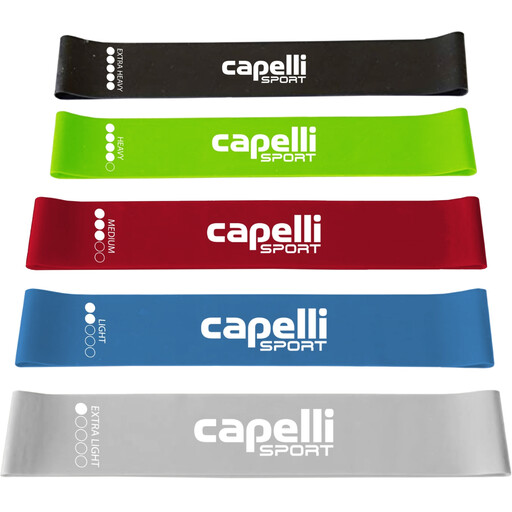
Why This Fits Their Persona: A five-piece set gives beginners several resistance options for home workouts, leg training, yoga and Pilates without requiring multiple types of equipment.
The five colour-coded levels make progression clearer than buying one band based only on colour or vague resistance wording.
Includes five resistance levels, a 60cm circumference and a travel carry bag.
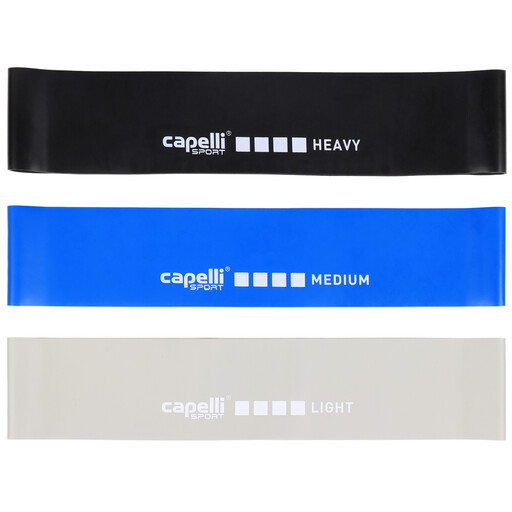
Why This Fits Their Persona: This compact three-band option suits regular users who want a simple, portable set for yoga, Pilates, physiotherapy-style exercises and general muscle training.
The stated 5cm width and 104cm circumference provide useful sizing information, rather than leaving fit and movement range unclear.
Light, medium and heavy latex bands are supplied with a storage bag.
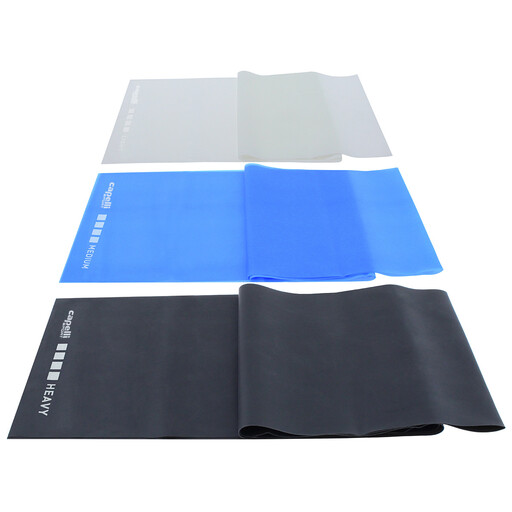
Why This Fits Their Persona: The latex-free TPE construction suits users looking for flat bands for stretching, Pilates, yoga or rehabilitation routines at home or in the office.
The product description identifies TPE as latex-free and provides separate light, medium and heavy levels.
Each band measures 15cm by 120cm and has a soft-touch, odourless TPE surface.
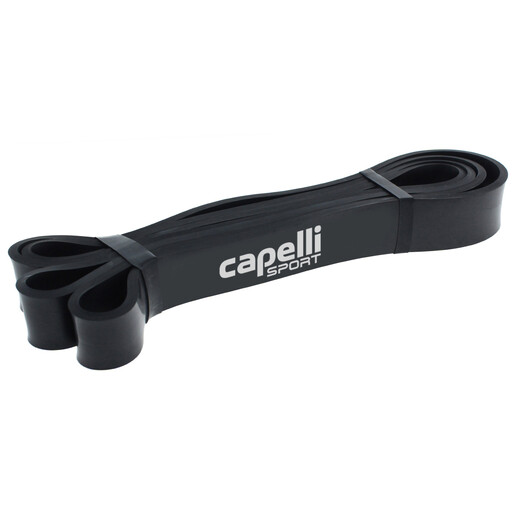
Why This Fits Their Persona: Its long-loop design is aimed at users who need a larger range of movement for pull-up assistance, body stretching and strength training.
The 208cm circumference and stated 40–50lb resistance range give more useful information than a generic “heavy-duty” label.
Natural latex construction, 2.8cm width and a long-loop format for full-body exercises.
We have compiled a complete, real-time list of products that fully satisfy these strict selection criteria and UK safety regulations.
Lifespan depends on material, frequency of use, storage and stretching distance. Inspect bands before every session and replace them if you notice cracks, thinning, tears or fraying. Keeping latex away from sunlight, heat and sharp edges can help protect the material.
They can provide resistance for many strength and toning exercises, but the training feel differs from free weights. Bands are particularly convenient for travel, warm-ups, mobility work and home workouts. Users focused on heavier progressive lifting may choose to combine them with other equipment.
Some bands are marketed for physiotherapy and rehabilitation, but the appropriate resistance and exercise depend on the individual. If you are recovering from an injury or surgery, seek guidance from a qualified healthcare professional before starting or changing a routine. Never use a damaged band or overstretch it beyond its natural range.