
24/7 Customer Support

Free returns

Same-day & Next-day Delivery

Quality Guaranteed

Unlock Your Welcome Offers: FREE Delivery | Up to 80% OFF | Free 30-day JoyPlus trial
Download the APP
Resistance bands can support strength training, mobility work, Pilates, yoga and rehabilitation without taking up much storage space. However, choosing the wrong type can lead to uncomfortable workouts, limited movement or a product that deteriorates sooner than expected.
The product description alone does not always tell you whether a band suits your routine. Before buying, look beyond colour coding and claims such as “heavy duty” or “professional quality”. The most useful checks relate to resistance level, material, dimensions and intended exercise.
There is no universal colour system across resistance band brands. A red band from one range may not provide the same resistance as a red band from another. Some listings also describe a band as light, medium or heavy without providing a measurable force range.
For beginners, a resistance band set with light, medium and heavy options is often more practical than choosing one colour or one level. It allows you to begin with controlled movement and progress gradually.
Resistance bands are designed in several formats:
A small glute band will not provide the same range of motion as a 120 cm flat band, while a pull-up band may be unnecessarily long for seated Pilates exercises.
Latex resistance bands usually offer a flexible, elastic feel, but natural latex may cause allergic reactions in sensitive users. Latex also needs protection from direct sunlight, sharp objects and excessive heat.
TPE resistance bands are latex-free and may be a useful alternative for people who prefer to avoid natural latex. TPE bands should still be kept away from sharp edges and inspected regularly. Fabric hip bands can feel more stable against clothing and may be less likely to roll during lower-body exercises, although their loop size and resistance still need to match your routine.
Consider whether you need one consistent level or several options. A light band may suit warm-ups, mobility drills or rehabilitation movements, whereas medium and heavy bands can provide more challenge for strength training.
For home workout bands, sets with three or five levels can be useful when more than one person uses the equipment or when you train different muscle groups. Keep in mind that the perceived difficulty changes as the band is stretched: a longer range of motion generally creates more tension.
Dimensions influence both comfort and exercise selection. Flat bands measuring around 120 cm long can work for upper-body, Pilates and physiotherapy movements. Wider bands may distribute pressure across the hands or legs more evenly.
For loop bands, check the circumference rather than relying only on the product title. A 60 cm mini loop band may sit differently from a 104 cm loop band. Fabric hip bands measuring approximately 38 cm by 8 cm are designed for close-fitting lower-body exercises rather than full-body pulling movements.
Handles can make resistance tube exercises more comfortable for rows, curls and shoulder presses. Look for foam or padded grips, secure straps and a handle connection that remains aligned during movement.
Flat Pilates bands and yoga resistance bands are usually held directly, tied or used around a fixed point. They offer more flexibility in positioning but require careful control. Never anchor a band to an unstable object, door handle or furniture unless the product instructions specifically permit it.
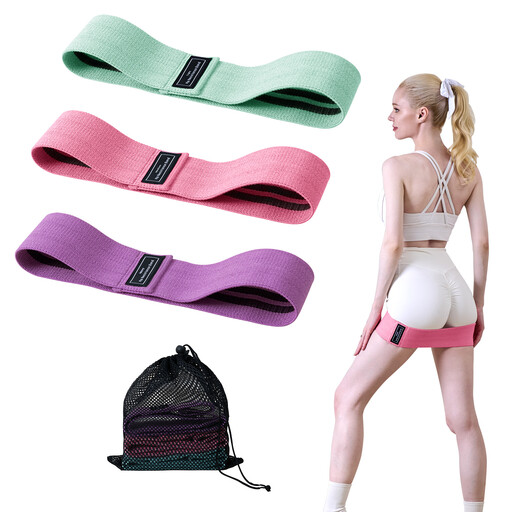
Why This Fits Their Persona: A three-band fabric set gives beginners light, medium and heavy options for home workouts, squats, Pilates and lower-body training without requiring several separate purchases.
The product specifies three resistance levels and a fabric loop design, so its intended lower-body use is clearer than a generic colour-coded band.
Cotton fabric construction, non-slip design, three bands and a storage bag.
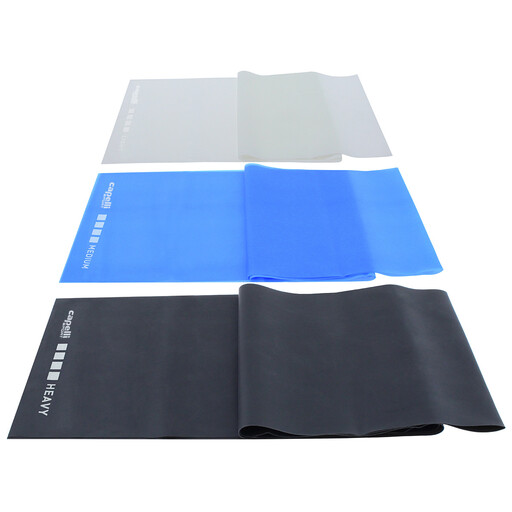
Why This Fits Their Persona: This latex-free set suits users who want soft-touch flat bands for yoga, Pilates, physiotherapy or mixed home training.
The material is clearly listed as TPE and latex-free, while each band has a stated 15 cm by 120 cm dimension.
Odourless TPE, three resistance levels and compatibility with Pilates circles and balls.
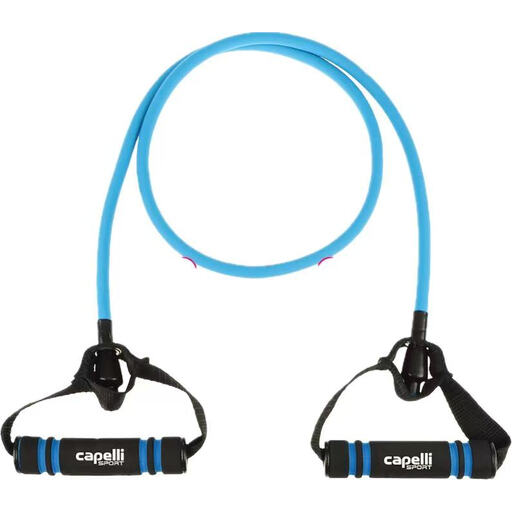
Why This Fits Their Persona: Foam handles provide a more familiar grip for rows, curls, triceps kickbacks and shoulder movements at home or in the gym.
The listing identifies a 120 cm tube, medium resistance, foam handles and a safety strap instead of relying on vague strength descriptions.
Natural latex tube, padded handles and portable single-band format.
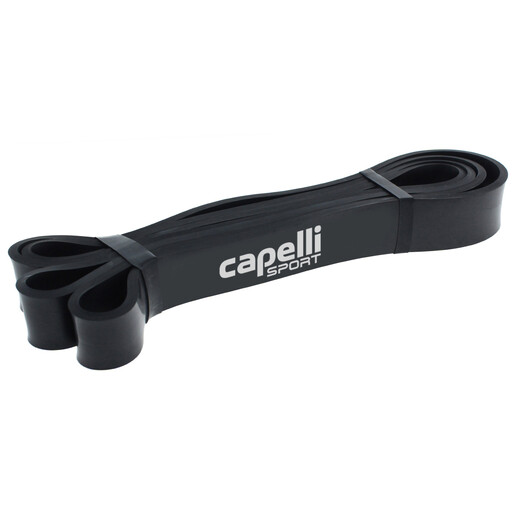
Why This Fits Their Persona: The long power-band format is intended for pull-up assistance, stretching, muscle training and larger movements requiring substantial band length.
Its 208 cm circumference and stated 40–50 lb resistance range make it more suitable for pull-up assistance than short mini loop bands.
Natural latex construction, long loop format and uses covering pull-up assistance, stretching and physiotherapy exercises.
We have compiled a complete, real-time list of products that fully satisfy these strict selection criteria and UK safety regulations.
Inspect resistance bands before every session. Look for tears, cracks, fraying, thinning or damaged handles and stop using the band if any defect appears. Avoid overstretching it beyond the stated capacity and keep the band away from your face and eyes during exercises.
Latex products should be stored in a cool, dry place away from direct sunlight. Flat TPE bands can be wiped with a damp cloth and mild soap, then air-dried fully. Do not use sharp objects to adjust or anchor a band.
When buying from a UK retailer, check the product information, warnings, material details and returns information. For physiotherapy or recovery after injury or surgery, follow guidance from an appropriately qualified healthcare professional rather than selecting resistance solely by colour or marketing language.
Yes, provided the resistance level and exercise are appropriate. Start with light resistance, use slow and controlled movements and select a set that allows progression. A resistance band should not force you to compromise posture or range of motion.
Lifespan depends on frequency of use, stretching range, storage and material. Regular inspection is more useful than relying on a fixed time period. Replace any band showing cracks, fraying, tears or permanent deformation.
Neither material is suitable for every user. Latex bands offer a familiar elastic feel but may not suit people with latex sensitivity. TPE resistance bands are latex-free and can be suitable for yoga, Pilates and physiotherapy routines. Compare the material, dimensions and resistance levels with your intended exercises before purchasing.