
24/7 Customer Support

Free returns

Same-day & Next-day Delivery

Quality Guaranteed

Unlock Your Welcome Offers: FREE Delivery | Up to 80% OFF | Free 30-day JoyPlus trial
Download the APP
Resistance bands are compact, affordable and easy to store, but choosing the wrong type can make your workouts uncomfortable or ineffective. A band that rolls up during glute exercises, stretches unevenly during rehabilitation or offers too much resistance for a beginner may quickly end up unused.
Before buying exercise resistance bands, look beyond colour and advertised resistance. The material, construction, measurements and intended use have a greater impact on whether a product suits your routine.
There is no universal colour system for light, medium or heavy resistance. One manufacturer’s purple band may not provide the same tension as another’s. Check the listed resistance level, dimensions and product description rather than relying on colour alone.
For progressive training, a resistance band set containing light, medium and heavy options is generally more adaptable than a single band. However, a three-band set is not automatically suitable for every exercise. A heavy band designed for pull-up assistance may be unsuitable for gentle Pilates or physiotherapy movements.
Loop resistance bands are convenient for glute, hip and leg exercises, while flat resistance bands offer more flexibility for yoga, Pilates and rehabilitation movements. Resistance bands with handles are easier to grip for rows, curls and shoulder presses, but they are less discreet to carry than flat or mini-loop designs.
Buying a heavy power band for general stretching, or a small glute band for assisted pull-ups, can limit how safely and comfortably you train.
Elastic materials can deteriorate when exposed to sunlight, heat, sharp edges, sweat and repeated overstretching. Fabric bands may resist rolling, while latex and TPE bands can offer substantial stretch, but every material still requires inspection and correct storage.
A responsible purchase should include clear material information, usable dimensions, cleaning instructions and safety warnings. Avoid any band showing cracks, thinning, tears or permanent distortion.
Natural latex is highly elastic and commonly used for power bands and handled tubes. It may provide a smooth stretch response, but people with latex sensitivity should choose a latex-free alternative. Keep latex away from direct sunlight and excessive heat.
TPE, or thermoplastic elastomer, is used in several flat and handled bands. The products listed here include TPE options described as latex-free or synthetic, which may be preferable for users avoiding natural latex. Always read the individual product information, particularly if allergies are a concern.
Cotton fabric can offer a softer, grippy feel. It is often selected for hip and glute training where a band needs to stay positioned around the legs. Fabric construction may be more comfortable against clothing, but it is still important to check for fraying and loss of elasticity.
Dimensions affect the range of movement and exercise suitability:
A longer band may be more versatile, but it can also be harder to control if you are new to resistance training.
Beginners may benefit from light, medium and heavy resistance bands so they can adjust tension as their control improves. For physiotherapy or rehabilitation, start with the level advised by a qualified healthcare professional rather than selecting a band based solely on colour.
For strength training, consider whether the band will be used alone, doubled or combined with another band. Never stretch it beyond its recommended range, and maintain control throughout the movement. A band should add manageable resistance without forcing poor technique.
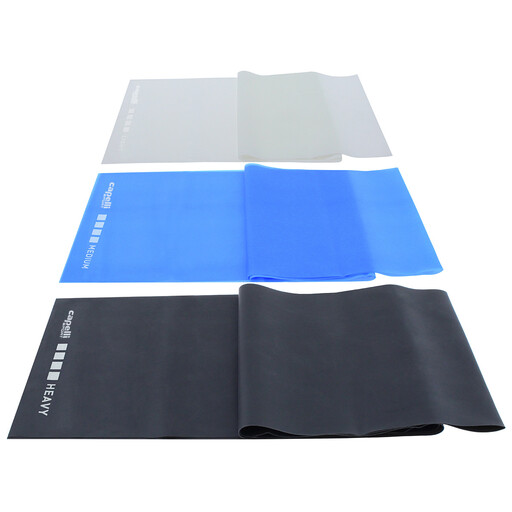
Why This Fits Their Persona: Three resistance levels give new home-workout users room to adjust their routine without buying separate bands immediately. The flat format is easy to store in a small UK home or take to the office.
The light, medium and heavy options make the resistance information clear instead of relying only on colour. TPE construction is described as latex-free, odourless and soft touch.
Three 15 x 120 cm bands; suitable for yoga, Pilates, physiotherapy and general strength training.
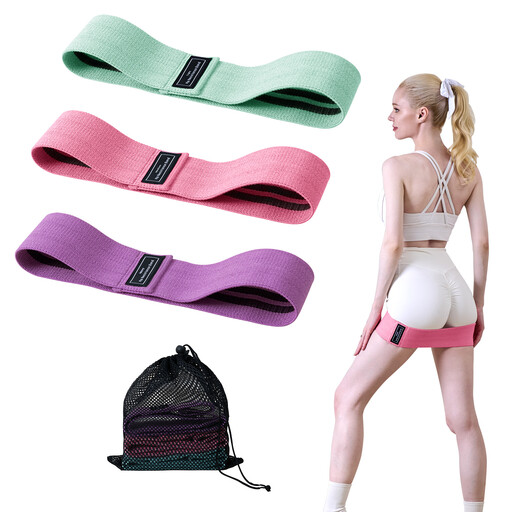
Why This Fits Their Persona: Users who prioritise comfort and stability for glute, hip and leg sessions may prefer these fabric loop bands for home fitness, Pilates and yoga routines.
The fabric construction is described as non-slip and designed to resist rolling during leg and glute movements, addressing a common comfort issue.
Set of three fabric loop bands in light, medium and heavy resistance, with a storage bag included.
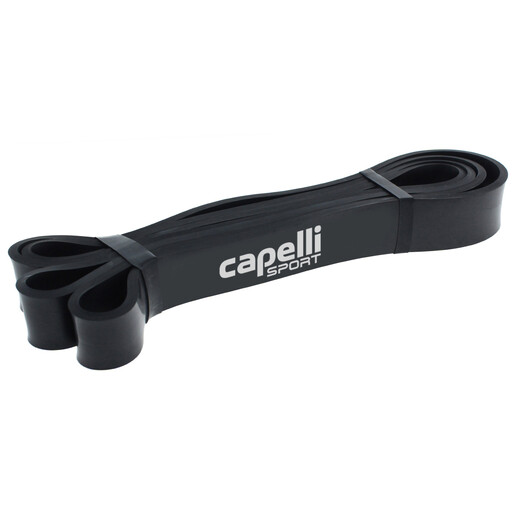
Why This Fits Their Persona: Strength-training users and people working towards assisted pull-ups need a long, continuous band rather than a small loop or handled tube.
Its stated 208 cm circumference and 2.8 cm width distinguish it from short bands intended mainly for isolated exercises. The listed resistance is 40–50 lb.
Natural latex construction; suitable for pull-up assistance, stretching, muscle training and physiotherapy exercises.
We have compiled a complete, real-time list of products that fully satisfy these strict selection criteria and UK safety regulations.
Inspect the band before every session, particularly around handles, seams and areas that receive repeated tension. Do not use a band with visible cuts, cracks, fraying or permanent stretching. Keep it away from sharp furniture edges and do not direct a stretched band towards your face.
Clean most bands with a damp cloth and mild soap, then allow them to air dry fully. Store them in a cool, dry place away from direct sunlight and excessive heat. If using latex, check the product warnings for possible allergic reactions. For physiotherapy or rehabilitation, follow the movement and resistance guidance provided by your healthcare professional.
Yes, provided the resistance level matches your current ability and you can perform each movement with control. Light bands or a set with multiple levels can help beginners develop technique before progressing to greater tension.
Lifespan depends on frequency of use, stretching range, storage and material. Regular inspection is more useful than relying on a fixed lifespan. Replace a band immediately if it develops cracks, tears, fraying or unusual thinning.
They can provide resistance for many arm, leg, glute and core exercises, but they do not replicate every feature of free weights. Bands are particularly useful for portable home workouts, warm-ups and controlled movements. Users focused on heavier strength training may combine them with other equipment.