
24/7 Customer Support

Free returns

Same-day & Next-day Delivery

Quality Guaranteed

Unlock Your Welcome Offers: FREE Delivery | Up to 80% OFF | Free 30-day JoyPlus trial
Download the APP
Resistance bands can support strength training, stretching, yoga, Pilates and general mobility without taking up much space. However, choosing the wrong type can lead to poor comfort, limited exercise options or premature damage.
Before buying, look beyond colour-coded packaging and claims such as “heavy duty”. The practical details that matter most are the band’s material, dimensions, resistance range and attachment design. This guide explains the main pitfalls and compares suitable options for different UK users.
Resistance colours are not a universal measurement. One manufacturer’s red band may provide a different level of tension from another’s red band. Check whether the set is described as light, medium and heavy, or provides a measured resistance range.
For beginners, a set with several levels is usually more flexible than a single heavy band. It allows you to start with controlled movements and adjust as your routine changes.
Many latex resistance bands offer strong elasticity and are widely used for exercise. However, natural latex may cause allergic reactions in some people. Product warnings should be read carefully, particularly if the bands will be shared at home or used in a group setting.
For users seeking latex-free resistance bands, TPE resistance bands are an alternative. TPE can provide a soft-touch surface and flexible stretch without natural latex. Always confirm the stated material rather than relying on descriptions such as “skin-friendly” or “odourless”.
A short loop resistance band is practical for leg, hip and glute exercises, but it is not a direct replacement for a long flat band with handles. Likewise, a flat band may be more versatile for stretching and upper-body movements, while an adjustable set can provide a more familiar grip for curls and presses.
Think about where you will exercise, how much space you have and whether you need portable workout bands for an office, gym bag or outdoor session.
There are three main formats to consider:
For resistance bands for legs and glutes, a mini loop can stay positioned around the legs during side steps or hip-focused movements. For yoga and Pilates, a flat band may be easier to hold in different positions.
Latex is elastic and commonly used in exercise bands, but it should be stored away from direct sunlight, heat and sharp objects. TPE is a useful option for shoppers specifically looking for a latex-free material. A soft-touch finish may improve handling, although it does not remove the need to inspect the band before use.
Do not use a band with visible cracks, tears, nicks or thinning. Avoid overstretching, as excessive tension can cause the material to snap.
A resistance band set with light, medium and heavy options supports gradual progression. It can also help different household members select a more appropriate level.
Adjustable resistance bands with handles are suitable for users who prefer a firm grip for arm curls, triceps movements and front raises. Check that clips are fully secured before exercise. If using an anchor or door attachment, follow the supplied instructions and make sure the anchor is stable before applying tension.
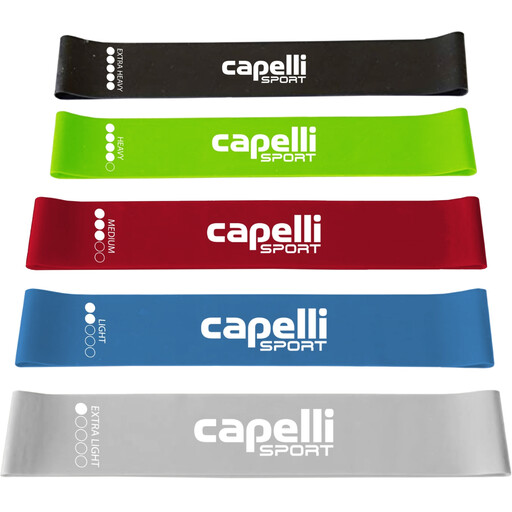
Why This Fits Their Persona: The five-band format gives new users several resistance options for home workouts, Pilates, yoga and leg-focused routines without requiring a large kit.
It states five varying levels rather than relying on one unspecified resistance and clearly identifies latex content in its safety information.
Five colour-coded bands, 5cm width, 60cm circumference and a travel carry bag.
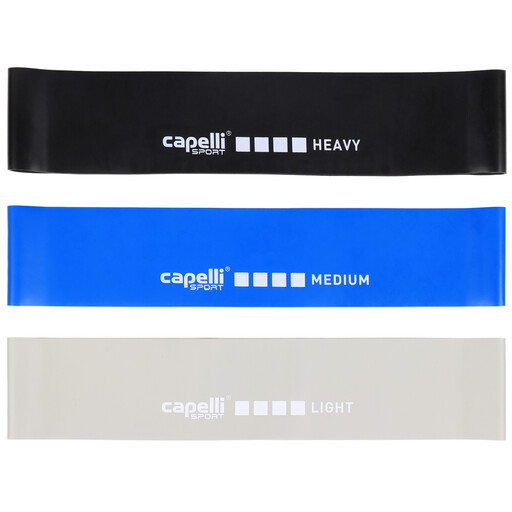
Why This Fits Their Persona: These longer closed loops suit users who want a soft-touch set for yoga, Pilates, stretching and full-body exercises at home, in the gym or outdoors.
The listing specifies light, medium and heavy levels, a 5cm width, 104cm circumference and latex material.
Three resistance levels, storage bag, soft-touch surface and compatibility with Pilates circles and balls.
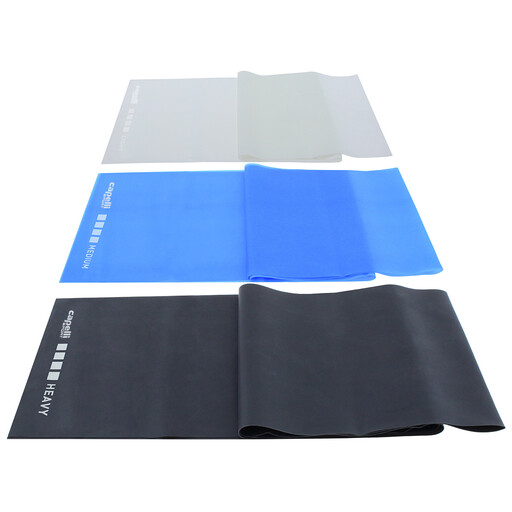
Why This Fits Their Persona: The open-ended format is practical for users combining resistance bands with stretching, physiotherapy routines, Pilates or wider strength exercises.
Its dimensions and material are clearly stated, helping buyers distinguish a 120cm flat band from shorter loop designs.
Three 15cm x 120cm latex bands in light, medium and heavy levels with a storage bag.
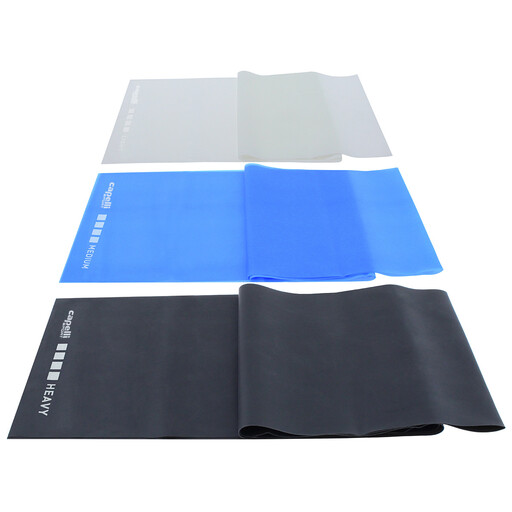
Why This Fits Their Persona: This latex-free option is suitable for shoppers who want flat elastic exercise bands for yoga, Pilates, rehabilitation-style routines or general fitness.
The listing identifies TPE as the latex-free material and gives the exact 15cm x 120cm dimensions.
Three light, medium and heavy bands with a soft-touch finish, stated odour-free design and no installation required.
Resistance bands do not have a fixed lifespan because frequency, stretch length, storage and surface contact all affect wear. To extend usable life:
Latex products should be avoided by anyone with a known latex allergy. For rehabilitation or recovery-related exercise, follow guidance from an appropriately qualified healthcare professional rather than using a band as a substitute for personalised advice.
We have compiled a complete, real-time list of products that fully satisfy these strict selection criteria and UK safety regulations.
Yes, provided the user selects a manageable resistance level and follows controlled movements. A set containing light, medium and heavy resistance bands allows beginners to start with lighter tension and adjust gradually.
There is no universal lifespan. Regular inspection is more useful than relying on a fixed timeframe. Replace a band when it shows cracking, tearing, thinning or loss of elasticity. Storing it away from sunlight, heat and sharp surfaces can help reduce avoidable wear.
Choose latex if you want a commonly used elastic material and have no latex sensitivity. Choose TPE when you specifically require latex-free resistance bands. In both cases, check the product dimensions, resistance levels and care instructions before purchase.