
24/7 Customer Support

Free returns

Same-day & Next-day Delivery

Quality Guaranteed

Unlock Your Welcome Offers: FREE Delivery | Up to 80% OFF | Free 30-day JoyPlus trial
Download the APP
Resistance bands can support home workouts, gym sessions, Pilates, yoga, mobility work and progressive strength training without taking up much space. However, choosing the wrong style can leave you with bands that roll up, handles that feel insecure or resistance levels that do not match your routine.
The product description alone does not always tell you what matters in everyday use. Before buying resistance bands, check the construction, dimensions, resistance range and intended exercises rather than relying on colour-coding or broad marketing claims.
A red band may represent light resistance in one resistance bands set and heavy resistance in another. Colour is not a universal measurement. Some listings also provide only labels such as “medium” without explaining whether the band is designed for arm exercises, glute work or pull-up assistance.
Look for a clearly stated resistance level and consider whether the set includes light, medium and heavy options. A three-level set gives beginners room to adjust their routine, while more experienced users may prefer a wider range or the ability to combine bands.
Small loop resistance bands are designed for exercises such as lateral steps, squats and glute activation. Flat exercise bands are more suitable for stretching, Pilates and controlled upper- or lower-body movements. Long power bands can assist pull-ups, support mobility drills or provide resistance for larger movement ranges.
Resistance bands with handles are practical for rows, curls, presses and similar movements, but they are less convenient for exercises that require placing a band around the thighs. Matching the format to your routine helps prevent unused equipment.
Latex resistance bands are flexible and widely used, but natural latex may cause allergic reactions in sensitive individuals. They should also be kept away from direct sunlight, sharp objects and excessive heat. TPE resistance bands are a latex-free alternative, while fabric bands can provide a different feel and may be less prone to rolling during leg exercises.
Inspect every band before use. Small tears, cracks, thinning areas or fraying can worsen under tension. Do not use a damaged band or stretch it beyond the stated limit.
For general home workout equipment, a set containing light, medium and heavy resistance offers a practical starting range. Light bands can suit warm-ups, mobility work and controlled Pilates movements. Medium bands may work for general strength training, while heavy bands can provide more challenge for leg exercises or assisted pull-ups.
Resistance is also affected by how far a band is stretched. Two users can experience different tension from the same band depending on starting position, range of motion and exercise technique. Treat the printed level as a guide, not a direct equivalent to a specific weight.
Check both length and width. Flat bands measuring around 15cm by 120cm provide a broad surface for stretching and rehabilitation-style movements. A 120cm tube with handles offers room for curls, rows and shoulder exercises, although the usable range depends on the user’s height and anchor point.
Mini loops with a circumference of around 60cm are more targeted towards glute and leg bands. Long power bands with a circumference of approximately 208cm can provide the length needed for pull-up assistance and full-body movements.
Natural latex offers elasticity but requires careful storage and allergy awareness. TPE is a useful latex-free option, particularly for users seeking soft-touch, low-odour exercise bands. Cotton fabric loops may feel comfortable against clothing and are designed to reduce sliding or rolling during lower-body exercises.
Handles should have a secure connection and a comfortable grip. If a product includes clips, straps or an anchor, check that these components are correctly attached before applying tension. A storage bag is useful for keeping bands away from sunlight and sharp household objects.
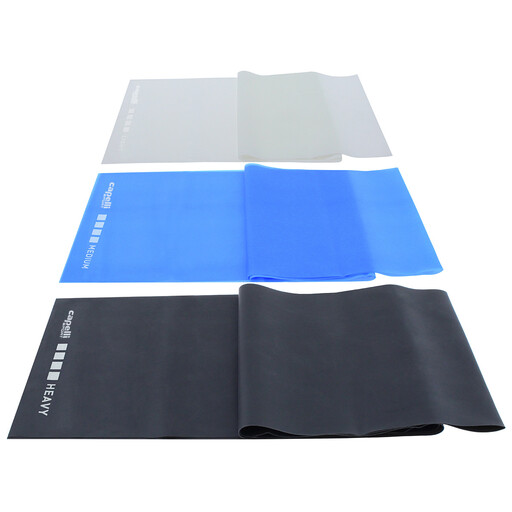
Why This Fits Their Persona: The three flat bands provide a straightforward option for beginners setting up compact equipment at home, in a flat or shared accommodation.
The listing specifies light, medium and heavy levels, plus a 15cm by 120cm size, rather than relying only on colour labels.
TPE construction is latex-free, with soft touch, reported low odour and portability for home, office or gym use.
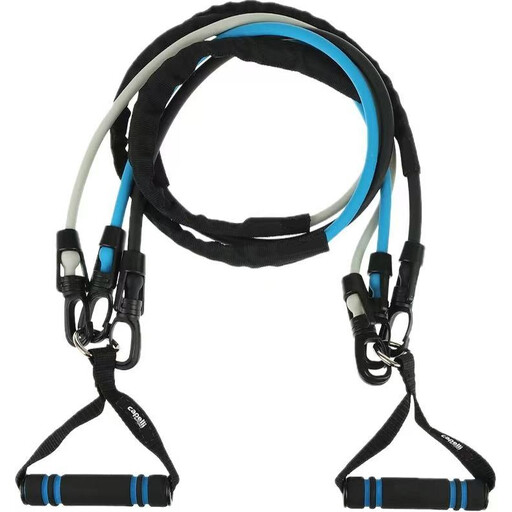
Why This Fits Their Persona: Users who want one adaptable system for home strength sessions, fitness classes and travel can add or remove tubes using the adjustable clips.
It states the included light, medium and heavy tubes, two foam handles and a defined approximate tube length.
Interchangeable bands allow resistance adjustment, while foam handles support a secure grip for arm and upper-body movements.
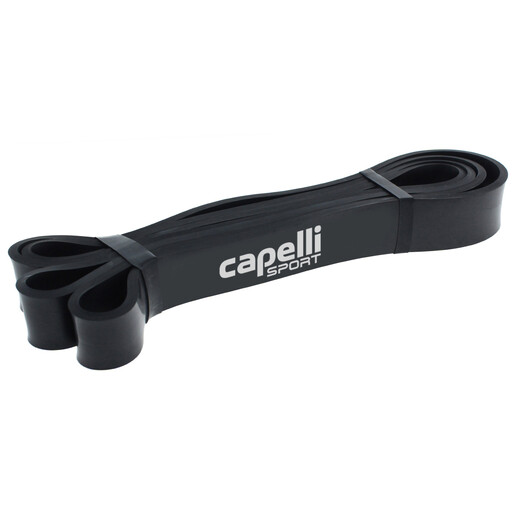
Why This Fits Their Persona: Users focused on pull-up assistance, stretching or larger full-body movements may benefit from a long power-band format.
The listing gives a 2.8cm width, 208cm circumference, 0.5cm thickness and stated 40–50lb resistance range.
The long natural latex loop is intended for pull-up assistance, body stretching, muscle training and physiotherapy applications.
For glute and leg bands, a fabric loop set such as the Miss Lulu Elastic Hip Bands includes three cotton bands labelled light, medium and heavy. Its non-slip construction is designed for squats, leg exercises, Pilates and yoga.
If you prefer a handled tube, the Capelli Sport Medium Resistance Band provides a 120cm latex tube with foam handles. Users with latex sensitivity should instead consider a TPE option, such as the Capelli Sport Heavy TPE Resistance Band.
For gradual leg training, the 5PK Mini Loop Resistance Band offers five levels, from extra light to extra heavy, with a 5cm width and 60cm circumference. Always follow professional guidance where bands form part of a rehabilitation programme.
We have compiled a complete, real-time list of products that fully satisfy these strict selection criteria and UK safety regulations.
Lifespan depends on material, frequency of use, storage and stretching habits. Inspect latex, TPE and fabric bands before every session. Replace a band if you notice cracks, tears, thinning, fraying or weakened connectors. Keeping bands cool, dry and away from sunlight can help reduce avoidable deterioration.
Yes, provided the resistance level matches the exercise and the user maintains controlled movement. Start with light resistance, learn the movement without forcing the band and increase tension gradually. Beginners should avoid overstretching and should read the product-specific safety instructions.
They provide adjustable tension and are convenient for home workouts, but they do not feel identical to free weights. Bands are useful for warm-ups, strength training, Pilates, yoga and travel workouts. Users seeking heavier progressive loading may choose a set with multiple levels or combine bands only where the product instructions permit it.