
24/7 Customer Support

Free returns

Same-day & Next-day Delivery

Quality Guaranteed

Unlock Your Welcome Offers: FREE Delivery | Up to 80% OFF | Free 30-day JoyPlus trial
Download the APP
Resistance bands can support strength training, stretching, Pilates, yoga and rehabilitation without taking up much space. However, choosing a suitable set is not simply a matter of picking the brightest colours or the heaviest resistance.
Marketing descriptions often leave out details that affect day-to-day use. A band may feel too light for your training, roll during leg exercises or contain latex when you need a latex-free option. Use the guide below to compare resistance bands, exercise bands and band sets by their practical specifications rather than promotional wording.
Colours do not represent the same resistance level across every manufacturer. A red band from one range may not provide the same tension as a red band from another. Look for stated resistance levels, dimensions and intended use instead of relying on colour alone.
Also remember that resistance changes as a band stretches. A band labelled light, medium or heavy is a useful guide, but it does not describe one fixed load throughout an exercise.
Latex resistance bands are elastic and widely used for pull-up assistance, strength training and stretching, but natural latex may cause an allergic reaction in sensitive individuals. Product warnings should be read before purchase.
TPE resistance bands are a latex-free alternative in the products listed here. They can suit users who prefer to avoid latex, although texture, stretchability and thickness still vary between products.
Long loop bands, flat resistance bands, tube bands with handles, mini loop resistance bands and fabric hip bands are designed for different movement patterns.
For example, pull-up bands need enough length and loop construction to attach around a bar. Mini loops are more convenient for glute and leg exercises, while resistance bands with handles can feel more familiar for rows, curls and presses. Selecting the wrong format can make a theoretically suitable band awkward to use.
Check whether the band is made from natural latex, synthetic rubber, TPE or cotton fabric. Latex and rubber products should be kept away from sharp objects, direct sunlight and excessive heat. Wipe bands with a damp cloth and mild soap when required, then allow them to air dry fully.
Fabric hip bands may offer a different grip and feel around the legs. They are not interchangeable with long power bands for pull-up assistance or full-body stretching.
A single heavy band may suit assisted pull-ups or stronger muscle-training movements, but it can be difficult for beginners to control during smaller exercises. A resistance band set containing light, medium and heavy options allows you to increase tension gradually or select different levels for upper- and lower-body movements.
For physical therapy bands, Pilates bands and yoga resistance bands, smooth control may be more useful than maximum tension. If you are recovering from an injury, follow the guidance provided by your healthcare professional rather than selecting resistance based only on fitness goals.
Measure the available space and consider how the band will be used. A 120 cm flat band can support a range of floor-based movements, while a 208 cm power band offers a longer loop for assisted pull-ups and large-range exercises.
Handles can make a tube band easier to hold for exercises such as arm curls, front raises and rows. Mini loops and hip bands are more compact, but their smaller circumference limits where they can be positioned. Before every session, inspect the band for tears, cracks, fraying or other damage, and stop using it if damage is visible.
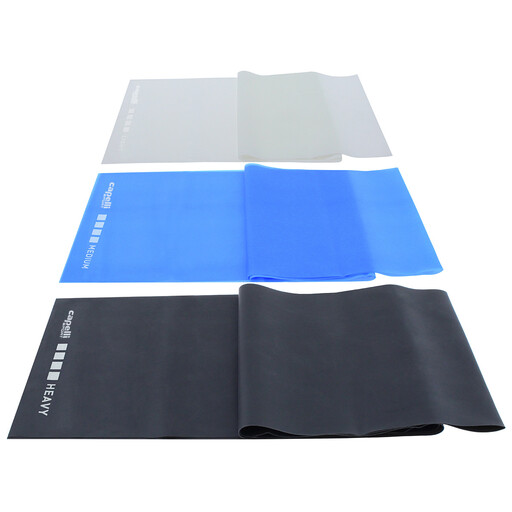
Why This Fits Their Persona: Three resistance levels provide a straightforward starting point for home workouts, Pilates, yoga or office-based movement sessions without requiring several separate purchases.
The listing specifies TPE construction, a latex-free material, plus light, medium and heavy options instead of relying only on colour coding.
Latex-free TPE; 15 x 120 cm dimensions; three bands included.
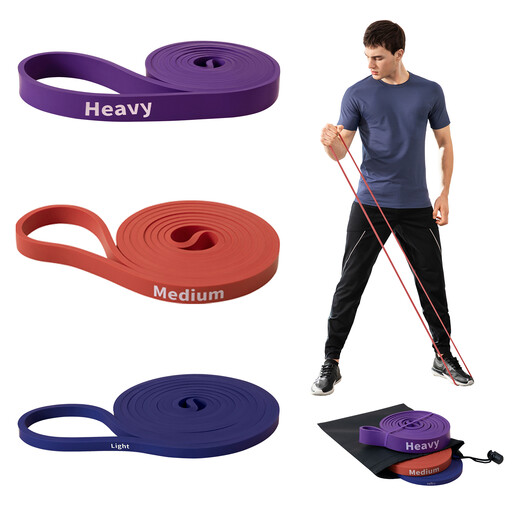
Why This Fits Their Persona: A portable three-level set suits users who want an organised kit for home training, yoga, Pilates or gym sessions around the UK.
It states three separate resistance levels and includes a carrying bag, helping users avoid buying a single band that becomes unsuitable as training changes.
Natural rubber latex; light, medium and heavy levels; carrying bag and exercise guide included.
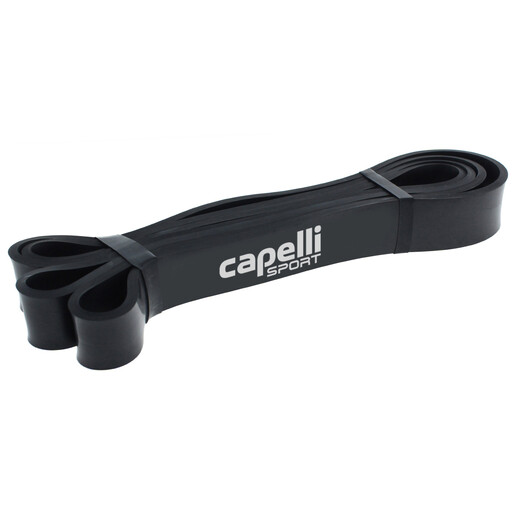
Why This Fits Their Persona: The long-loop format is suited to users prioritising pull-up assistance, body stretching, muscle training and higher-resistance movements.
Its stated 40–50 lb resistance, 2.8 cm width and 208 cm circumference give more useful information than a vague “heavy-duty” label.
100% natural latex; long-loop construction; listed for pull-up assistance and physical therapy use.
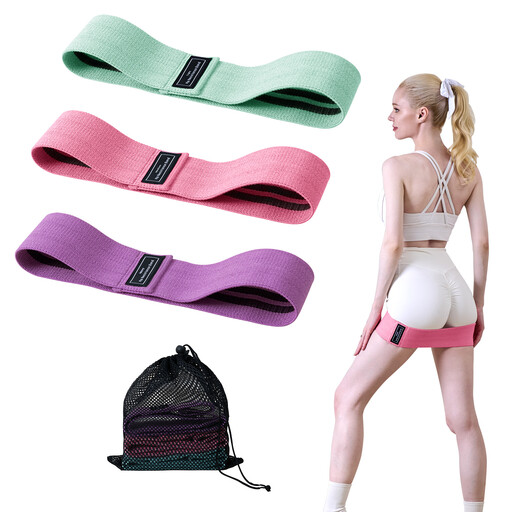
Why This Fits Their Persona: These fabric loop bands are designed around lower-body exercises, making them a practical choice for squats, leg work and home Pilates routines.
The cotton fabric and non-slip design address the common problem of narrow elastic loops rolling or moving during lower-body movements.
Cotton fabric; three levels; storage bag included; designed for hip and leg exercises.
We have compiled a complete, real-time list of products that fully satisfy these strict selection criteria and UK safety regulations.
Begin with a light or medium band and practise slow, controlled movements. Keep the band away from your face, maintain a secure grip and avoid stretching it beyond its natural elasticity. Clear enough space around you, especially when using long exercise bands or pull-up bands.
There is no fixed lifespan. Usage frequency, stretching range, storage conditions and exposure to sunlight or sharp surfaces all affect durability. Inspect the band before every use and replace it when you notice cracks, tears, thinning, fraying or a permanent change in elasticity.
They require no batteries, electricity or installation, so their direct running cost is limited to the purchase and replacement of worn bands. A compact resistance band set can also reduce the need for bulky home workout equipment, although it should be selected according to the exercises and resistance levels you actually plan to use.