
24/7 Customer Support

Free returns

Same-day & Next-day Delivery

Quality Guaranteed

Unlock Your Welcome Offers: FREE Delivery | Up to 80% OFF | Free 30-day JoyPlus trial
Download the APP
Resistance bands can support strength training, stretching, yoga, Pilates and low-impact exercise without taking up much space. However, choosing a suitable set is not simply a matter of picking the most colourful pack or the highest resistance level.
The wrong design may roll up during glute exercises, feel uncomfortable against the skin or offer little practical progression. Before buying resistance bands, focus on the material, dimensions, resistance range and intended use.
Colours are not universal across manufacturers. A red band may represent light resistance in one set and heavy resistance in another. Some products also list resistance in pounds, while others only use terms such as light, medium and heavy.
Look for a clearly described resistance system and, where available, a stated measurement. A resistance band set with several levels is usually more adaptable than a single band, particularly if more than one person will use it.
Different resistance bands are shaped for different movements:
A long pull-up band may be inconvenient for side steps, while a mini loop band will not provide the range of motion needed for assisted pull-ups.
Latex resistance bands offer elasticity and are widely used for strength training, but natural latex can cause allergic reactions. TPE resistance bands are latex-free according to the listed product specifications and may suit buyers who prefer to avoid latex. Fabric resistance bands can provide a textured, non-slip feel for lower-body exercises.
No material is immune to damage. Heat, direct sunlight, sharp objects, excessive stretching and poor storage can shorten the useful life of any band.
Natural latex generally offers a flexible stretch and is common in power bands, flat bands and handled tubes. Check the product information for latex warnings if you or someone in your household has a sensitivity.
TPE is a latex-free alternative in the listed TPE products. It can be a practical choice for home workouts, yoga, Pilates and physiotherapy-style movements, although users should still inspect the band regularly.
Fabric can feel more secure against clothing or skin, particularly during glute and leg exercises. A non-slip construction may help reduce rolling, but fit still depends on the user’s leg or hip circumference.
A mini loop band measuring around 60cm in circumference is intended for compact lower-body movements. Wider flat bands, such as 15cm by 120cm, provide a broader surface for stretching and controlled exercises. Long power bands measuring over two metres are more appropriate for pull-up assistance and full-body training.
For handled bands, check the tube length and grip construction. Foam handles may make repeated curls and presses more comfortable, but they do not remove the need to maintain control throughout each movement.
Beginners may benefit from a light-to-heavy set rather than starting with one demanding band. Multiple levels allow you to adjust the challenge for warm-ups, mobility work and strength exercises.
For physiotherapy, rehabilitation or recovery after an injury, resistance bands should be used according to guidance from an appropriate healthcare professional. Product descriptions may list these uses, but a band itself is not a medical treatment.
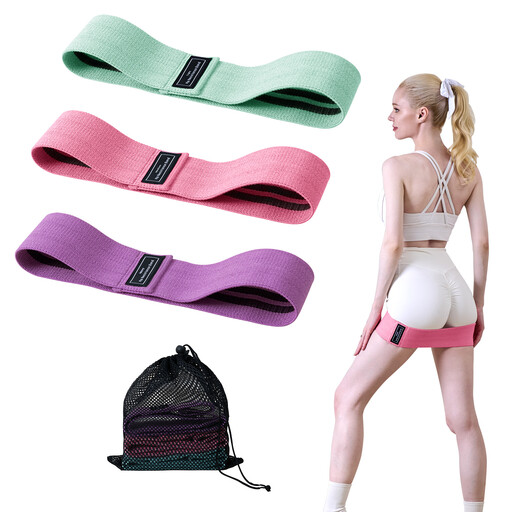
Why This Fits Their Persona: This three-band fabric set is a straightforward option for home users focusing on squats, Pilates, yoga and lower-body routines.
The Light, Medium and Heavy structure is clearer than relying on colour alone, while the fabric construction is designed to resist sliding and rolling.
Three fabric loop bands, a storage bag and a 350g listed set weight.
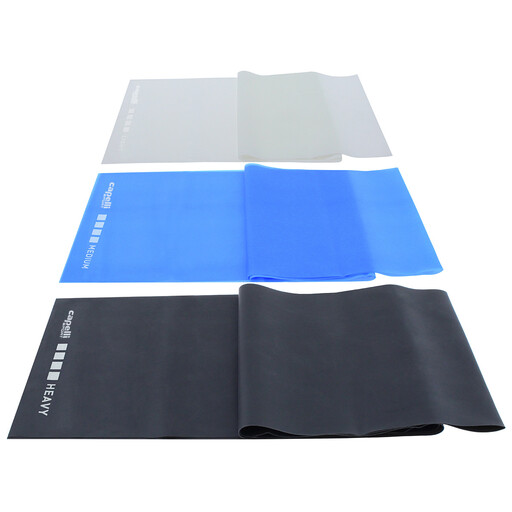
Why This Fits Their Persona: Buyers wanting a latex-free set for a mixture of stretching, Pilates, yoga and controlled strength work may appreciate this broader flat-band format.
The TPE material is listed as latex-free, and the three resistance levels provide more flexibility than a single flat band.
Each band measures 15cm by 120cm and the set is designed for portable use.
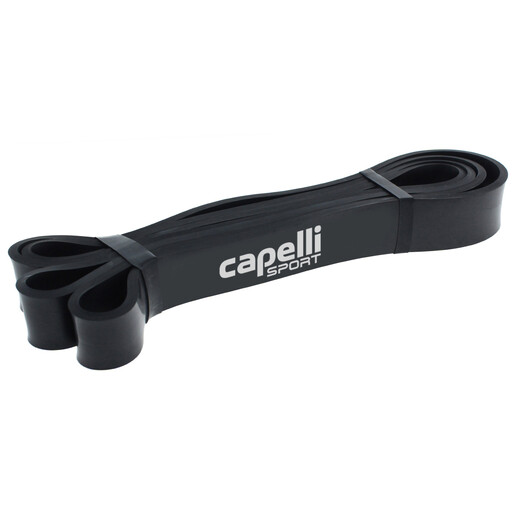
Why This Fits Their Persona: Its long loop format is suited to users seeking pull-up assistance, stretching, muscle training or a larger range of movement.
The listed dimensions and 40–50lb resistance give buyers more information than a vague “heavy duty” label.
Made from natural latex, with a 208cm circumference and 2.8cm width.
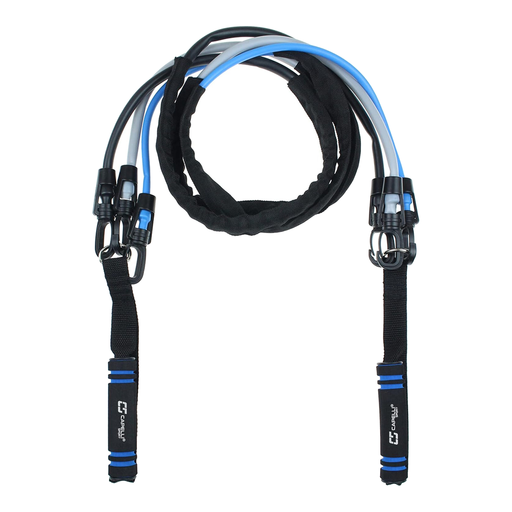
Why This Fits Their Persona: This format suits users who prefer a familiar handle grip for arm curls, triceps kickbacks and front raises at home or in the gym.
The interchangeable light, medium and heavy cords make resistance adjustable rather than fixed.
Includes two foam handles, adjustable clips, three TPE bands and a storage strap.
We have compiled a complete, real-time list of products that fully satisfy these strict selection criteria and UK safety regulations.
Inspect resistance bands before every session for cracks, tears, nicks or thinning. Do not use a damaged band, and avoid overstretching it beyond its intended capacity. Keep latex bands away from direct sunlight, radiators and sharp edges. Wipe bands with a damp cloth and allow them to dry fully before placing them in a storage bag.
During anchored exercises, check that the anchor point is secure and keep the band away from your face and eyes. Children and pets should not have access to unused bands, as long loops can present an injury or strangulation risk.
Lifespan depends on the material, frequency of use, stretching range and storage conditions. Regular inspection matters more than a promised timeframe. Replace a band if it develops visible damage, becomes sticky or loses consistent elasticity.
Yes, provided the resistance level and exercise are appropriate. Start with light resistance, controlled movements and a manageable range of motion. A resistance band set with light, medium and heavy options can help beginners progress gradually.
Neither is automatically suitable for everyone. Latex offers a familiar elastic feel but may not suit people with latex sensitivity. TPE resistance bands are listed as latex-free in the relevant product specifications. Choose according to material preference, intended exercises, comfort and storage conditions.