
24/7 Customer Support

Free returns

Same-day & Next-day Delivery

Quality Guaranteed

Unlock Your Welcome Offers: FREE Delivery | Up to 80% OFF | Free 30-day JoyPlus trial
Download the APP
By the Joybuy Product Recommendation Officer
Resistance bands can add useful resistance to home workouts without taking up the space or cost of a full weights set. However, choosing the right set requires more than comparing colours or the number of bands in a pack. Material, dimensions, resistance progression and comfort all affect whether the bands remain practical after the first few sessions.
For UK shoppers, three common buying pitfalls deserve attention:
The guide below explains the practical specifications to check before selecting resistance bands for your routine.
Fabric resistance bands are often made from cotton or a cotton blend with elastic fibres. Their textured surface can feel more secure against clothing and skin, which is useful during lower-body movements. They are commonly selected as resistance bands for legs and glutes, including squats, hip abductions and lateral walks.
Latex resistance bands usually offer a smooth surface and considerable stretch. They are widely used for full-body exercise, Pilates, yoga and rehabilitation routines. Latex can be easier to wipe clean, but anyone with a known latex allergy should avoid it or seek a clearly labelled latex-free alternative.
Neither material is automatically suitable for every user. Fabric may feel more stable for hip exercises, while latex can provide a broader stretch range for arm, shoulder and mobility work.
Dimensions influence how a loop band sits on the body. A mini loop with a 5cm width and 60cm circumference is designed for compact lower-body movements. A longer loop measuring 5cm wide and 104cm in circumference may offer more room for positioning around the thighs, hips or upper body.
Check the measurements rather than relying on product photographs. A band that is too small may feel excessively tight before the exercise begins, while one that is too large may provide limited challenge during certain movements.
A useful set should match your current ability and allow gradual progression. Three-level sets typically include light, medium and heavy resistance. Five-level sets may provide more increments, from extra light to extra heavy.
Remember that resistance changes as a band stretches. The stated level is not the same as a fixed weight in kilograms. Beginners should start with controlled movements and avoid selecting a band solely because the label sounds stronger. For physical therapy resistance bands or rehabilitation exercises, follow the instructions provided by a qualified healthcare professional and choose a level that allows the prescribed movement safely.
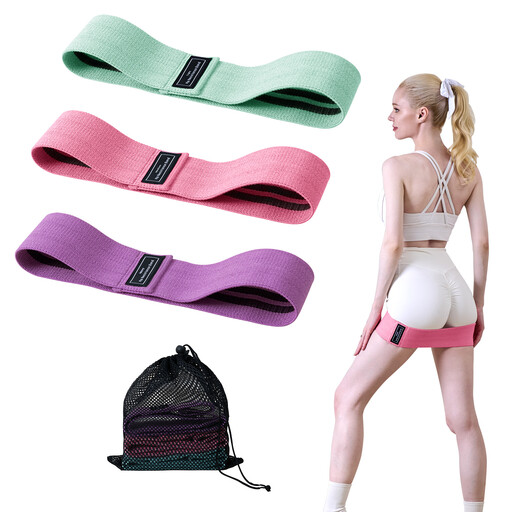
Why This Fits Their Persona: A three-band fabric set gives new home exercisers a straightforward way to begin lower-body training, with light, medium and heavy options for gradual progression.
The cotton fabric construction and non-slip design are intended to reduce rolling and movement during leg and glute exercises.
Three fabric loop bands, a storage bag and stated dimensions of 38 x 8 x 0.25cm; suitable for home fitness, yoga and Pilates.
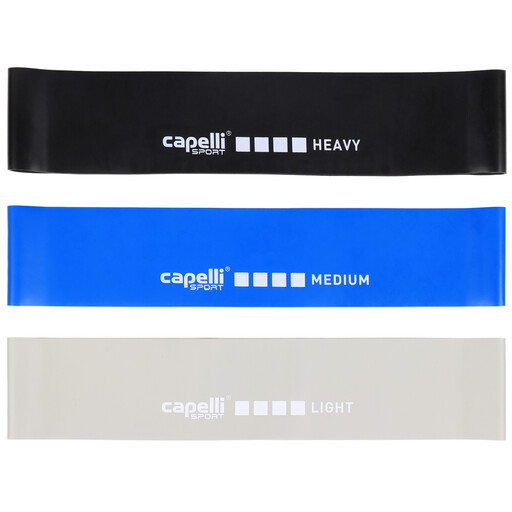
Why This Fits Their Persona: This latex set suits shoppers who want a soft-touch loop design for varied home, office, gym or outdoor sessions.
The 5cm width and 104cm circumference provide clearly stated sizing, while the three labelled resistance levels avoid relying on colour alone.
Light, medium and heavy latex bands with a soft-touch finish and storage bag; suitable for yoga, Pilates and arm, leg or hip exercises.
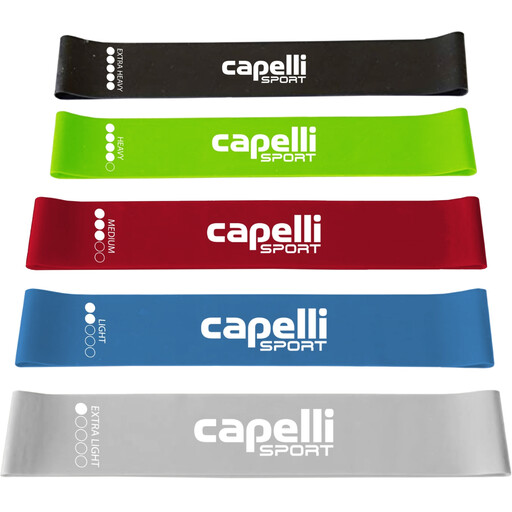
Why This Fits Their Persona: Five resistance levels suit users who want more adjustment for regular leg and glute workouts, yoga, Pilates or prescribed physical therapy movements.
The set provides extra light through extra heavy options, helping users make smaller changes instead of jumping between widely spaced levels.
Five latex mini loops, 5cm width, 60cm circumference and a travel carry bag. Latex allergy warnings and overstretching guidance are provided.
Before every session, inspect the band for cuts, cracks, thinning or damaged seams. Do not use a damaged band, and avoid overstretching beyond its intended range. Keep latex bands away from sharp objects, direct sunlight and excessive heat. Wipe them with a damp cloth when needed and allow them to dry fully before storage.
A carry or storage bag helps keep portable resistance bands organised in a gym bag or cupboard. Store bands flat or loosely coiled rather than tightly knotted. During exercise, maintain controlled tension and keep the band away from the face. Latex products should be kept away from children and pets, and users with latex sensitivity should check the material before purchase.
If you are buying exercise bands for working out after an injury, during postpartum recovery or for rehabilitation, seek appropriate professional guidance before starting or changing exercises.
We have compiled a complete, real-time list of products that fully satisfy these strict selection criteria and UK safety regulations.
Lifespan depends on frequency of use, stretching range, storage and exposure to heat or sunlight. Inspect bands before each session rather than relying on a fixed replacement date. Replace them when you notice visible damage, reduced elasticity or uneven thinning.
Yes, provided the user starts with a manageable level and focuses on controlled form. A three-level set can provide a simple starting point, while a five-level set offers more gradual progression. The lightest option may also be useful for warm-ups or mobility exercises.
Yes. Resistance bands for yoga and Pilates can add gentle challenge to leg, arm and core movements. Choose a band that allows a full, controlled range of motion and avoid using a level that causes the band to snap back abruptly.