
24/7 Customer Support

Free returns

Same-day & Next-day Delivery

Quality Guaranteed

Unlock Your Welcome Offers: FREE Delivery | Up to 80% OFF | Free 30-day JoyPlus trial
Download the APP
Resistance bands can support strength training, mobility work, Pilates, yoga, rehabilitation exercises and targeted leg workouts without taking up much room. However, choosing the wrong type can lead to wasted money, uncomfortable workouts or equipment that is unsuitable for your routine.
Marketing labels such as “heavy duty”, “professional” and “extra strong” are not always directly comparable. Before buying resistance bands, check the construction, dimensions, resistance options and intended use rather than relying on colour or promotional wording.
There is no universal colour system for exercise bands. A red band from one range may not provide the same tension as a red band from another. Some products list approximate resistance in pounds, while others only describe levels as light, medium or heavy.
For a more useful comparison, check whether the listing provides:
Different designs suit different movements. A compact mini loop band is practical for glute activation and lateral leg exercises, but it is not designed for assisted pull-ups. Conversely, a long power band may be awkward for small Pilates movements.
Think about the exercises you intend to perform:
Latex resistance bands are elastic and widely used, but natural latex may cause an allergic reaction in sensitive individuals. Latex-free TPE resistance bands can be an alternative, although material alone does not determine suitability or durability.
Bands should be kept away from sharp edges, excessive heat and direct sunlight. Inspect them before every use and stop using any band showing cracks, nicks, thinning or tears.
A single light band may be suitable for gentle movement or beginners, while heavier options are generally more appropriate for demanding strength exercises. Yet the tension also depends on how far the band is stretched and whether it is doubled.
A resistance band set with light, medium and heavy options can make progression easier. A 3-in-1 design with interchangeable bands may also let you add or remove resistance without buying separate equipment.
For rehabilitation or physical therapy bands, select a level that allows controlled movement without forcing painful ranges. If you are recovering from an injury or surgery, seek advice from an appropriately qualified healthcare professional before beginning a new routine.
Natural latex usually offers a springy stretch, while TPE is a latex-free synthetic material. Fabric hip bands can feel more stable around the thighs and may be less likely to roll during leg exercises.
Check the listing for practical details such as:
No material is immune to wear. Good maintenance and controlled use matter as much as the material description.
Length affects the range of movement and the type of exercise possible. A 120cm flat band may work well for stretching, Pilates and upper-body movements, while a 208cm power band can provide the length needed for pull-up assistance or full-body exercises.
Width also affects handling. A 5cm mini loop may sit comfortably around the thighs, whereas a narrower long band may be easier to grip or attach to equipment. Always compare the listed dimensions with the space available in your home or gym bag.
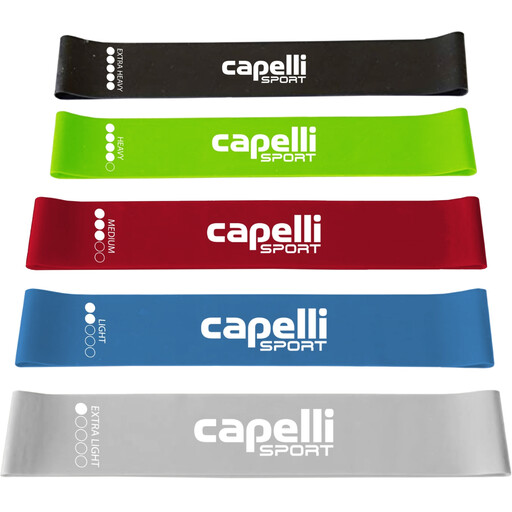
Why This Fits Their Persona: Five resistance levels provide room to adjust a home workout routine as confidence and control develop. The carry bag is convenient for small UK homes, office use or travel.
The listing identifies five levels rather than relying only on colour names, and states the 5cm width and 60cm circumference.
Five latex mini loops, colour-coded resistance levels and a portable travel bag.
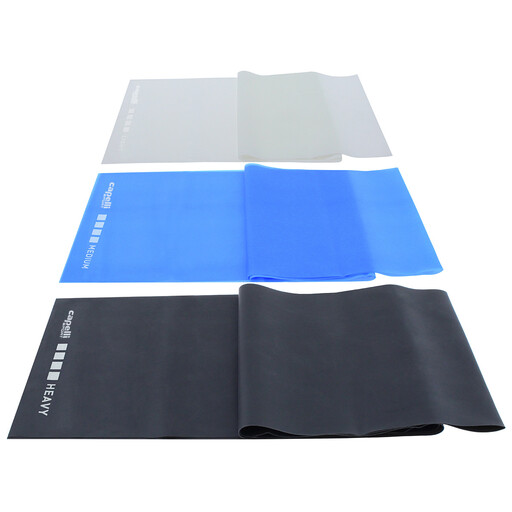
Why This Fits Their Persona: This latex-free set suits shoppers prioritising a soft-touch, odourless material for home, office, Pilates or yoga sessions.
The specification clearly states TPE construction, latex-free material and three separate resistance levels.
Three 15cm by 120cm bands, soft touch, no stated latex content and damp-cloth cleaning.
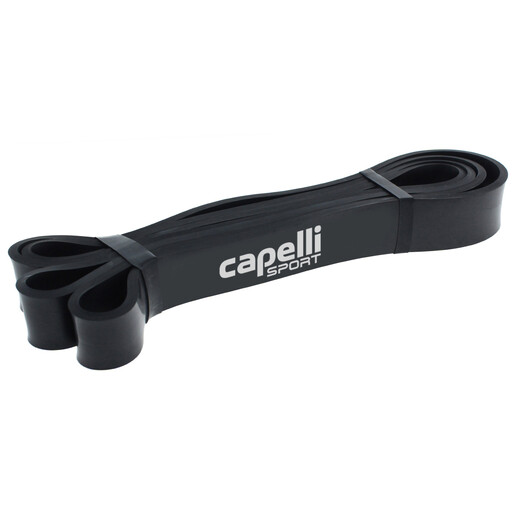
Why This Fits Their Persona: The long continuous format is suited to users who specifically need pull-up assistance, full-body strength work or stretching with a heavier band.
Its stated 40–50lb resistance, 2.8cm width and 208cm circumference give more useful buying information than a simple “heavy duty” label.
100% natural latex construction and a long-loop format for pull-up assistance, stretching and muscle training.
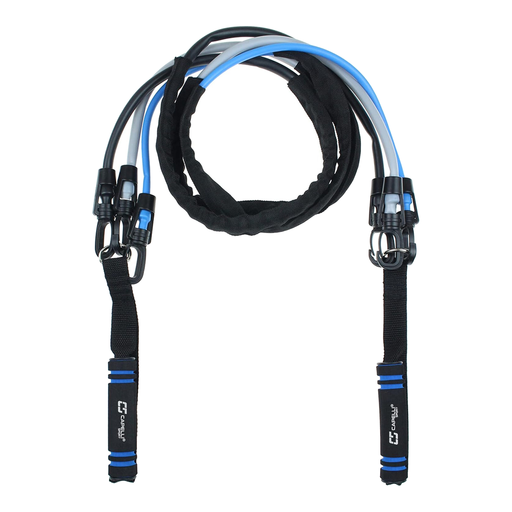
Why This Fits Their Persona: Users who prefer the feel and control of handles can adjust the workout by attaching one, two or three resistance cords for home or gym sessions.
The interchangeable design makes progression clearer, while the clips should be checked before each exercise.
TPE material, three resistance cords, foam handles and easy-adjust clips.
We have compiled a complete, real-time list of products that fully satisfy these strict selection criteria and UK safety regulations.
Yes, provided the resistance level allows steady, controlled movement. Beginners can start with light or medium bands and focus on technique before increasing tension. A set with several levels can make adjustment easier.
There is no fixed lifespan. Frequency of use, stretching distance, storage conditions and exposure to heat or sunlight all affect wear. Replace a band when you see cracks, thinning, fraying, tears or permanent deformation, regardless of how long you have owned it.
They can provide useful resistance for many strength and muscle-toning exercises, particularly where portability matters. However, the feel of elastic tension differs from free weights, and some exercises may require different equipment. Choose based on your training aims, available space and preferred movement style.